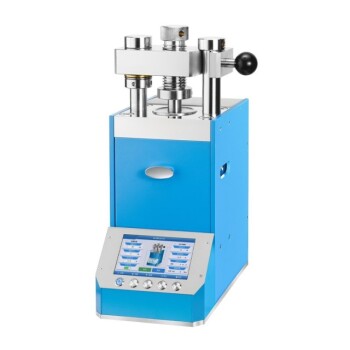
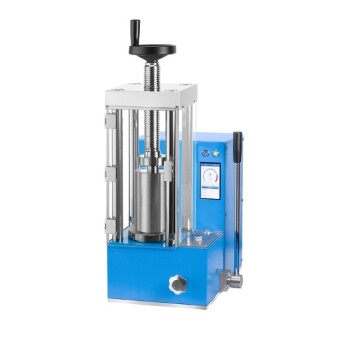
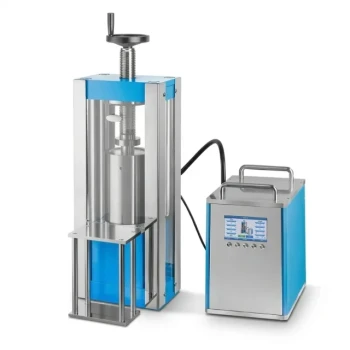
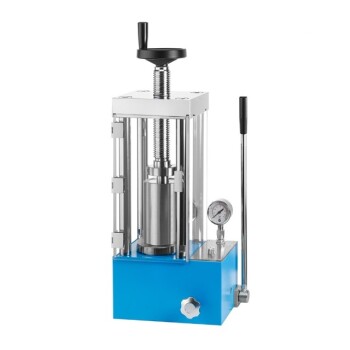
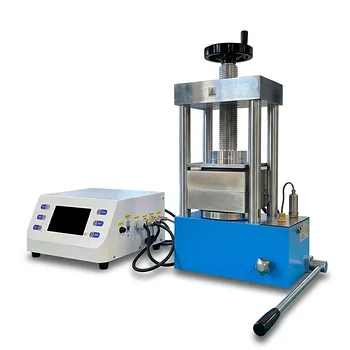
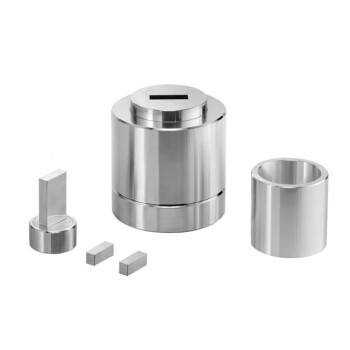
The primary purpose of using a laboratory hydraulic or cold isostatic press is to transform loose powders into a cohesive structural foundation.
By applying pressure at room temperature, these tools compress ball-milled powders into solid pellets, known technically as "green bodies." This stage is essential for establishing initial contact between particles and providing the physical integrity required for subsequent processing steps, such as melt-hot-pressing or sintering.
Core Takeaway Cold-pressing is the critical "formatting" step in dry-process electrolyte preparation. It converts difficult-to-handle powders into a structured solid with defined geometry and reduced porosity, ensuring the material is mechanically stable enough to undergo final high-temperature densification.
The Mechanics of Cold-Pressing
Creating the "Green Body"
The immediate goal of the cold-pressing stage is to consolidate loose, ball-milled powder into a manageable solid form.
Without this pre-compaction, the powder would lack the defined shape and handling strength necessary for transfer into heating molds or sintering furnaces.
Establishing Particle Contact
Effective densification requires particles to be in close proximity.
The hydraulic or isostatic press forces particles together, reducing the interstitial gaps. This initial contact provides the necessary physical bridge for mass transport and grain bonding that will occur during later heat treatment.
Preparing for Secondary Densification
Cold-pressing is frequently a precursor, not the final step.
For example, a hydraulic press may apply uniaxial pressure to create a pre-formed shape that is sufficiently robust to be encapsulated in rubber molds. This allows the sample to undergo further, more uniform densification in a cold isostatic press or a hot press.
Impact on Electrochemical Performance
Minimizing Internal Porosity
High-tonnage pressure significantly increases the compaction density of the material.
By reducing porosity—potentially to less than 5%—and minimizing void sizes to the sub-micrometer level, the press ensures a denser internal structure. This is critical for preventing the formation of tortuous (inefficient) ion transport paths.
Optimizing Ion Transport Pathways
In composite electrolytes, the active materials must be in tight physical contact with the solid electrolyte.
Cold-pressing forces these components together, optimizing the pathways for ion movement. This reduction in voids also lowers the risk of short circuits, which are often caused by structural inconsistencies within the electrolyte layer.
Understanding the Trade-offs
Mechanical Strength vs. Final Density
While cold-pressing provides handling strength, it rarely achieves theoretical density on its own.
It produces a "green" sample that is mechanically stable but typically requires heat (sintering or hot-pressing) to fuse the particles fully. Relying solely on cold-pressing without subsequent heat treatment often results in insufficient conductivity.
Uniaxial vs. Isostatic Limitations
A standard laboratory hydraulic press applies pressure in one direction (uniaxial).
This can lead to density gradients where the edges are denser than the center. Cold isostatic presses resolve this by applying uniform pressure from all directions, but they often require the pre-forming step provided by the hydraulic press first.
Making the Right Choice for Your Goal
When integrating a press into your dry-process workflow, tailor the application to your specific density and handling requirements:
- If your primary focus is handling strength: Use a hydraulic press to form a "green body" with just enough pressure (e.g., 6–7 MPa) to allow for safe transfer to a hot press or sintering furnace.
- If your primary focus is maximizing conductivity: Utilize higher pressures (up to 300–770 MPa) or isostatic pressing to minimize void sizes and maximize particle-to-particle contact before any heating occurs.
- If your primary focus is shape complexity: Use a hydraulic press for initial shaping (pre-forming), followed by cold isostatic pressing to ensure uniform density throughout the complex geometry.
The quality of your final electrolyte is defined not just by the material chemistry, but by the structural foundation laid during this initial compression.
Summary Table:
| Feature | Hydraulic Press (Uniaxial) | Cold Isostatic Press (CIP) |
|---|---|---|
| Primary Function | Initial pre-forming & green body creation | Uniform secondary densification |
| Pressure Direction | Single direction (Vertical) | All directions (Omni-directional) |
| Best For | Simple geometries & handling strength | Complex shapes & density uniformity |
| Pressure Range | Low to High (e.g., 6–770 MPa) | Very High (Uniform compaction) |
| Key Benefit | Precise shape definition | Minimizes internal porosity & voids |
Elevate Your Material Research with KINTEK
Precision in the cold-pressing stage is vital for the electrochemical performance of your dry-process composite electrolytes. KINTEK specializes in high-performance laboratory equipment, providing the tools you need to achieve maximum particle contact and structural integrity.
Our extensive portfolio includes:
- Advanced Hydraulic Presses: Manual and automated pellet presses for robust green body formation.
- Isostatic Solutions: Cold and hot isostatic presses for uniform material density.
- Thermal Processing: High-temperature muffle, tube, and vacuum furnaces for final sintering.
- Sample Prep Tools: Precision crushing, milling, and sieving systems.
Whether you are developing solid-state batteries or advanced ceramics, our team is dedicated to providing laboratory solutions that ensure consistency and reliability. Contact KINTEK today to discuss your specific application and find the perfect press for your lab!
Related Products
- Automatic Lab Cold Isostatic Press CIP Machine Cold Isostatic Pressing
- Electric Lab Cold Isostatic Press CIP Machine for Cold Isostatic Pressing
- Electric Split Lab Cold Isostatic Press CIP Machine for Cold Isostatic Pressing
- Manual Cold Isostatic Pressing Machine CIP Pellet Press
- Laboratory Hydraulic Press Lab Pellet Press Machine for Glove Box
People Also Ask
- What is the cold isostatic process? Achieve Uniform Density in Complex Powder Parts
- What is hot and cold isostatic pressing? A Guide to Forming and Densifying Materials
- What role does cold isostatic pressing play in the formation of feed rods for single crystal growth? Ensure Stability.
- What is isostatic pressing method for ceramics? Achieve Uniform Density for Complex Parts
- What are the advantages of isostatic pressing? Achieve Superior Material Integrity and Design Freedom