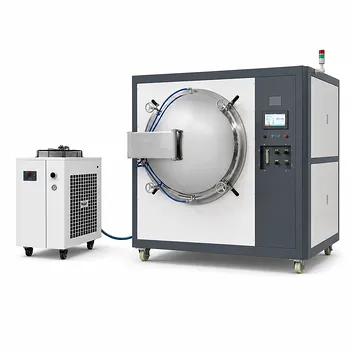
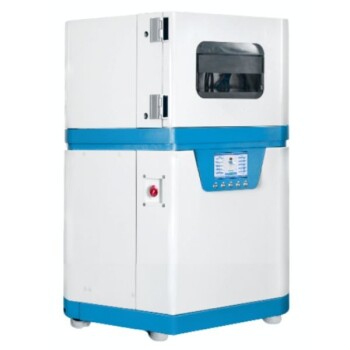
The vacuum environment in a Vacuum Hot Pressing (VHP) furnace serves as a critical barrier against chemical contamination, specifically preventing the oxidation of highly reactive aluminum and titanium powders. By maintaining a pristine environment, the VHP process eliminates oxide interference, which is the primary obstacle to successful solid-state diffusion and the in-situ formation of the desired Al3Ti reinforcement phase.
The vacuum environment is not merely a passive container; it is an active process enabler that strips away oxide barriers and adsorbed gases. This creates the necessary "clean" conditions for aluminum and titanium atoms to diffuse across boundaries, forming a pure Al3Ti phase and a high-strength metallurgical bond.
The Barrier of Reactivity
Eliminating Oxide Interference
Aluminum and titanium are known for their high chemical affinity for oxygen. When exposed to air at elevated temperatures, they rapidly form stable oxide layers on their surfaces.
These oxide layers act as ceramic barriers. They physically separate the metal particles, preventing the direct contact required for reaction.
The VHP furnace maintains a vacuum (often around $10^{-3}$ Pa) to effectively remove residual oxygen. This prevents these oxide layers from forming or growing during the heating phase.
Promoting Solid-State Diffusion
The formation of Al3Ti is an in-situ reaction, meaning it occurs within the solid state through atomic movement.
For this reaction to occur, titanium and aluminum atoms must migrate across particle boundaries.
By eliminating surface oxides, the vacuum environment ensures that diffusion paths remain open. This facilitates the rapid and complete reaction between the metals to form the target Al3Ti reinforcement phase.
Ensuring Structural Integrity
Removal of Adsorbed Contaminants
Beyond preventing new oxidation, the vacuum environment plays a crucial role in cleaning the raw materials.
Metal powders often carry adsorbed moisture and gases on their surfaces. If trapped during consolidation, these contaminants lead to porosity and voids.
The negative pressure of the VHP furnace draws these volatile elements out of the powder compact before full densification occurs.
Achieving High-Quality Interface Bonding
The mechanical performance of a composite relies heavily on the interface—the boundary where the matrix (Aluminum) meets the reinforcement (Al3Ti).
A "clean" interface, free from oxides and gas pockets, allows for true metallurgical bonding.
This results in a composite where the load is effectively transferred from the softer aluminum matrix to the harder Al3Ti reinforcement, maximizing strength.
Understanding the Trade-offs
The Brittleness Factor
While the vacuum enables the formation of Al3Ti, it is important to recognize the material properties of the result. Al3Ti is an intermetallic compound that is inherently hard but brittle.
The VHP process must be precisely controlled. If the reaction is too aggressive due to uncontrolled temperatures, excessive growth of the Al3Ti phase can occur.
This can severely reduce the plasticity of the final composite, making it prone to fracture despite the high-quality vacuum environment.
Process Complexity and Cost
Maintaining a high vacuum at high temperatures adds significant complexity to the manufacturing process.
It requires specialized seals, pumps, and maintenance protocols compared to inert gas sintering.
Any leak or failure in the vacuum system during the heating cycle will immediately ruin the composite by allowing rapid oxidation of the titanium.
Making the Right Choice for Your Goal
To maximize the effectiveness of the VHP process for your specific composite requirements:
- If your primary focus is Phase Purity: Ensure your vacuum system can maintain at least $10^{-3}$ Pa to prevent the formation of unwanted oxides that inhibit the creation of pure Al3Ti.
- If your primary focus is Mechanical Ductility: Couple the vacuum environment with precise temperature control (avoiding overshoot above 600°C) to manage the volume and morphology of the brittle Al3Ti phase.
- If your primary focus is Densification: Utilize the vacuum's degassing capability by including a hold time at a lower temperature before applying maximum pressure to allow adsorbed moisture to escape.
The vacuum environment is the foundational tool that transforms reactive powders into a cohesive, high-performance composite by guaranteeing the atomic-level cleanliness required for diffusion.
Summary Table:
| Feature | Role in Al3Ti/Al Composite Preparation | Benefit |
|---|---|---|
| Oxide Prevention | Removes residual oxygen from the chamber | Enables direct metal-to-metal contact for reaction |
| Solid-State Diffusion | Clears atomic paths between Al and Ti | Facilitates in-situ formation of the Al3Ti phase |
| Degassing | Extracts moisture and adsorbed gases | Eliminates porosity and internal voids |
| Interface Quality | Maintains clean particle boundaries | Ensures high-strength metallurgical bonding |
Maximize Your Material Performance with KINTEK
Precision is non-negotiable when dealing with reactive aluminum and titanium powders. KINTEK specializes in advanced Vacuum Hot Pressing (VHP) furnaces, alongside a full suite of laboratory solutions—from high-temperature high-pressure reactors and induction melting furnaces to crushing systems and PTFE consumables.
Our vacuum technology is engineered to provide the pristine environment required for superior solid-state diffusion and metallurgical bonding, ensuring your Al3Ti/Al composites achieve peak mechanical integrity.
Ready to elevate your material research? Contact us today to find the perfect equipment solution for your lab!
Related Products
- Vacuum Hot Press Furnace Heated Vacuum Press Machine Tube Furnace
- 600T Vacuum Induction Hot Press Furnace for Heat Treat and Sintering
- Vacuum Hot Press Furnace Machine Heated Vacuum Press
- Vacuum Hot Press Furnace Machine for Lamination and Heating
- Vacuum Heat Treat and Pressure Sintering Furnace for High Temperature Applications
People Also Ask
- What advantages does a vacuum hot press furnace provide for LSLBO ceramic electrolytes? Achieve 94% Relative Density
- What role does a Vacuum Hot Press (VHP) furnace play in the densification of austenitic stainless steel 316 composites?
- What are the advantages of using a vacuum hot pressing furnace? Superior Densification for 2024Al/Gr/SiC Composites
- What are the advantages of a vacuum hot press furnace for LTPO solid electrolytes? Boost Density and Conductivity
- What core processing conditions does a vacuum hot press furnace provide? Achieve High-Density Cu-SiC/Diamond Composites