Knowledge What is the temperature range for silver brazing? Optimize Your Metal Joining Process
Author avatar

Tech Team · Kintek Solution

Updated 6 days ago

What is the temperature range for silver brazing? Optimize Your Metal Joining Process


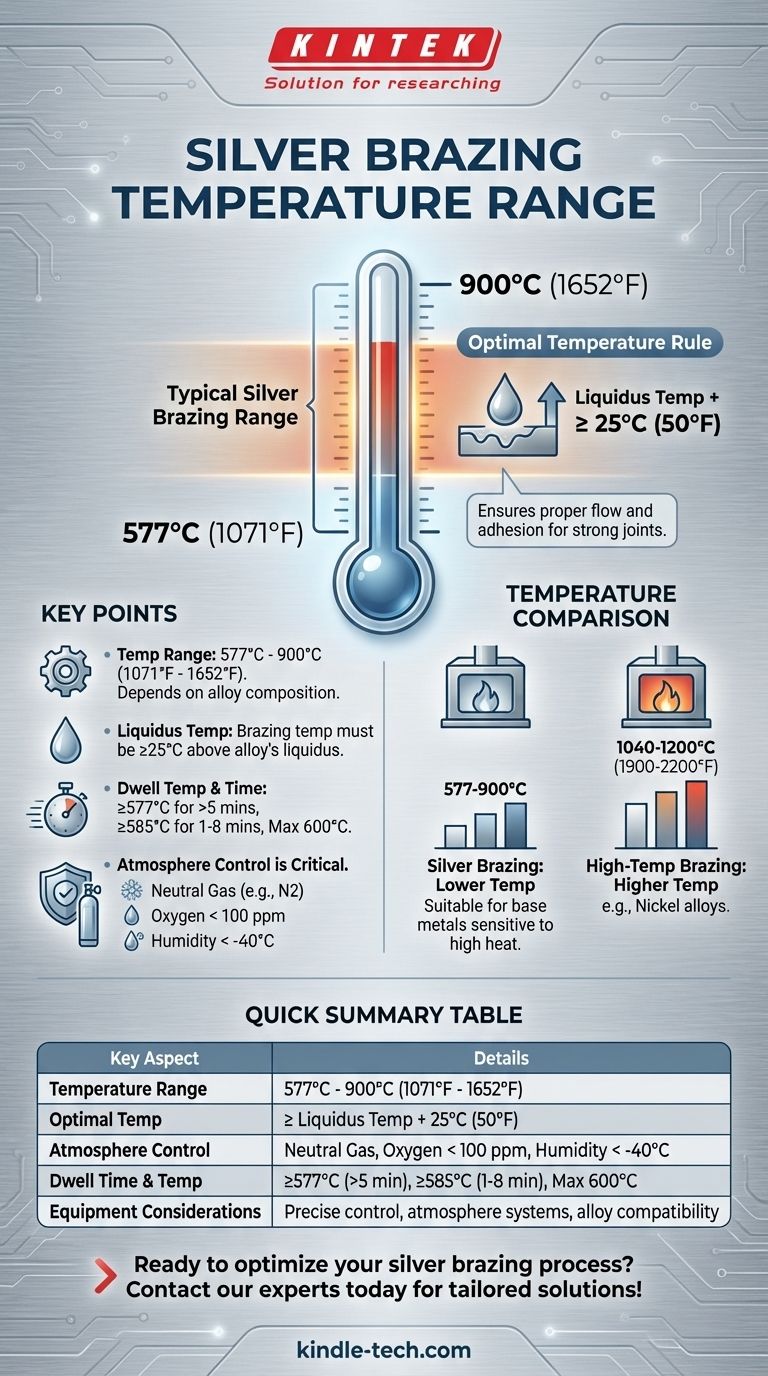
Silver brazing, a process used to join metals, involves heating a filler metal (silver-based alloy) to a temperature above its melting point but below the melting point of the base metals being joined. The temperature range for silver brazing typically depends on the specific alloy used, but it generally falls between 577°C (1071°F) and 900°C (1652°F). The optimal temperature is usually at least 25°C (50°F) above the liquidus temperature of the braze alloy to ensure proper flow and adhesion. Key factors influencing the temperature range include the alloy composition, the base metals being joined, and the desired joint strength. Proper atmosphere control, such as maintaining a neutral gas environment with low oxygen and humidity, is also critical for successful brazing.
What is the temperature range for silver brazing? Optimize Your Metal Joining Process

Key Points Explained:

  1. Temperature Range for Silver Brazing:

    • Silver brazing typically occurs within a temperature range of 577°C (1071°F) to 900°C (1652°F). This range ensures the filler metal melts and flows properly without damaging the base metals.
    • The exact temperature depends on the specific silver alloy used, as different alloys have varying melting points.
  2. Importance of Liquidus Temperature:

    • The brazing temperature should be at least 25°C (50°F) above the liquidus temperature of the braze alloy. The liquidus temperature is the point at which the alloy becomes fully liquid.
    • Staying above this temperature ensures the filler metal flows adequately to form strong, durable joints.
  3. Optimal Temperature Selection:

    • The lowest possible temperature within the recommended range is preferred to minimize thermal stress on the base metals and reduce energy consumption.
    • For example, if the liquidus temperature of a silver alloy is 600°C (1112°F), the brazing temperature should be at least 625°C (1157°F).
  4. Atmosphere Control:

    • A controlled atmosphere is critical for successful brazing. The environment should be free of oxidants, oxygen, and moisture.
    • Ideal conditions include:
      • Neutral gas (e.g., pure nitrogen).
      • Oxygen content < 100 ppm.
      • Humidity < -40°C.
    • This prevents oxidation and ensures proper wetting of the filler metal.
  5. Dwell Temperature and Time:

    • The dwell temperature (the temperature maintained during brazing) and the duration are critical parameters.
    • For silver brazing, typical parameters include:
      • ≥577°C (1071°F) for more than 5 minutes.
      • ≥585°C (1085°F) for 1 to 8 minutes.
      • A maximum temperature of 600°C (1112°F) to avoid overheating.
  6. Comparison with High-Temperature Brazing:

    • Silver brazing operates at lower temperatures compared to high-temperature brazing of materials like nickel alloys, which occurs at 1040-1200°C (1900-2200°F).
    • This makes silver brazing suitable for joining materials that cannot withstand extremely high temperatures.
  7. Practical Considerations for Equipment Purchasers:

    • When selecting brazing equipment, ensure it can maintain precise temperature control within the required range.
    • Consider the need for atmosphere control systems, such as vacuum furnaces or inert gas environments, to achieve optimal brazing conditions.
    • Evaluate the compatibility of the equipment with the specific silver alloys and base metals being used.

By understanding these key points, equipment and consumable purchasers can make informed decisions about the materials and tools needed for successful silver brazing operations.

Summary Table:

Key Aspect Details
Temperature Range 577°C (1071°F) to 900°C (1652°F)
Liquidus Temperature Brazing temp ≥ 25°C (50°F) above liquidus temp for proper flow
Atmosphere Control Neutral gas, oxygen < 100 ppm, humidity < -40°C
Dwell Temperature & Time ≥577°C (1071°F) for >5 mins, ≥585°C (1085°F) for 1-8 mins, max 600°C (1112°F)
Equipment Considerations Precise temp control, atmosphere systems, alloy/base metal compatibility

Ready to optimize your silver brazing process? Contact our experts today for tailored solutions!

Visual Guide
What is the temperature range for silver brazing? Optimize Your Metal Joining Process Visual Guide

Related Products

People Also Ask

Related Products

Vacuum Heat Treat Sintering Brazing Furnace

Vacuum Heat Treat Sintering Brazing Furnace

A vacuum brazing furnace is a type of industrial furnace used for brazing, a metalworking process that joins two pieces of metal using a filler metal that melts at a lower temperature than the base metals. Vacuum brazing furnaces are typically used for high-quality applications where a strong, clean joint is required.

Vacuum Heat Treat Furnace with Ceramic Fiber Liner

Vacuum Heat Treat Furnace with Ceramic Fiber Liner

Vacuum furnace with polycrystalline ceramic fiber insulation liner for excellent heat insulation and uniform temperature field. Choose from 1200℃ or 1700℃ max. working temperature with high vacuum performance and precise temperature control.

Vacuum Heat Treat and Sintering Furnace with 9MPa Air Pressure

Vacuum Heat Treat and Sintering Furnace with 9MPa Air Pressure

The air pressure sintering furnace is a high-tech equipment commonly used for the sintering of advanced ceramic materials. It combines vacuum sintering and pressure sintering techniques to achieve high-density and high-strength ceramics.

Molybdenum Vacuum Heat Treat Furnace

Molybdenum Vacuum Heat Treat Furnace

Discover the benefits of a high-configuration molybdenum vacuum furnace with heat shield insulation. Ideal for high-purity, vacuum environments like sapphire crystal growth and heat treatment.

Vacuum Heat Treat and Molybdenum Wire Sintering Furnace for Vacuum Sintering

Vacuum Heat Treat and Molybdenum Wire Sintering Furnace for Vacuum Sintering

A vacuum molybdenum wire sintering furnace is a vertical or bedroom structure, which is suitable for withdrawal, brazing, sintering and degassing of metal materials under high vacuum and high temperature conditions. It is also suitable for dehydroxylation treatment of quartz materials.

2200 ℃ Tungsten Vacuum Heat Treat and Sintering Furnace

2200 ℃ Tungsten Vacuum Heat Treat and Sintering Furnace

Experience the ultimate refractory metal furnace with our Tungsten vacuum furnace. Capable of reaching 2200℃, perfect for sintering advanced ceramics and refractory metals. Order now for high-quality results.

Vertical Laboratory Quartz Tube Furnace Tubular Furnace

Vertical Laboratory Quartz Tube Furnace Tubular Furnace

Elevate your experiments with our Vertical Tube Furnace. Versatile design allows for operation under various environments and heat treatment applications. Order now for precise results!

1200℃ Controlled Atmosphere Furnace Nitrogen Inert Atmosphere Furnace

1200℃ Controlled Atmosphere Furnace Nitrogen Inert Atmosphere Furnace

Discover our KT-12A Pro Controlled atmosphere furnace - high precision, heavy duty vacuum chamber, versatile smart touch screen controller, and excellent temperature uniformity up to 1200C. Ideal for both laboratory and industrial application.

Vacuum Sealed Continuous Working Rotary Tube Furnace Rotating Tube Furnace

Vacuum Sealed Continuous Working Rotary Tube Furnace Rotating Tube Furnace

Experience efficient material processing with our vacuum-sealed rotary tube furnace. Perfect for experiments or industrial production, equipped with optional features for controlled feeding and optimized results. Order now.

600T Vacuum Induction Hot Press Furnace for Heat Treat and Sintering

600T Vacuum Induction Hot Press Furnace for Heat Treat and Sintering

Discover the 600T Vacuum Induction Hot Press Furnace, designed for high-temperature sintering experiments in vacuum or protected atmospheres. Its precise temperature and pressure control, adjustable working pressure, and advanced safety features make it ideal for nonmetal materials, carbon composites, ceramics, and metal powders.

High Pressure Laboratory Vacuum Tube Furnace Quartz Tubular Furnace

High Pressure Laboratory Vacuum Tube Furnace Quartz Tubular Furnace

KT-PTF High Pressure Tube Furnace: Compact split tube furnace with strong positive pressure resistance. Working temp up to 1100°C and pressure up to 15Mpa. Also works under controller atmosphere or high vacuum.

1700℃ Controlled Atmosphere Furnace Nitrogen Inert Atmosphere Furnace

1700℃ Controlled Atmosphere Furnace Nitrogen Inert Atmosphere Furnace

KT-17A Controlled atmosphere furnace: 1700℃ heating, vacuum sealing technology, PID temperature control, and versatile TFT smart touch screen controller for laboratory and industrial use.

Laboratory Muffle Oven Furnace Bottom Lifting Muffle Furnace

Laboratory Muffle Oven Furnace Bottom Lifting Muffle Furnace

Efficiently produce batches with excellent temperature uniformity using our Bottom Lifting Furnace. Features two electric lifting stages and advanced temperature control up to 1600℃.

Vacuum Dental Porcelain Sintering Furnace

Vacuum Dental Porcelain Sintering Furnace

Get precise and reliable results with KinTek's Vacuum Porcelain Furnace. Suitable for all porcelain powders, it features hyperbolic ceramic furnace function, voice prompt, and automatic temperature calibration.

1400℃ Laboratory Quartz Tube Furnace with Alumina Tube Tubular Furnace

1400℃ Laboratory Quartz Tube Furnace with Alumina Tube Tubular Furnace

Looking for a tube furnace for high-temperature applications? Our 1400℃ Tube Furnace with Alumina Tube is perfect for research and industrial use.

High Temperature Muffle Oven Furnace for Laboratory Debinding and Pre Sintering

High Temperature Muffle Oven Furnace for Laboratory Debinding and Pre Sintering

KT-MD High temperature debinding and pre-sintering furnace for ceramic materials with various molding processes. Ideal for electronic components such as MLCC and NFC.

Graphite Vacuum Continuous Graphitization Furnace

Graphite Vacuum Continuous Graphitization Furnace

High-temperature graphitization furnace is a professional equipment for graphitization treatment of carbon materials. It is a key equipment for the production of high-quality graphite products. It has high temperature, high efficiency and uniform heating. It is suitable for various high-temperature treatments and graphitization treatments. It is widely used in metallurgy, electronics, aerospace, etc. industry.

1400℃ Controlled Atmosphere Furnace with Nitrogen and Inert Atmosphere

1400℃ Controlled Atmosphere Furnace with Nitrogen and Inert Atmosphere

Achieve precise heat treatment with KT-14A controlled atmosphere furnace. Vacuum sealed with a smart controller, it's ideal for lab and industrial use up to 1400℃.

1800℃ Muffle Oven Furnace for Laboratory

1800℃ Muffle Oven Furnace for Laboratory

KT-18 muffle furnace with Japan Al2O3 polycrystalline fibe and Silicon Molybdenum heating element, up to 1900℃, PID temperature control and 7" smart touch screen. Compact design, low heat loss, and high energy efficiency. Safety interlock system and versatile functions.

1700℃ Muffle Oven Furnace for Laboratory

1700℃ Muffle Oven Furnace for Laboratory

Get superior heat control with our 1700℃ Muffle Furnace. Equipped with intelligent temperature microprocessor, TFT touch screen controller & advanced insulation materials for precise heating up to 1700C. Order now!


Leave Your Message