Knowledge What is the thermal deposition method? A Guide to Thin-Film Coating Technology
Author avatar

Tech Team · Kintek Solution

Updated 5 days ago

What is the thermal deposition method? A Guide to Thin-Film Coating Technology


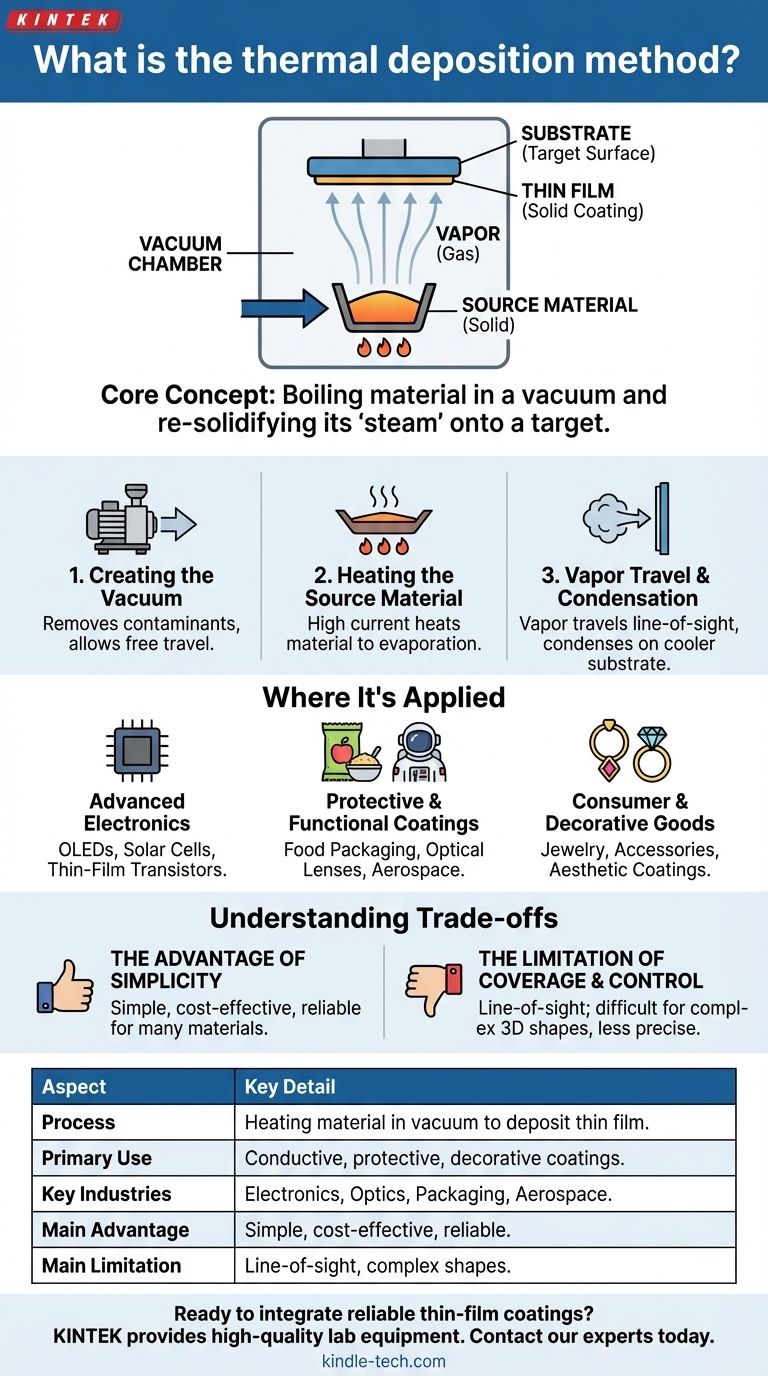
At its core, thermal deposition is a method for creating an ultra-thin film of material on a surface. In a high-vacuum chamber, a source material is heated until it evaporates, turning from a solid into a vapor. This vapor then travels through the vacuum and condenses onto a cooler target surface, known as a substrate, forming a solid, uniform coating.

The central concept is simple: you are essentially boiling a material in a vacuum and letting its "steam" re-solidify onto a target. This straightforward principle makes thermal deposition one of the most fundamental and widely used techniques in the thin-film industry.
What is the thermal deposition method? A Guide to Thin-Film Coating Technology

How Thermal Deposition Works: A Step-by-Step Breakdown

To truly understand this method, it's best to break it down into its three critical phases. Each step is essential for achieving a high-quality, pure thin film.

Phase 1: Creating the Vacuum

The entire process must occur in a high-vacuum environment. This is non-negotiable for two key reasons.

First, the vacuum removes air and other gas molecules that could react with the hot vapor, contaminating the final film. Second, it allows the evaporated material atoms to travel freely and directly to the substrate without colliding with other particles.

Phase 2: Heating the Source Material

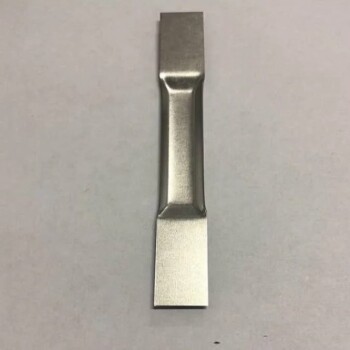
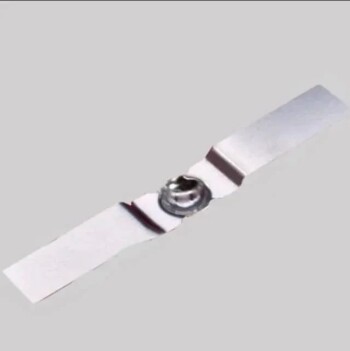
The material intended for the film is placed inside the chamber, typically in a small, electrically-resistant container called a "boat" or "basket."

A high electric current is passed through this container, causing it to heat up intensely. This heat is transferred to the source material, increasing its temperature until its atoms gain enough energy to leave the surface and enter a gaseous state, creating a vapor pressure.

Phase 3: Vapor Travel and Condensation

Once evaporated, the vapor stream travels in a straight, line-of-sight path from the source to the substrate.

The substrate is kept at a lower temperature than the vapor. When the hot vapor atoms strike the cooler surface, they rapidly lose energy, condense, and bond to the surface, building up layer by layer to form a solid thin film.

Where This Method is Applied

The simplicity and effectiveness of thermal deposition make it a vital process across numerous high-tech and consumer industries.

In Advanced Electronics

This method is crucial for depositing the ultra-thin metal layers that serve as conductors or bonding layers in devices like OLEDs, solar cells, and thin-film transistors.

For Protective and Functional Coatings

Thermal deposition is used to apply thin films of aluminum onto plastic for food packaging, creating a barrier against moisture and oxygen. It's also used for reflective coatings in NASA spacesuits, firefighter uniforms, and emergency blankets, as well as for anti-reflective and UV-protection layers on optical lenses.

In Consumer and Decorative Goods

The technique is widely used to apply lustrous, aesthetic thin-film coatings to jewelry and other accessories, providing a high-quality finish without a significant amount of material.

Understanding the Trade-offs

While powerful, thermal deposition is not the solution for every scenario. Understanding its advantages and limitations is key to using it effectively.

The Advantage of Simplicity

As one of the oldest technologies in the field, its primary strength is its straightforward nature. It does not require complex chemical precursors or reactive gases, making it a relatively cost-effective and reliable process for a wide range of materials, especially metals.

The Limitation of Coverage and Control

The process is fundamentally "line-of-sight," meaning the vapor travels in a straight line from the source to the substrate. This can make it difficult to uniformly coat complex, three-dimensional shapes with shadowed areas. Furthermore, control over the final film's structural properties (like density) can be less precise compared to more advanced deposition techniques.

Making the Right Choice for Your Application

Your specific goal will determine if thermal deposition is the ideal approach.

  • If your primary focus is cost-effective metalization for packaging or simple electronics: Thermal deposition is an excellent, well-established choice for its reliability and efficiency.
  • If your primary focus is creating high-purity optical or anti-reflective coatings: This method is highly effective due to the clean, controlled vacuum environment.
  • If your primary focus is coating complex 3D shapes with perfect uniformity: You may need to investigate alternative methods, such as sputtering, that are not strictly line-of-sight.

Ultimately, thermal deposition remains a cornerstone of thin-film technology because of its fundamental effectiveness and elegant simplicity.

Summary Table:

Aspect Key Detail
Process Heating a material in a vacuum to deposit a thin film on a substrate.
Primary Use Creating conductive, protective, and decorative coatings.
Key Industries Electronics, Optics, Packaging, Aerospace.
Main Advantage Simple, cost-effective, and reliable for many materials.
Main Limitation Line-of-sight process; less effective for complex 3D shapes.

Ready to integrate reliable thin-film coatings into your production?

KINTEK specializes in providing high-quality lab equipment and consumables for thermal deposition and other thin-film processes. Whether you are developing advanced electronics, optical coatings, or protective layers, our expertise ensures you have the right tools for precise, efficient, and cost-effective results.

Contact our experts today to discuss how our solutions can meet your specific laboratory and production needs.

Visual Guide
What is the thermal deposition method? A Guide to Thin-Film Coating Technology Visual Guide

Related Products

People Also Ask

Related Products

RF PECVD System Radio Frequency Plasma-Enhanced Chemical Vapor Deposition RF PECVD

RF PECVD System Radio Frequency Plasma-Enhanced Chemical Vapor Deposition RF PECVD

RF-PECVD is an acronym for "Radio Frequency Plasma-Enhanced Chemical Vapor Deposition." It deposits DLC (Diamond-like carbon film) on germanium and silicon substrates. It is utilized in the 3-12um infrared wavelength range.

Molybdenum Tungsten Tantalum Evaporation Boat for High Temperature Applications

Molybdenum Tungsten Tantalum Evaporation Boat for High Temperature Applications

Evaporation boat sources are used in thermal evaporation systems and are suitable for depositing various metals, alloys and materials. Evaporation boat sources are available in different thicknesses of tungsten, tantalum and molybdenum to ensure compatibility with a variety of power sources. As a container, it is used for vacuum evaporation of materials. They can be used for thin film deposition of various materials, or designed to be compatible with techniques such as electron beam fabrication.

Chemical Vapor Deposition CVD Equipment System Chamber Slide PECVD Tube Furnace with Liquid Gasifier PECVD Machine

Chemical Vapor Deposition CVD Equipment System Chamber Slide PECVD Tube Furnace with Liquid Gasifier PECVD Machine

KT-PE12 Slide PECVD System: Wide power range, programmable temp control, fast heating/cooling with sliding system, MFC mass flow control & vacuum pump.

Hemispherical Bottom Tungsten Molybdenum Evaporation Boat

Hemispherical Bottom Tungsten Molybdenum Evaporation Boat

Used for gold plating, silver plating, platinum, palladium, suitable for a small amount of thin film materials. Reduce the waste of film materials and reduce heat dissipation.

Aluminized Ceramic Evaporation Boat for Thin Film Deposition

Aluminized Ceramic Evaporation Boat for Thin Film Deposition
Vessel for depositing thin films; has an aluminum-coated ceramic body for improved thermal efficiency and chemical resistance. making it suitable for various applications.

Electron Beam Evaporation Coating Conductive Boron Nitride Crucible BN Crucible

Electron Beam Evaporation Coating Conductive Boron Nitride Crucible BN Crucible

High-purity and smooth conductive boron nitride crucible for electron beam evaporation coating, with high temperature and thermal cycling performance.

Tungsten Evaporation Boat for Thin Film Deposition

Tungsten Evaporation Boat for Thin Film Deposition

Learn about tungsten boats, also known as evaporated or coated tungsten boats. With a high tungsten content of 99.95%, these boats are ideal for high-temperature environments and widely used in various industries. Discover their properties and applications here.

VHP Sterilization Equipment Hydrogen Peroxide H2O2 Space Sterilizer

VHP Sterilization Equipment Hydrogen Peroxide H2O2 Space Sterilizer

A hydrogen peroxide space sterilizer is a device that uses vaporized hydrogen peroxide to decontaminate enclosed spaces. It kills microorganisms by damaging their cellular components and genetic material.

Ceramic Evaporation Boat Set Alumina Crucible for Laboratory Use

Ceramic Evaporation Boat Set Alumina Crucible for Laboratory Use

It can be used for vapor deposition of various metals and alloys. Most metals can be evaporated completely without loss. Evaporation baskets are reusable.1

Lab-Scale Vacuum Induction Melting Furnace

Lab-Scale Vacuum Induction Melting Furnace

Get precise alloy composition with our Vacuum Induction Melting Furnace. Ideal for aerospace, nuclear energy, and electronic industries. Order now for effective smelting and casting of metals and alloys.

Vacuum Heat Treat and Molybdenum Wire Sintering Furnace for Vacuum Sintering

Vacuum Heat Treat and Molybdenum Wire Sintering Furnace for Vacuum Sintering

A vacuum molybdenum wire sintering furnace is a vertical or bedroom structure, which is suitable for withdrawal, brazing, sintering and degassing of metal materials under high vacuum and high temperature conditions. It is also suitable for dehydroxylation treatment of quartz materials.

600T Vacuum Induction Hot Press Furnace for Heat Treat and Sintering

600T Vacuum Induction Hot Press Furnace for Heat Treat and Sintering

Discover the 600T Vacuum Induction Hot Press Furnace, designed for high-temperature sintering experiments in vacuum or protected atmospheres. Its precise temperature and pressure control, adjustable working pressure, and advanced safety features make it ideal for nonmetal materials, carbon composites, ceramics, and metal powders.

Graphite Vacuum Furnace High Thermal Conductivity Film Graphitization Furnace

Graphite Vacuum Furnace High Thermal Conductivity Film Graphitization Furnace

The high thermal conductivity film graphitization furnace has uniform temperature, low energy consumption and can operate continuously.

Vacuum Heat Treat Furnace with Ceramic Fiber Liner

Vacuum Heat Treat Furnace with Ceramic Fiber Liner

Vacuum furnace with polycrystalline ceramic fiber insulation liner for excellent heat insulation and uniform temperature field. Choose from 1200℃ or 1700℃ max. working temperature with high vacuum performance and precise temperature control.

Non Consumable Vacuum Arc Induction Melting Furnace

Non Consumable Vacuum Arc Induction Melting Furnace

Explore the benefits of Non-Consumable Vacuum Arc Furnace with high melting point electrodes. Small, easy to operate & eco-friendly. Ideal for laboratory research on refractory metals & carbides.

Rotating Platinum Disk Electrode for Electrochemical Applications

Rotating Platinum Disk Electrode for Electrochemical Applications

Upgrade your electrochemical experiments with our Platinum Disc Electrode. High-quality and reliable for accurate results.

1400℃ Controlled Atmosphere Furnace with Nitrogen and Inert Atmosphere

1400℃ Controlled Atmosphere Furnace with Nitrogen and Inert Atmosphere

Achieve precise heat treatment with KT-14A controlled atmosphere furnace. Vacuum sealed with a smart controller, it's ideal for lab and industrial use up to 1400℃.

Ultra-High Temperature Graphite Vacuum Graphitization Furnace

Ultra-High Temperature Graphite Vacuum Graphitization Furnace

The ultra-high temperature graphitization furnace utilizes medium frequency induction heating in a vacuum or inert gas environment. The induction coil generates an alternating magnetic field, inducing eddy currents in the graphite crucible, which heats up and radiates heat to the workpiece, bringing it to the desired temperature. This furnace is primarily used for graphitization and sintering of carbon materials, carbon fiber materials, and other composite materials.

Molybdenum Vacuum Heat Treat Furnace

Molybdenum Vacuum Heat Treat Furnace

Discover the benefits of a high-configuration molybdenum vacuum furnace with heat shield insulation. Ideal for high-purity, vacuum environments like sapphire crystal growth and heat treatment.

Polygon Press Mold for Lab

Polygon Press Mold for Lab

Discover precision polygon press molds for sintering. Ideal for pentagon-shaped parts, our molds ensure uniform pressure and stability. Perfect for repeatable, high-quality production.


Leave Your Message