
At its core, a vacuum brazing furnace uses a high-purity vacuum environment and precise thermal control to join materials. It works by pumping all reactive gases out of a sealed chamber, heating the components and a filler metal to a specific temperature where the filler melts and flows into the joint, and then cooling the assembly in a controlled manner to create a strong, clean, and flux-free bond.
The fundamental principle is not just about heating parts, but about creating a chemically inert environment. By removing oxygen and other contaminants, the furnace enables the brazing alloy to wet and bond with the parent materials perfectly, achieving a level of joint integrity that is impossible in a normal atmosphere.
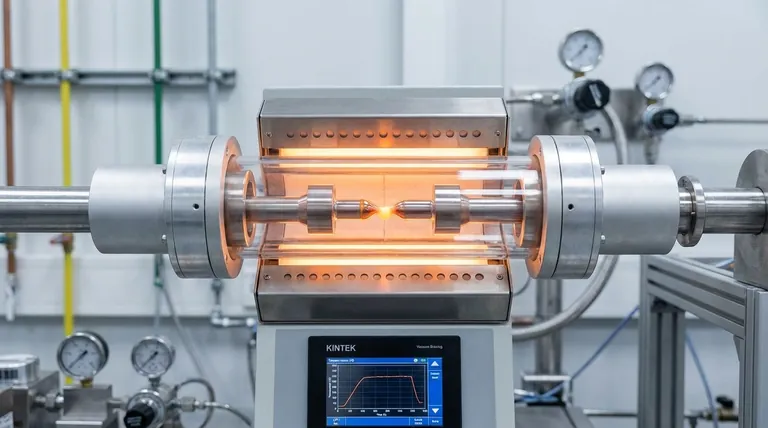
The Core Principle: Combining Vacuum and Heat
The entire process is a carefully orchestrated sequence designed to manage the atmosphere, temperature, and material interactions at a molecular level.
Creating the Vacuum Environment
A vacuum furnace first removes the air and moisture from its sealed chamber. This is typically a two-stage process involving a mechanical "roughing" pump to remove the bulk of the air, followed by a high-vacuum pump (like a diffusion or turbomolecular pump) to achieve the required low-pressure state.
The primary goal is to eliminate oxygen and other reactive gases. This prevents the formation of oxides on the surface of the parts and the brazing filler metal, which would otherwise inhibit proper bonding.
Precise Heating and Soaking
Once the vacuum level is stable, the heating system raises the temperature of the workload. Heating elements, often made of graphite or molybdenum, are arranged within a "hot zone" to ensure high temperature uniformity.
The temperature is raised above the melting point of the brazing filler metal but kept safely below the melting point of the components being joined. The parts are held at this brazing temperature, a step known as "soaking," to ensure the entire assembly reaches a stable and uniform temperature.
The Brazing and Wetting Action
In the clean, high-temperature vacuum environment, the filler metal melts and is drawn into the tight gap between the components via capillary action. Because the surfaces are free of oxides, the molten filler metal can "wet" the surfaces effectively, creating a continuous and strong metallurgical bond.
Interestingly, the high temperatures and vacuum can also help to clean the parts by causing some surface oxides to dissociate, a process known as active vacuum brazing.
Controlled Cooling
After brazing is complete, the assembly must be cooled carefully. Cooling too quickly can induce thermal stress, while cooling too slowly in a poor vacuum can allow re-oxidation.
Cooling can be done by simply letting the furnace cool naturally under vacuum. For faster cycles, the furnace can be backfilled with a high-purity inert gas like argon or nitrogen, which is then circulated by a fan to remove heat more quickly.
Why a Vacuum is the Ideal Brazing Environment
Using a vacuum is not just an alternative; it provides distinct advantages that are critical for high-performance applications.
Elimination of Oxidation and Contamination
This is the single most important benefit. By removing oxygen, the process eliminates the need for corrosive chemical fluxes that are required in atmosphere brazing. The final product is exceptionally clean, with no post-braze cleaning required.
Superior Joint Integrity and Strength
The vacuum actively pulls trapped gases out of the base metals as they are heated, a phenomenon called outgassing. This leads to purer, denser joints with fewer voids or inclusions, resulting in maximum strength and hermeticity.
Unmatched Process Control and Repeatability
Modern vacuum furnaces offer sophisticated computer control over every process variable. Heating rates, soak times, and cooling profiles can be programmed and executed with perfect precision, ensuring that every cycle is identical. This level of repeatability is essential for industries like aerospace and medical devices, which operate under strict standards like NADCAP.
Understanding the Trade-offs and Critical Factors
While powerful, vacuum brazing technology comes with its own set of considerations.
Inadequate Part Cleanliness
Vacuum brazing is not a substitute for proper cleaning. The process is intolerant of surface contaminants like oils, grease, or dirt. Parts must be meticulously cleaned before being loaded into the furnace for the process to succeed.
Choosing the Correct Vacuum Level
The vacuum level must be matched to the materials being processed. While a high vacuum prevents oxidation, an excessively high vacuum can cause vaporization of certain elements (like zinc, magnesium, or cadmium) from the base metals or brazing alloy, altering their composition.
Importance of System Integrity
The entire system, from the chamber seals to the water-cooling lines that protect the furnace body, must be flawlessly maintained. A small leak can compromise the vacuum, ruin the workload, and potentially damage the furnace's internal components.
Applying This to Your Goal
Your choice to use vacuum brazing depends entirely on the requirements of your application.
- If your primary focus is aerospace, medical, or research components: The ultra-clean, fluxless, and highly repeatable joints created by vacuum brazing are often the only way to meet stringent quality and performance specifications.
- If your primary focus is joining reactive metals like titanium or refractory metals: A vacuum furnace is essential, as these materials will instantly form brittle oxides in the presence of even trace amounts of oxygen at brazing temperatures.
- If your primary focus is achieving the highest possible joint strength and purity: Vacuum brazing provides an unparalleled environment for creating dense, void-free bonds that are often as strong as the parent materials themselves.
Ultimately, understanding these principles allows you to leverage vacuum brazing to create joints of the highest possible purity, strength, and reliability.
Summary Table:
| Key Principle | Function | Benefit |
|---|---|---|
| Vacuum Environment | Removes oxygen and reactive gases from the chamber | Prevents oxidation, eliminates need for flux |
| Precise Heating | Heats parts above filler metal melting point but below base metal melting point | Ensures uniform temperature for proper bonding |
| Capillary Action | Molten filler metal flows into tight joints between components | Creates continuous, void-free metallurgical bond |
| Controlled Cooling | Cools assembly under vacuum or inert gas atmosphere | Prevents thermal stress and re-oxidation |
Ready to achieve flawless, high-strength brazed joints for your critical applications?
At KINTEK, we specialize in advanced vacuum brazing furnaces and lab equipment that deliver the precision, cleanliness, and repeatability required for aerospace, medical device, and high-tech manufacturing. Our solutions eliminate oxidation and contamination while ensuring superior joint integrity and process control.
Contact us today to discuss how our vacuum brazing technology can enhance your metal joining processes and meet your most demanding quality standards.
Get in touch with our experts now!
Visual Guide

Related Products
- Vacuum Heat Treat Sintering Brazing Furnace
- Ultra-High Temperature Graphite Vacuum Graphitization Furnace
- Vacuum Heat Treat and Pressure Sintering Furnace for High Temperature Applications
- Vacuum Hot Press Furnace Heated Vacuum Press Machine Tube Furnace
- Vacuum Sealed Continuous Working Rotary Tube Furnace Rotating Tube Furnace
People Also Ask
- What is the cost of a vacuum brazing furnace? A guide to key factors and investment strategy
- What is a vacuum heat treatment furnace? Achieve Unmatched Purity and Control
- How does a vacuum brazing furnace work? Achieve Superior, Flux-Free Metal Joining
- What is a vacuum heat treatment furnace? The Ultimate Guide to Controlled Atmosphere Processing
- How do you braze a furnace? A Guide to High-Volume, Precision Metal Joining



















