Knowledge What measures the temperature of a furnace? The Complete Guide to Thermocouples & Pyrometers
Author avatar

Tech Team · Kintek Solution

Updated 6 days ago

What measures the temperature of a furnace? The Complete Guide to Thermocouples & Pyrometers


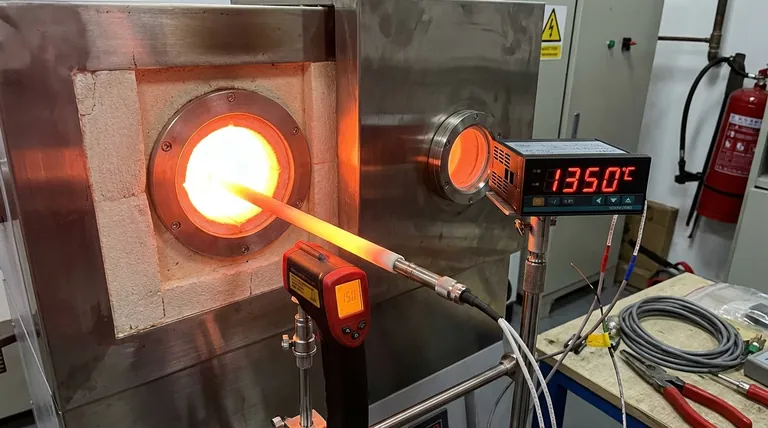
In most industrial and laboratory settings, a thermocouple is the primary instrument used to measure the internal temperature of a furnace. This robust sensor is favored for its ability to withstand extreme heat, its wide measurement range, and its reliability in harsh environments.

The core challenge in furnace temperature measurement isn't just finding a tool that can survive the heat, but choosing one that provides accurate and repeatable data for precise process control. While thermocouples are the industry standard for direct measurement, understanding their types and limitations is critical.
What measures the temperature of a furnace? The Complete Guide to Thermocouples & Pyrometers

How a Thermocouple Works: The Seebeck Effect

A thermocouple operates on a simple, elegant principle of physics discovered nearly 200 years ago. It doesn't contain complex electronics at the sensing point, which is key to its high-temperature durability.

Two Dissimilar Metals

A thermocouple is made from two different types of metal wires welded together at one end. This welded junction is the point where the temperature is measured—the "hot junction."

Generating a Voltage Signal

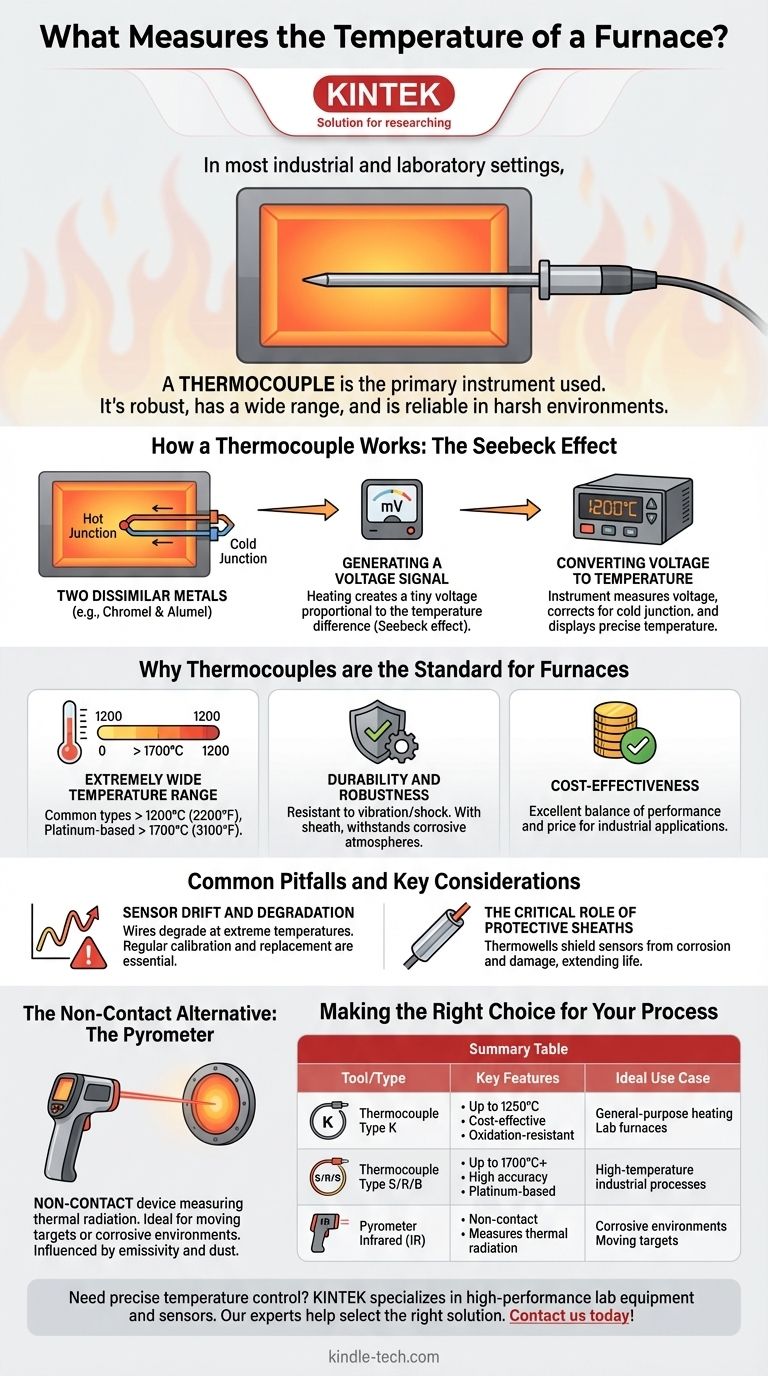
When this hot junction is heated, a tiny voltage (millivolts) is produced that is directly proportional to the temperature difference between the hot junction inside the furnace and the "cold junction" outside. This phenomenon is known as the Seebeck effect.

Converting Voltage to Temperature

This millivolt signal travels along the thermocouple wires to a temperature controller or transmitter. This instrument measures the voltage, applies a correction for the cold junction temperature, and converts the reading into a precise temperature display (e.g., in Celsius or Fahrenheit).

Why Thermocouples are the Standard for Furnaces

While other sensors exist, thermocouples have remained the dominant choice for high-temperature applications for several key reasons.

Extremely Wide Temperature Range

Different types of thermocouples can measure a vast spectrum of temperatures. Common types work well above 1200°C (2200°F), while specialized platinum-based types can accurately measure temperatures approaching 1700°C (3100°F) and higher.

Durability and Robustness

Their simple construction—essentially two welded wires—makes them inherently resistant to vibration and mechanical shock. When housed in a protective sheath, they can withstand corrosive and high-pressure furnace atmospheres.

Cost-Effectiveness

Compared to other high-temperature sensors, thermocouples provide an excellent balance of performance and price, making them a practical choice for most industrial applications.

Common Pitfalls and Key Considerations

Simply choosing a thermocouple is not enough. Proper selection and implementation are critical for accuracy and longevity.

Sensor Drift and Degradation

At extreme temperatures, thermocouple wires can degrade, causing the voltage signal to "drift" and give inaccurate readings over time. Regular calibration checks and planned replacement are essential for critical processes.

The Critical Role of Protective Sheaths

The thermocouple is almost always protected by a sheath, typically made of ceramic or a high-temperature metal alloy. This thermowell shields the sensor from chemical corrosion and physical damage inside the furnace, dramatically extending its life.

The Non-Contact Alternative: The Pyrometer

In some cases, direct contact measurement is impossible or impractical. An infrared (IR) pyrometer is a non-contact device that measures temperature by detecting the thermal radiation an object emits. It is aimed at the target through a viewport in the furnace wall.

Pyrometers are ideal for measuring moving targets or when the furnace atmosphere would instantly destroy a probe. However, their accuracy can be affected by dust, smoke, and the surface properties (emissivity) of the material being measured.

Making the Right Choice for Your Process

Selecting the correct instrument depends entirely on your specific temperature range, environment, and accuracy requirements.

  • If your primary focus is general-purpose heating up to 1250°C (2282°F): A Type K thermocouple offers the best combination of wide range, low cost, and good resistance to oxidation.
  • If your primary focus is high-temperature industrial processes above 1250°C (2282°F): A platinum-based Type S, R, or B thermocouple is required for its superior stability and accuracy at extreme temperatures.
  • If your primary focus is non-contact measurement due to a corrosive environment or moving product: An infrared pyrometer is the correct tool, but requires careful setup to account for emissivity and atmospheric interference.

Ultimately, precise temperature measurement is the foundation of a controlled and repeatable thermal process.

Summary Table:

Measurement Tool Type Key Features Ideal Use Case
Thermocouple Type K Up to 1250°C, cost-effective, oxidation-resistant General-purpose heating, lab furnaces
Thermocouple Type S/R/B Up to 1700°C+, high accuracy, platinum-based High-temperature industrial processes
Pyrometer Infrared (IR) Non-contact, measures thermal radiation Corrosive environments, moving targets

Need precise temperature control for your furnace processes? KINTEK specializes in high-performance lab equipment and consumables, including durable thermocouples and pyrometers designed for accurate thermal measurement. Our experts can help you select the right sensor for your specific temperature range and environment, ensuring reliable process control and repeatable results. Contact us today to discuss your furnace temperature measurement needs!

Visual Guide
What measures the temperature of a furnace? The Complete Guide to Thermocouples & Pyrometers Visual Guide

Related Products

People Also Ask

Related Products

1700℃ Laboratory Quartz Tube Furnace with Alumina Tube Tubular Furnace

1700℃ Laboratory Quartz Tube Furnace with Alumina Tube Tubular Furnace

Looking for a high-temperature tube furnace? Check out our 1700℃ Tube Furnace with Alumina Tube. Perfect for research and industrial applications up to 1700C.

Infrared Thermal Imaging Temperature Measurement Double-Sided Coated Germanium Ge Lens

Infrared Thermal Imaging Temperature Measurement Double-Sided Coated Germanium Ge Lens

Germanium lenses are durable, corrosion-resistant optical lenses suited for harsh environments and applications exposed to the elements.

Laboratory Muffle Oven Furnace Bottom Lifting Muffle Furnace

Laboratory Muffle Oven Furnace Bottom Lifting Muffle Furnace

Efficiently produce batches with excellent temperature uniformity using our Bottom Lifting Furnace. Features two electric lifting stages and advanced temperature control up to 1600℃.

High Temperature Muffle Oven Furnace for Laboratory Debinding and Pre Sintering

High Temperature Muffle Oven Furnace for Laboratory Debinding and Pre Sintering

KT-MD High temperature debinding and pre-sintering furnace for ceramic materials with various molding processes. Ideal for electronic components such as MLCC and NFC.

1700℃ Muffle Oven Furnace for Laboratory

1700℃ Muffle Oven Furnace for Laboratory

Get superior heat control with our 1700℃ Muffle Furnace. Equipped with intelligent temperature microprocessor, TFT touch screen controller & advanced insulation materials for precise heating up to 1700C. Order now!

1800℃ Muffle Oven Furnace for Laboratory

1800℃ Muffle Oven Furnace for Laboratory

KT-18 muffle furnace with Japan Al2O3 polycrystalline fibe and Silicon Molybdenum heating element, up to 1900℃, PID temperature control and 7" smart touch screen. Compact design, low heat loss, and high energy efficiency. Safety interlock system and versatile functions.

1200℃ Split Tube Furnace with Quartz Tube Laboratory Tubular Furnace

1200℃ Split Tube Furnace with Quartz Tube Laboratory Tubular Furnace

KT-TF12 split tube furnace: high-purity insulation, embedded heating wire coils, and max. 1200C. Widely used for new materials and chemical vapour deposition.

Infrared High Resistance Single Crystal Silicon Lens

Infrared High Resistance Single Crystal Silicon Lens

Silicon (Si) is widely regarded as one of the most durable mineral and optical materials for applications in the near-infrared (NIR) range, approximately 1 μm to 6 μm.

High Pressure Laboratory Vacuum Tube Furnace Quartz Tubular Furnace

High Pressure Laboratory Vacuum Tube Furnace Quartz Tubular Furnace

KT-PTF High Pressure Tube Furnace: Compact split tube furnace with strong positive pressure resistance. Working temp up to 1100°C and pressure up to 15Mpa. Also works under controller atmosphere or high vacuum.

Vacuum Hot Press Furnace Machine for Lamination and Heating

Vacuum Hot Press Furnace Machine for Lamination and Heating

Experience clean and precise lamination with Vacuum Lamination Press. Perfect for wafer bonding, thin-film transformations, and LCP lamination. Order now!

Vertical High Temperature Graphite Vacuum Graphitization Furnace

Vertical High Temperature Graphite Vacuum Graphitization Furnace

Vertical high temperature graphitization furnace for carbonization and graphitization of carbon materials up to 3100℃.Suitable for shaped graphitization of carbon fiber filaments and other materials sintered in a carbon environment.Applications in metallurgy, electronics, and aerospace for producing high-quality graphite products like electrodes and crucibles.

Vacuum Heat Treat and Sintering Furnace with 9MPa Air Pressure

Vacuum Heat Treat and Sintering Furnace with 9MPa Air Pressure

The air pressure sintering furnace is a high-tech equipment commonly used for the sintering of advanced ceramic materials. It combines vacuum sintering and pressure sintering techniques to achieve high-density and high-strength ceramics.

1400℃ Controlled Atmosphere Furnace with Nitrogen and Inert Atmosphere

1400℃ Controlled Atmosphere Furnace with Nitrogen and Inert Atmosphere

Achieve precise heat treatment with KT-14A controlled atmosphere furnace. Vacuum sealed with a smart controller, it's ideal for lab and industrial use up to 1400℃.

Vacuum Heat Treat and Molybdenum Wire Sintering Furnace for Vacuum Sintering

Vacuum Heat Treat and Molybdenum Wire Sintering Furnace for Vacuum Sintering

A vacuum molybdenum wire sintering furnace is a vertical or bedroom structure, which is suitable for withdrawal, brazing, sintering and degassing of metal materials under high vacuum and high temperature conditions. It is also suitable for dehydroxylation treatment of quartz materials.

1200℃ Controlled Atmosphere Furnace Nitrogen Inert Atmosphere Furnace

1200℃ Controlled Atmosphere Furnace Nitrogen Inert Atmosphere Furnace

Discover our KT-12A Pro Controlled atmosphere furnace - high precision, heavy duty vacuum chamber, versatile smart touch screen controller, and excellent temperature uniformity up to 1200C. Ideal for both laboratory and industrial application.

Vacuum Sealed Continuous Working Rotary Tube Furnace Rotating Tube Furnace

Vacuum Sealed Continuous Working Rotary Tube Furnace Rotating Tube Furnace

Experience efficient material processing with our vacuum-sealed rotary tube furnace. Perfect for experiments or industrial production, equipped with optional features for controlled feeding and optimized results. Order now.

Graphite Vacuum Continuous Graphitization Furnace

Graphite Vacuum Continuous Graphitization Furnace

High-temperature graphitization furnace is a professional equipment for graphitization treatment of carbon materials. It is a key equipment for the production of high-quality graphite products. It has high temperature, high efficiency and uniform heating. It is suitable for various high-temperature treatments and graphitization treatments. It is widely used in metallurgy, electronics, aerospace, etc. industry.

600T Vacuum Induction Hot Press Furnace for Heat Treat and Sintering

600T Vacuum Induction Hot Press Furnace for Heat Treat and Sintering

Discover the 600T Vacuum Induction Hot Press Furnace, designed for high-temperature sintering experiments in vacuum or protected atmospheres. Its precise temperature and pressure control, adjustable working pressure, and advanced safety features make it ideal for nonmetal materials, carbon composites, ceramics, and metal powders.

Vacuum Hot Press Furnace Machine Heated Vacuum Press

Vacuum Hot Press Furnace Machine Heated Vacuum Press

Discover the advantages of Vacuum Hot Press Furnace! Manufacture dense refractory metals & compounds, ceramics, and composites under high temp and pressure.

1700℃ Controlled Atmosphere Furnace Nitrogen Inert Atmosphere Furnace

1700℃ Controlled Atmosphere Furnace Nitrogen Inert Atmosphere Furnace

KT-17A Controlled atmosphere furnace: 1700℃ heating, vacuum sealing technology, PID temperature control, and versatile TFT smart touch screen controller for laboratory and industrial use.


Leave Your Message