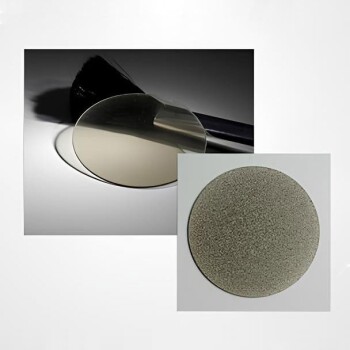
In Counter-Diffusion Chemical Vapor Deposition (CDCVD), the porous substrate functions as a dynamic process regulator rather than a simple mechanical scaffold. It serves as a critical diffusion barrier that controls the flow of the precursor and oxidant from opposite sides. By acting as the physical reaction site, it spatially confines the deposition process to the interior of the pores.
The porous substrate acts as the engine of the CDCVD process. By separating reactant flows and forcing them to meet within its internal structure, it enables the precise growth of ultra-thin, dense separation layers that standard deposition methods cannot achieve.
The Mechanics of Substrate Control
Acting as a Diffusion Barrier
In standard CVD, reactants often mix in the gas phase. In CDCVD, the substrate prevents this immediate mixing.
The precursor and oxidant are introduced from opposite sides of the substrate. The porous material restricts their movement, forcing them to diffuse slowly toward one another.
Defining the Reaction Zone
The substrate dictates exactly where the chemical reaction occurs.
Instead of reacting on the surface or in the chamber, the precursor and oxidant meet within the pores. The substrate effectively becomes the reaction vessel, localizing the chemistry to a specific internal interface.
The Impact of Spatial Confinement
Deposition on Inner Walls
The confinement provided by the substrate ensures that material is not deposited loosely on top of the surface.
Instead, the reaction coats the inner walls of the pores. This internal coating modifies the effective pore size without blocking the structure entirely.
Enabling Molecular Sieving
This specific geometry is crucial for creating high-performance membranes.
By growing dense layers inside the pores, the process creates ultra-thin barriers capable of molecular sieving. This allows the final material to separate molecules based on size with high precision.
Understanding the Constraints
Dependency on Pore Structure
Because the substrate acts as the diffusion barrier, the uniformity of the deposition is inextricably linked to the uniformity of the substrate.
The substrate is not a blank canvas; its internal architecture defines the diffusion path. Therefore, the quality of the final separation layer relies heavily on the consistency of the substrate's original pore network.
Making the Right Choice for Your Goal
To leverage CDCVD effectively, you must align your substrate selection with your desired outcome:
- If your primary focus is Membrane Selectivity: Choose a substrate with a uniform pore structure to ensure the "diffusion barrier" effect creates a consistent, dense separation layer for molecular sieving.
- If your primary focus is Internal Coating: Rely on the substrate's ability to confine the reaction spatially, ensuring the deposition targets the inner walls rather than the outer surface.
The porous substrate in CDCVD is not just holding the film; it is the physical template that shapes the reaction and defines the final material's performance.
Summary Table:
| Feature | Role in CDCVD Process | Impact on Final Material |
|---|---|---|
| Diffusion Barrier | Prevents gas-phase mixing; forces controlled reactant flow. | Enables ultra-thin, dense layer formation. |
| Reaction Site | Confines the chemical reaction to the interior of pores. | Localizes deposition to specific internal interfaces. |
| Spatial Confinement | Directs deposition onto the inner walls of the substrate. | Modifies pore size for high-precision molecular sieving. |
| Structural Template | Architecture defines the diffusion path and uniformity. | Ensures high membrane selectivity and consistency. |
Elevate Your Membrane Research with KINTEK Precision
Unlock the full potential of Counter-Diffusion Chemical Vapor Deposition with high-quality substrates and advanced thermal systems from KINTEK. As specialists in laboratory equipment, we provide the essential tools needed to master spatial confinement and diffusion control, including:
- Advanced CVD & PECVD Systems: For precise control over precursor delivery and reaction environments.
- High-Temperature Muffle & Tube Furnaces: To ensure thermal stability during critical deposition phases.
- Specialized Ceramics & Crucibles: Durable consumables designed for rigorous chemical processes.
- Precision Crushing & Milling: To prepare your materials with the exact consistency required for high-performance research.
Whether you are developing molecular sieving membranes or advanced catalytic coatings, KINTEK offers the comprehensive range of furnaces, reactors, and laboratory consumables your lab needs to succeed.
Ready to optimize your deposition process? Contact our technical experts today to find the perfect solution for your research goals!
References
- Amir Hossein Mostafavi, Seyed Saeid Hosseini. Advances in surface modification and functionalization for tailoring the characteristics of thin films and membranes via chemical vapor deposition techniques. DOI: 10.1002/app.53720
This article is also based on technical information from Kintek Solution Knowledge Base .
Related Products
- Customer Made Versatile CVD Tube Furnace Chemical Vapor Deposition Chamber System Equipment
- Chemical Vapor Deposition CVD Equipment System Chamber Slide PECVD Tube Furnace with Liquid Gasifier PECVD Machine
- Multi Heating Zones CVD Tube Furnace Machine Chemical Vapor Deposition Chamber System Equipment
- Split Chamber CVD Tube Furnace with Vacuum Station Chemical Vapor Deposition System Equipment Machine
- Cylindrical Resonator MPCVD Machine System Reactor for Microwave Plasma Chemical Vapor Deposition and Lab Diamond Growth
People Also Ask
- What is a CVD tube furnace? A Complete Guide to Thin-Film Deposition
- What is the function of a high-temperature CVD tube furnace in 3D graphene foam prep? Master 3D Nanomaterial Growth
- What are the technical advantages of using a CVD tube furnace? Optimize Silicon-Carbon Battery Anodes
- How does a CVD tube furnace inhibit the sintering of silver supports? Boost Membrane Durability and Performance
- What is the function of a tube furnace in CVD SiC synthesis? Achieving Ultra-Pure Silicon Carbide Powders