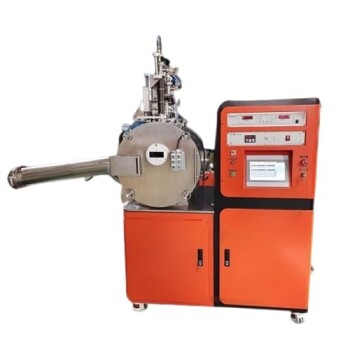
Vacuum induction melting (VIM) and vacuum arc remelting (VAR) serve as the fundamental purification stages for creating aerospace-grade Inconel 718. This specialized equipment isolates the molten alloy in a vacuum environment to effectively prevent oxidation, strip away volatile impurities, and lock in the precise chemical composition necessary for extreme heat resistance.
Core Insight: The primary function of VIM and VAR equipment is not just to melt metal, but to act as a filtration system at the atomic level. By refining the alloy in a vacuum, these processes eliminate contamination that would otherwise compromise the structural integrity of Inconel 718 in high-stress environments.
The Mechanics of Metallurgical Purity
Prevention of Oxidation
Inconel 718 contains reactive elements that degrade instantly upon contact with air. VIM and VAR equipment create an oxygen-free environment during the melting process. This prevents the formation of oxides that would otherwise weaken the alloy's matrix.
Removal of Volatile Impurities
The vacuum environment allows for the efficient removal of harmful impurities that have high vapor pressures. This equipment effectively extracts volatile elements, ensuring the final cast product maintains a clean microstructure.
Elimination of Trace Contaminants
Vacuum melting is specifically designed to remove harmful low-melting-point metallic impurities. Elements such as lead (Pb), bismuth (Bi), antimony (Sb), copper (Cu), tin (Sn), and tellurium (Te) are eliminated to prevent embrittlement.
Enhancing Thermal and Mechanical Performance
Increasing Operating Temperatures
The purity achieved through VIM and VAR directly correlates to the alloy's thermal limits. While standard melting might limit superalloys to a working range of 750-810°C, vacuum melting can extend this range to 980-1090°C.
Reducing Interstitial Defects
This equipment significantly improves mechanical properties by reducing interstitial gas elements. The process aggressively lowers the levels of oxygen (O2), nitrogen (N2), and hydrogen (H2), which are known to cause porosity and cracking.
Improving Hot Working Characteristics
By removing non-metallic inclusions and gases, the ductility of the material improves. This makes the Inconel 718 easier to forge and shape (hot working) without developing structural flaws.
Chemical Precision and Decarburization
Controlled Decarburization
VIM equipment allows for the precise removal of excess carbon without sacrificing valuable alloying elements. In a vacuum, the pressure dependence of the carbon monoxide (CO) reaction changes, facilitating decarburization.
Protecting Reactive Elements
Standard decarburization techniques often result in the loss of reactive elements critical to the superalloy's formula. The vacuum environment preserves these reactive elements while successfully removing carbon, preventing unwanted carbide formation.
Understanding the Process Trade-offs
The Necessity of Complex Processing
While VIM and VAR ensure superior quality, they introduce significant process complexity compared to air melting. The equipment is capital-intensive and requires rigorous control to maintain the vacuum integrity.
Dependency on Subsequent Treatments
It is important to note that while VIM/VAR produces a pure "blank," it does not set the final microstructure. The alloy still requires high-vacuum heat treatment to precipitate the gamma prime and gamma double prime phases that provide Inconel 718 with its ultimate creep resistance.
Making the Right Choice for Your Goal
- If your primary focus is High-Temperature Resilience: Rely on VIM/VAR processed material to push working temperatures toward the 980-1090°C range.
- If your primary focus is Structural Integrity: Ensure your specification mandates vacuum melting to eliminate interstitial gases and low-melting-point metals like Lead and Bismuth.
- If your primary focus is Weldability: Utilize vacuum-processed alloys to ensure low carbon content and freedom from inclusions that cause weld defects.
Ultimately, VIM and VAR equipment are not optional luxuries but technical necessities for ensuring Inconel 718 can survive the extreme environments it was designed for.
Summary Table:
| Feature | Vacuum Induction Melting (VIM) | Vacuum Arc Remelting (VAR) |
|---|---|---|
| Primary Role | Initial melting & alloying | Secondary refining & solidification control |
| Impurity Removal | Eliminates volatile elements & gases | Removes non-metallic inclusions |
| Temp. Range | Extends working limits to 1090°C | Ensures uniform ingot microstructure |
| Key Outcome | Atomic-level filtration & decarburization | Improved fatigue life & forgeability |
Optimize Your Superalloy Production with KINTEK Precision
Achieving the extreme performance required for aerospace-grade Inconel 718 demands uncompromising equipment. At KINTEK, we specialize in the high-performance laboratory and industrial solutions necessary for advanced metallurgy. From our specialized induction melting systems to high-vacuum heat treatment furnaces, we provide the tools needed to lock in precise chemical compositions and eliminate structural defects.
Whether you are refining superalloys, conducting battery research, or require high-pressure reactors and precision hydraulic presses, our comprehensive portfolio is designed to enhance your lab's efficiency and material quality. Contact our technical experts today to discover how KINTEK can provide the specialized equipment and consumables—including ceramics, crucibles, and cooling solutions—tailored to your most demanding research and production goals.
References
- С. В. Разоренов, S. A. Atroshenko. Effect of Heat Treatment and Test Temperature on the Strength Properties of Cast Heat-Resistant Nickel Base Inconel 718 Superalloy under Shock-Wave Loading. DOI: 10.3390/met12071098
This article is also based on technical information from Kintek Solution Knowledge Base .
Related Products
- Lab-Scale Vacuum Induction Melting Furnace
- Vacuum Induction Melting Spinning System Arc Melting Furnace
- Vacuum Arc Induction Melting Furnace
- Non Consumable Vacuum Arc Induction Melting Furnace
- Vacuum Heat Treat Furnace and Levitation Induction Melting Furnace
People Also Ask
- How do vacuum induction or arc melting furnaces facilitate the synthesis of U-Al-C MAX phases? Precision Heat & Purity
- What is the primary function of a vacuum induction melting furnace in Ni-Mo-Cr-Fe master alloy prep? Ensure High Purity
- What types of metals are typically processed in a vacuum induction melting furnace? High-Purity Alloys for Critical Applications
- Why use VIM for rare earth steel? Essential Precision for Melting Reactive Lanthanum and Cerium
- What are the advantages of a vacuum induction melting furnace? Achieve High-Purity Alloys with Precision VIM