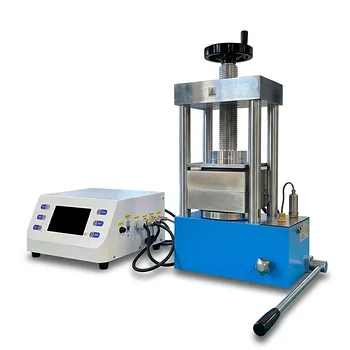
A benchtop hot press with heated platens serves as the critical instrument for inducing thermo-mechanical coupling in composite materials. By simultaneously applying high pressure (e.g., 370 MPa) and a precise temperature field (often exceeding 200°C), the equipment forces materials into a state of plastic flow. This process eliminates microscopic voids between particles, transforming loose powder mixtures into dense, unified structures.
Core Takeaway: The hot press functions by maintaining the material above its glass transition temperature ($T_g$) while applying mechanical force. This combination drives the plastic flow of electrolytes to fill particle gaps, reducing porosity to below 10% and significantly enhancing the interfacial stability and energy density of the battery.
The Mechanics of Densification
Triggering Plastic and Viscous Flow
The primary role of the heated platens is to raise the material's temperature above its glass transition temperature or melting point.
Once this thermal threshold is crossed, the material softens. The hydraulic system then applies immense pressure, causing the now-malleable material—such as sulfide glass or polymer—to exhibit plastic or viscous flow.
Minimizing Porosity
In a cold press, particles often simply lock together, leaving air gaps (pores) that impede ion transfer.
The hot press forces the softened electrolyte material to physically flow into and fill these interstitial gaps. This rapid densification creates a pore-free, three-dimensional network structure, which is essential for maximizing ionic conductivity.
Material-Specific Roles
Densifying Sulfide Glass Composites
For sulfide-based materials, the equipment typically operates at higher pressures to achieve optimal density.
The "thermo-mechanical" environment promotes the flow of sulfide glass, ensuring it fully coats the cathode particles. This results in interfacial contact stability, preventing the physical separation of layers that often leads to battery failure.
Fabricating Polymer (PEO) Electrolytes
When working with polymers like PEO, the hot press acts as a solvent-free reactor.
It melts the polymer matrix, allowing it to achieve molecular-level bonding with lithium salts and plasticizers. This produces a flexible, mechanically strong film with controllable thickness (e.g., 70–100 μm) without the use of chemical solvents.
The Advantage of Solvent-Free Processing
Eliminating Residual Solvents
Traditional casting methods often leave behind trace solvents that degrade battery performance.
A benchtop hot press enables dry film formation. By utilizing the thermoplasticity of the polymer, it presses mixed powders directly into a film. This avoids the negative electrochemical side effects caused by residual casting solvents.
Precision Microstructure Control
The equipment allows for exact control over the film's architecture.
By regulating the specific pressure (e.g., 10 MPa for polymers vs. 370 MPa for sulfides) and temperature, researchers can fine-tune the mechanical strength and thickness of the electrolyte membrane, tailoring it to specific energy density requirements.
Understanding the Trade-offs
Thermal Sensitivity
While heat aids densification, precise control is non-negotiable.
Exceeding the optimal temperature range can degrade sensitive lithium salts or cause phase separation in the composite. The "role" of the machine is only as effective as the thermal stability of the materials being pressed.
Pressure Uniformity
A benchtop unit provides high force, but ensuring that force is distributed perfectly evenly across the platen is critical.
Uneven pressure can lead to density gradients within the cathode or electrolyte, creating localized hotspots or areas of high resistance that compromise the final cell performance.
Making the Right Choice for Your Goal
When utilizing a hot press for solid-state battery fabrication, tailor your approach to the material chemistry:
- If your primary focus is Sulfide Electrolytes: Prioritize high-pressure capabilities (up to 370 MPa) to force plastic flow and reduce porosity to <10% for maximum energy density.
- If your primary focus is Polymer (PEO) Systems: Prioritize precise temperature control to enable solvent-free melting and molecular bonding without degrading the lithium salts.
- If your primary focus is Microstructure Control: Leverage the equipment to produce dry, self-supporting films with specific thickness targets (e.g., 70-100 μm) to replace wet casting methods.
Ultimately, the benchtop hot press replaces chemical bonding with physical fusion, creating the dense, cohesive interfaces required for viable solid-state batteries.
Summary Table:
| Feature | Sulfide-Based Electrolytes | Polymer (PEO) Electrolytes |
|---|---|---|
| Primary Role | Inducing plastic flow in sulfide glass | Solvent-free melting and molecular bonding |
| Typical Pressure | High (Up to 370 MPa) | Low to Moderate (~10 MPa) |
| Key Outcome | Reduced porosity (<10%) and interfacial stability | Uniform dry films (70–100 μm) without residues |
| Mechanism | Filling interstitial gaps via pressure | Thermoplasticity-driven film formation |
Elevate Your Battery Research with KINTEK Precision
Unlock the full potential of your solid-state battery fabrication with KINTEK’s high-performance hydraulic hot presses. Whether you are developing sulfide-based composites or solvent-free polymer electrolytes, our laboratory systems provide the uniform heat and immense pressure required to achieve theoretical density and superior interfacial contact.
Our value to your lab:
- Versatile Systems: From precision manual pellet presses to advanced heated platen systems.
- Total Solutions: Explore our full range of high-temperature furnaces, crushing systems, and specialized battery research tools.
- Reliable Performance: Ensure repeatable microstructure control and eliminate residual solvents.
Ready to optimize your densification process? Contact KINTEK today for a consultation and quote!
Related Products
- Automatic Heated Hydraulic Press Machine with Heated Plates for Laboratory Hot Press 25T 30T 50T
- Heated Hydraulic Press Machine with Heated Plates Split Manual Laboratory Hot Press
- Automatic High Temperature Heated Hydraulic Press Machine with Heated Plates for Lab
- Manual High Temperature Heated Hydraulic Press Machine with Heated Plates for Lab
- 24T 30T 60T Heated Hydraulic Press Machine with Heated Plates for Laboratory Hot Press
People Also Ask
- Why is the heating function of a laboratory hydraulic press essential for MEA assembly in DEFC? Optimize Cell Bonding
- What technical conditions does a heated hydraulic press provide for PEO batteries? Optimize Solid-State Interfaces
- How is a heated hydraulic press used for Li-LLZO batteries? Optimize Interfacial Bonding with Thermal-Pressure
- What role does a heated hydraulic press play in Cold Sintering (CSP)? Enhancing LATP-Halide Densification
- What are heated hydraulic presses used for? Molding Composites, Vulcanizing Rubber, and More