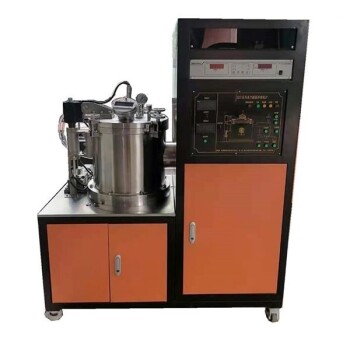
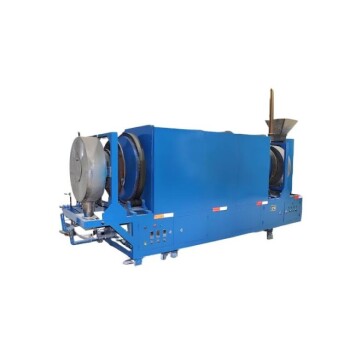
The multi-stage zone refining furnace serves as the foundational purification step in the production of detector-grade Thallium Bromide (TlBr). It operates by exploiting the difference in how impurities distribute themselves between the molten and solid states of the material, systematically segregating contaminants to ensure the raw material achieves the "deep purification" necessary for high-performance electronics.
Core Insight While later processing steps determine the shape and density of the crystal, the zone refining furnace dictates its chemical integrity. By performing multiple heating and cooling cycles, it pushes impurities to the material's extremities, creating the ultra-pure baseline required for growing crystals capable of sensitive photon-counting.
The Mechanism of Purification
Exploiting Distribution Coefficients
The furnace relies on a fundamental physical principle: impurities have different solubility levels in liquid TlBr compared to solid TlBr. This ratio is known as the distribution coefficient.
When a specific zone of the material is melted and then slowly solidified, impurities are naturally rejected by the forming crystal lattice. They remain in the molten zone, effectively being "dragged" along with the heat source.
The Role of Multiple Cycles
A single pass is rarely sufficient to achieve detector-grade purity. The "multi-stage" aspect refers to performing these heating and cooling cycles repeatedly.
With each cycle, the concentration of impurities at one end of the ingot increases, while the remaining material becomes progressively purer. This iterative process achieves a level of deep purification that simple melting cannot match.
Enabling Detector Performance
Prerequisite for Crystal Growth
High-quality TlBr detectors act as photon counters, translating incoming radiation into distinct electrical signals. This requires a crystal lattice free of chemical contaminants that could trap charge carriers.
The primary reference establishes that the high purity achieved by this furnace is a strict prerequisite for growing these high-performance crystals. Without this initial deep cleaning, the material would lack the electronic properties needed for accurate radiation sensing.
Integration into the Production Workflow
Preparing for Densification
It is critical to understand where this furnace fits in the wider manufacturing context. Zone refining produces purified raw materials, which are the essential input for subsequent processing steps like Hot Pressing.
While the furnace handles chemical purity, subsequent equipment (the hot press) handles physical structure. The hot press applies high pressure (approx. 30 kN) and temperature (455-465°C) to these refined materials.
Ensuring Structural Consistency
If the raw material is not purified first in the zone refining furnace, the hot press would simply densify impure material.
The furnace ensures that when the hot press eventually eliminates internal defects and controls crystal orientation, it is working with a chemically pure substance. This sequence ensures the final detector has both high energy resolution and high detection efficiency.
Understanding the Constraints
Yield vs. Purity
The fundamental trade-off of zone refining is material yield. Because the furnace concentrates impurities at one specific end of the ingot, that contaminated section must eventually be removed and discarded. To achieve higher purity, a larger portion of the raw material may effectively become waste.
Processing Time
This is not a rapid process. Moving impurities through a solid ingot requires slow, controlled migration of the molten zone over multiple cycles. It is a time-intensive investment required to secure the baseline quality of the semiconductor.
Making the Right Choice for Your Goal
To obtain high-quality TlBr detectors, you must balance chemical purification with physical densification.
- If your primary focus is energy resolution and electronic performance: Prioritize the cycle count and control within the zone refining furnace, as this step removes the chemical impurities that cause signal noise.
- If your primary focus is geometric accuracy and mechanical density: Ensure your hot pressing parameters are precise (30 kN at ~460°C), but remember that this step cannot correct chemical impurities missed during refining.
Summary: The multi-stage zone refining furnace is the non-negotiable gatekeeper of quality, stripping away chemical impurities so that subsequent manufacturing steps can produce a structurally sound and electrically sensitive detector.
Summary Table:
| Feature | Description | Impact on TlBr Quality |
|---|---|---|
| Mechanism | Exploits distribution coefficients between liquid/solid phases | Effectively segregates and removes chemical impurities |
| Multi-Stage Cycles | Repeated heating and cooling passes | Achieves the ultra-pure baseline for detector-grade material |
| Purification Depth | Deep chemical cleaning of the raw ingot | Essential prerequisite for high energy resolution |
| Workflow Position | Pre-processing before Hot Pressing | Ensures subsequent densification works with pure material |
| Process Trade-off | Time-intensive migration of molten zones | Necessary investment for high electronic sensitivity |
Elevate Your Material Purity with KINTEK
High-performance radiation detectors demand nothing less than absolute chemical integrity. KINTEK specializes in advanced laboratory equipment designed for the most rigorous purification and synthesis workflows. From our precision multi-stage zone refining furnaces to our high-pressure hot pressing systems (up to 30 kN), we provide the tools necessary to achieve deep purification and structural consistency in TlBr and other semiconductor materials.
Whether you are refining raw materials or densifying crystals, KINTEK offers a comprehensive range of:
- High-temperature furnaces (Vacuum, Tube, Muffle)
- Hydraulic & Hot Presses for material densification
- Consumables including high-purity ceramics and crucibles
Ready to optimize your semiconductor production? Contact our technical experts today to discuss how our tailored solutions can enhance your research and manufacturing outcomes.
References
- Ashkan Ajeer, Robert Moss. A step closer to a benchtop x-ray diffraction computed tomography (XRDCT) system. DOI: 10.21175/rad.abstr.book.2023.21.2
This article is also based on technical information from Kintek Solution Knowledge Base .
Related Products
- Multi-zone Laboratory Tube Furnace
- Multi Heating Zones CVD Tube Furnace Machine Chemical Vapor Deposition Chamber System Equipment
- 2200 ℃ Tungsten Vacuum Heat Treat and Sintering Furnace
- Rotary Tube Furnace Split Multi Heating Zone Rotating Tube Furnace
- Horizontal High Temperature Graphite Vacuum Graphitization Furnace
People Also Ask
- What are the advantages of a multi-zone tube furnace for Sb2S3? Unlock Superior Semiconductor Thin Film Purity
- How does the temperature control precision of a laboratory tube furnace affect the quality of grown single crystals?
- What role does a laboratory tube furnace play in the high-temperature calcination of LaPrO3+x catalyst precursors? Guide
- What is the role of a laboratory tube furnace in zeolite nitridation? Precision Engineering for Advanced Catalysts
- How does a laboratory tube furnace provide atmospheric control during the sintering of glass-ceramics? Achieve Precision