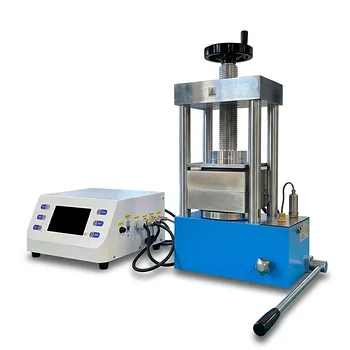
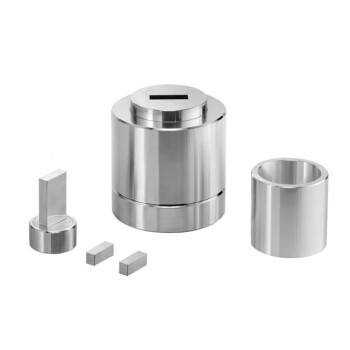
Laboratory hydraulic pressing equipment serves as the critical forming mechanism used to convert flat metallic plates into precise U-bend specimens for corrosion evaluation. By utilizing specialized bending dies, the press applies controlled force to pre-form stainless steel plates, which are subsequently secured with bolts to maintain a state of constant tensile stress.
Core Takeaway The hydraulic press enables the accurate simulation of industrial residual stresses by mechanically deforming materials into a fixed U-shape. This creates a standardized environment for evaluating Stress Corrosion Cracking (SCC) without introducing the variables of dynamic plastic deformation.
The Mechanics of Specimen Preparation
Precise Deformation
The process begins with a flat stainless steel plate. The laboratory hydraulic press, fitted with specific bending dies, applies significant, controlled pressure to bend the plate into a uniform U-geometry.
Establishing Constant Tension
Once the press has formed the shape, the specimen is mechanically secured using bolts. This step effectively "locks in" the deformation caused by the press.
Creating the Stress State
The combination of hydraulic bending and subsequent bolting generates a permanent state of constant tensile stress across the curvature of the specimen. This stress is the active variable utilized during the corrosion test.
Simulating Real-World Conditions
Replicating Industrial Environments
The U-bend method is not an abstract test; it is designed to mimic specific industrial realities. It replicates the residual stresses and loads commonly found in heavy infrastructure, such as heat exchanger tube bundles and reactor internals.
Evaluating Stress Corrosion Cracking (SCC)
The primary objective of this preparation method is to test for Stress Corrosion Cracking. By exposing the pre-stressed U-bend to corrosive environments, engineers can determine how the material will behave when subjected to both tension and chemical attack simultaneously.
Understanding the Trade-offs
Static vs. Dynamic Evaluation
The U-bend test focuses exclusively on static stress. As noted in the primary methodology, this allows for evaluation in the absence of dynamic plastic deformation.
Limitation of Scope
While this method is excellent for simulating constant loads (like those in bolted assemblies or welded joints), it does not predict material behavior under fatigue conditions or fluctuating stress cycles. It creates a "worst-case scenario" for static tension, not active mechanical wear.
Making the Right Choice for Your Goal
To ensure your testing protocol aligns with your material requirements, consider the following:
- If your primary focus is Industrial Simulation: Prioritize the U-bend method to replicate the residual stresses found in heat exchangers and reactor components.
- If your primary focus is Static Stress Resistance: Use this preparation technique to isolate Stress Corrosion Cracking (SCC) performance without the noise of dynamic deformation variables.
By precisely forming the material before locking it into tension, the hydraulic press transforms a simple metal plate into a high-fidelity predictor of long-term industrial reliability.
Summary Table:
| Feature | Role in U-Bend Preparation |
|---|---|
| Equipment Type | Laboratory Hydraulic Press |
| Mechanism | Controlled mechanical deformation using specialized dies |
| Specimen Geometry | High-precision U-shape for standardized testing |
| Primary Stress State | Constant tensile stress (Static) |
| Primary Test Objective | Stress Corrosion Cracking (SCC) evaluation |
| Industrial Application | Simulating residual stress in heat exchangers & reactors |
Optimize Your Corrosion Testing with KINTEK Precision
Ensure the highest accuracy in your Stress Corrosion Cracking (SCC) evaluations with KINTEK’s advanced laboratory solutions. Our precision hydraulic presses (pellet, hot, and isostatic) are designed to deliver the controlled force required for consistent U-bend specimen preparation, while our high-temperature high-pressure reactors and autoclaves provide the perfect environment for rigorous corrosion testing. From crushing and milling systems to essential PTFE and ceramic consumables, KINTEK specializes in equipping modern labs with the tools needed for industrial-grade material analysis.
Ready to enhance your lab's reliability? Contact our experts today to find the ideal equipment for your research and production needs.
References
- Marina Cabrini, Roberta Miglio. Study of the Corrosion Resistance of Austenitic Stainless Steels during Conversion of Waste to Biofuel. DOI: 10.3390/ma10030325
This article is also based on technical information from Kintek Solution Knowledge Base .
Related Products
- Laboratory Manual Hydraulic Pellet Press for Lab Use
- Automatic Laboratory Hydraulic Pellet Press Machine for Lab Use
- Laboratory Hydraulic Press Split Electric Lab Pellet Press
- Laboratory Manual Hydraulic Pellet Press for Lab Use
- Manual Lab Heat Press
People Also Ask
- What is the role of a laboratory hydraulic pellet press and stainless steel molds in the fabrication of RuO2/NbC anodes?
- How does a laboratory hydraulic pellet press contribute to SiCw/2024 aluminum composite preforms? Optimize Densification
- What is the significance of applying 200 MPa of pressure with a laboratory hydraulic pellet press for composite ceramics?
- What is the necessity of using a laboratory hydraulic pellet press in the preparation of biomass fuel pellets? Guide
- What key role does a laboratory pellet press play in FTIR analysis? Master KBr Sample Preparation Excellence