Knowledge What temperature is aluminum sintering? Master the 550°C-650°C Window for Strong Parts
Author avatar

Tech Team · Kintek Solution

Updated 2 weeks ago

What temperature is aluminum sintering? Master the 550°C-650°C Window for Strong Parts


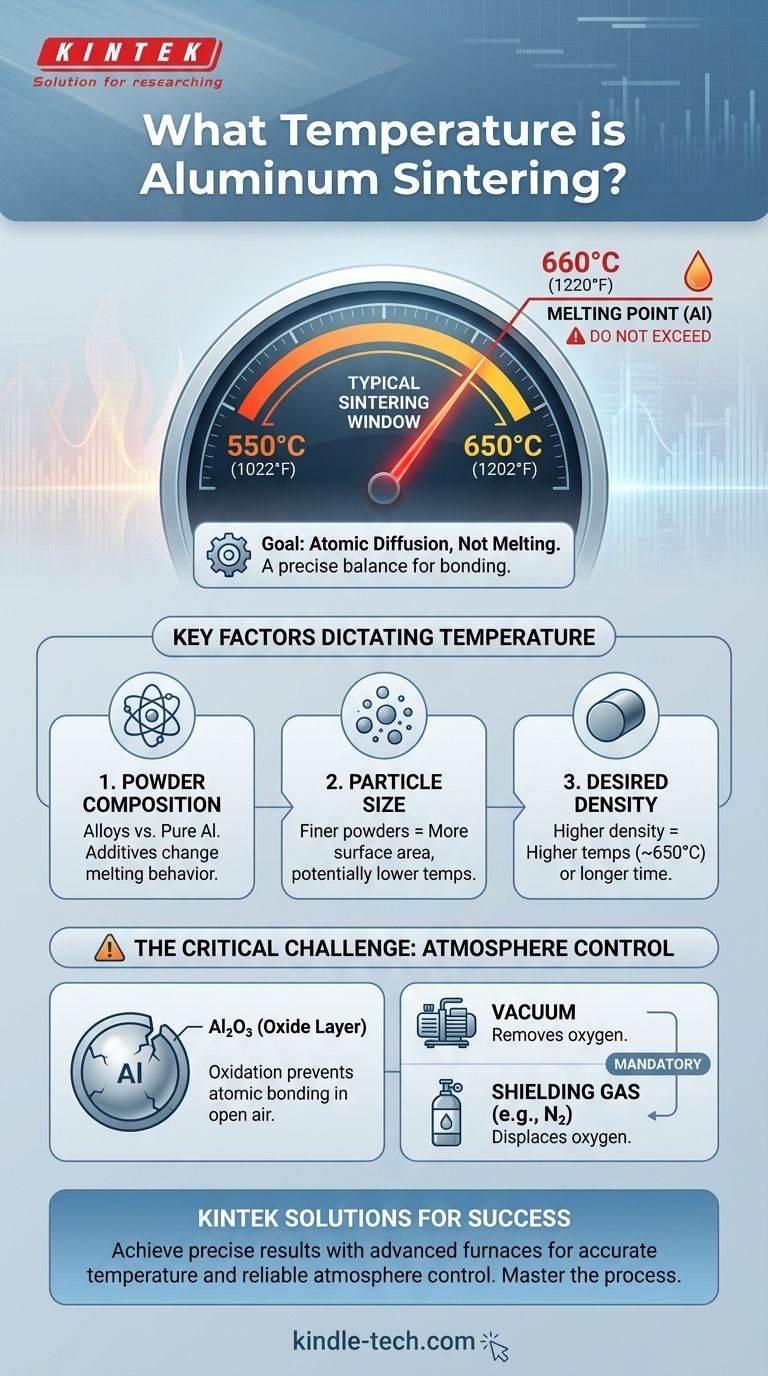
The typical sintering temperature for aluminum falls within a precise window of approximately 550°C to 650°C (1022°F to 1202°F). This temperature is intentionally kept just below aluminum's melting point of 660°C. The exact temperature required is not a fixed number but is highly dependent on the specific characteristics of the aluminum powder and the desired properties of the final component.

Successful aluminum sintering is less about hitting a single magic number and more about carefully managing the relationship between temperature, material properties, and atmospheric conditions to achieve atomic bonding without melting.
What temperature is aluminum sintering? Master the 550°C-650°C Window for Strong Parts

The Science of Aluminum Sintering

Sintering is a thermal process that fuses powder particles into a solid mass using heat, but without melting the material into a liquid state. This is crucial for creating parts with specific porosity or near-net shapes directly from powder.

The Goal: Atomic Diffusion

The heat applied during sintering gives the atoms within the aluminum particles enough energy to move. This movement, known as atomic diffusion, allows atoms to migrate across the boundaries of adjacent particles, forming strong metallic bonds and fusing the powder together.

Why Temperature Varies

The ideal sintering temperature is a function of several variables. Simply setting a furnace to a generic temperature without considering these factors will lead to inconsistent and unreliable results.

Key Factors That Dictate Sintering Temperature

To achieve the desired outcome, you must adjust the temperature based on the unique properties of your starting material and your end goal.

Powder Composition

Pure aluminum sinters differently than aluminum alloys. The addition of other elements (like copper, magnesium, or silicon) changes the material's melting behavior and the rate of diffusion, requiring adjustments to the sintering temperature.

Particle Size and Distribution

Powders with smaller particles have a much higher surface-area-to-volume ratio. This increased surface area provides more pathways for atomic diffusion, often allowing for effective sintering at the lower end of the temperature range or for shorter cycle times.

Desired Degree of Sintering

The final density and strength required for the component directly influence the process. Achieving a higher density typically requires operating at the higher end of the temperature range (closer to 650°C) or holding the temperature for a longer period to allow for more complete diffusion.

Common Pitfalls and Critical Considerations

Temperature is only one part of the equation. For a metal as reactive as aluminum, the processing atmosphere is just as critical.

The Oxidation Challenge

Aluminum instantly reacts with oxygen in the air to form a very thin but extremely tough and stable layer of aluminum oxide (Al₂O₃). This oxide layer has a much higher melting point than aluminum itself and acts as a barrier, preventing the direct metal-to-metal contact necessary for atomic diffusion.

The Absolute Need for a Controlled Atmosphere

To overcome the oxidation problem, aluminum sintering must be performed in a controlled atmosphere. Attempting to sinter aluminum in open air will fail.

The two primary methods are:

  1. Vacuum: Performing the process in a vacuum furnace removes the oxygen, preventing the oxide layer from forming.
  2. Shielding Gas: Using an inert or specific shielding gas (like nitrogen or an endothermic gas) displaces the oxygen, protecting the aluminum particles as they are heated.

How to Apply This to Your Project

Your specific goal will determine your approach to the sintering process.

  • If your primary focus is achieving maximum part density: Plan to operate at the higher end of the 550°C to 650°C range and ensure you are using a high-quality vacuum or a pure, dry shielding gas.
  • If your primary focus is working with a specific aluminum alloy: You must obtain the technical data sheet for that specific alloy, as its ideal sintering window may be significantly different from that of pure aluminum.
  • If your primary focus is process efficiency: Carefully analyze the trade-off between particle size, temperature, and time. Finer powders may allow for slightly lower temperatures or shorter cycles, but are often more expensive.

Ultimately, successful aluminum sintering is a precise balancing act between temperature, time, material characteristics, and atmospheric control.

Summary Table:

Factor Impact on Sintering Temperature
Powder Composition Alloys require different temperatures than pure aluminum.
Particle Size Finer powders may allow for sintering at lower temperatures.
Desired Density Higher density parts need temperatures at the higher end of the range (~650°C).
Atmosphere Control Critical for success; vacuum or shielding gas is mandatory to prevent oxidation.

Achieve precise and reliable aluminum sintering results.

Navigating the precise temperature window and critical atmosphere controls for aluminum sintering is complex. KINTEK specializes in providing the advanced lab furnaces and expert support you need to master this process.

Our sintering furnaces offer the precise temperature control and reliable vacuum or gas atmospheres required to successfully bond aluminum powders without melting or oxidation. Whether you are working on R&D or production, we provide the equipment and consumables to ensure your success.

Contact us today to discuss your specific aluminum sintering requirements and how our solutions can enhance your lab's capabilities and efficiency. Get in touch with our experts now!

Visual Guide
What temperature is aluminum sintering? Master the 550°C-650°C Window for Strong Parts Visual Guide

Related Products

People Also Ask

Related Products

Vacuum Heat Treat Furnace with Ceramic Fiber Liner

Vacuum Heat Treat Furnace with Ceramic Fiber Liner

Vacuum furnace with polycrystalline ceramic fiber insulation liner for excellent heat insulation and uniform temperature field. Choose from 1200℃ or 1700℃ max. working temperature with high vacuum performance and precise temperature control.

Vacuum Heat Treat Sintering Brazing Furnace

Vacuum Heat Treat Sintering Brazing Furnace

A vacuum brazing furnace is a type of industrial furnace used for brazing, a metalworking process that joins two pieces of metal using a filler metal that melts at a lower temperature than the base metals. Vacuum brazing furnaces are typically used for high-quality applications where a strong, clean joint is required.

Vacuum Heat Treat and Sintering Furnace with 9MPa Air Pressure

Vacuum Heat Treat and Sintering Furnace with 9MPa Air Pressure

The air pressure sintering furnace is a high-tech equipment commonly used for the sintering of advanced ceramic materials. It combines vacuum sintering and pressure sintering techniques to achieve high-density and high-strength ceramics.

Molybdenum Vacuum Heat Treat Furnace

Molybdenum Vacuum Heat Treat Furnace

Discover the benefits of a high-configuration molybdenum vacuum furnace with heat shield insulation. Ideal for high-purity, vacuum environments like sapphire crystal growth and heat treatment.

1400℃ Laboratory Quartz Tube Furnace with Alumina Tube Tubular Furnace

1400℃ Laboratory Quartz Tube Furnace with Alumina Tube Tubular Furnace

Looking for a tube furnace for high-temperature applications? Our 1400℃ Tube Furnace with Alumina Tube is perfect for research and industrial use.

High Pressure Laboratory Vacuum Tube Furnace Quartz Tubular Furnace

High Pressure Laboratory Vacuum Tube Furnace Quartz Tubular Furnace

KT-PTF High Pressure Tube Furnace: Compact split tube furnace with strong positive pressure resistance. Working temp up to 1100°C and pressure up to 15Mpa. Also works under controller atmosphere or high vacuum.

Vacuum Heat Treat and Molybdenum Wire Sintering Furnace for Vacuum Sintering

Vacuum Heat Treat and Molybdenum Wire Sintering Furnace for Vacuum Sintering

A vacuum molybdenum wire sintering furnace is a vertical or bedroom structure, which is suitable for withdrawal, brazing, sintering and degassing of metal materials under high vacuum and high temperature conditions. It is also suitable for dehydroxylation treatment of quartz materials.

Laboratory Muffle Oven Furnace Bottom Lifting Muffle Furnace

Laboratory Muffle Oven Furnace Bottom Lifting Muffle Furnace

Efficiently produce batches with excellent temperature uniformity using our Bottom Lifting Furnace. Features two electric lifting stages and advanced temperature control up to 1600℃.

Vertical High Temperature Graphite Vacuum Graphitization Furnace

Vertical High Temperature Graphite Vacuum Graphitization Furnace

Vertical high temperature graphitization furnace for carbonization and graphitization of carbon materials up to 3100℃.Suitable for shaped graphitization of carbon fiber filaments and other materials sintered in a carbon environment.Applications in metallurgy, electronics, and aerospace for producing high-quality graphite products like electrodes and crucibles.

600T Vacuum Induction Hot Press Furnace for Heat Treat and Sintering

600T Vacuum Induction Hot Press Furnace for Heat Treat and Sintering

Discover the 600T Vacuum Induction Hot Press Furnace, designed for high-temperature sintering experiments in vacuum or protected atmospheres. Its precise temperature and pressure control, adjustable working pressure, and advanced safety features make it ideal for nonmetal materials, carbon composites, ceramics, and metal powders.

1700℃ Laboratory Quartz Tube Furnace with Alumina Tube Tubular Furnace

1700℃ Laboratory Quartz Tube Furnace with Alumina Tube Tubular Furnace

Looking for a high-temperature tube furnace? Check out our 1700℃ Tube Furnace with Alumina Tube. Perfect for research and industrial applications up to 1700C.

Vacuum Hot Press Furnace Heated Vacuum Press Machine Tube Furnace

Vacuum Hot Press Furnace Heated Vacuum Press Machine Tube Furnace

Reduce forming pressure & shorten sintering time with Vacuum Tube Hot Press Furnace for high-density, fine-grain materials. Ideal for refractory metals.

1200℃ Split Tube Furnace with Quartz Tube Laboratory Tubular Furnace

1200℃ Split Tube Furnace with Quartz Tube Laboratory Tubular Furnace

KT-TF12 split tube furnace: high-purity insulation, embedded heating wire coils, and max. 1200C. Widely used for new materials and chemical vapour deposition.

1700℃ Muffle Oven Furnace for Laboratory

1700℃ Muffle Oven Furnace for Laboratory

Get superior heat control with our 1700℃ Muffle Furnace. Equipped with intelligent temperature microprocessor, TFT touch screen controller & advanced insulation materials for precise heating up to 1700C. Order now!

1800℃ Muffle Oven Furnace for Laboratory

1800℃ Muffle Oven Furnace for Laboratory

KT-18 muffle furnace with Japan Al2O3 polycrystalline fibe and Silicon Molybdenum heating element, up to 1900℃, PID temperature control and 7" smart touch screen. Compact design, low heat loss, and high energy efficiency. Safety interlock system and versatile functions.

Vacuum Dental Porcelain Sintering Furnace

Vacuum Dental Porcelain Sintering Furnace

Get precise and reliable results with KinTek's Vacuum Porcelain Furnace. Suitable for all porcelain powders, it features hyperbolic ceramic furnace function, voice prompt, and automatic temperature calibration.

1700℃ Controlled Atmosphere Furnace Nitrogen Inert Atmosphere Furnace

1700℃ Controlled Atmosphere Furnace Nitrogen Inert Atmosphere Furnace

KT-17A Controlled atmosphere furnace: 1700℃ heating, vacuum sealing technology, PID temperature control, and versatile TFT smart touch screen controller for laboratory and industrial use.

Vacuum Heat Treat Furnace and Levitation Induction Melting Furnace

Vacuum Heat Treat Furnace and Levitation Induction Melting Furnace

Experience precise melting with our Vacuum Levitation Melting Furnace. Ideal for high melting point metals or alloys, with advanced technology for effective smelting. Order now for high-quality results.

High Temperature Muffle Oven Furnace for Laboratory Debinding and Pre Sintering

High Temperature Muffle Oven Furnace for Laboratory Debinding and Pre Sintering

KT-MD High temperature debinding and pre-sintering furnace for ceramic materials with various molding processes. Ideal for electronic components such as MLCC and NFC.

Spark Plasma Sintering Furnace SPS Furnace

Spark Plasma Sintering Furnace SPS Furnace

Discover the benefits of Spark Plasma Sintering Furnaces for rapid, low-temperature material preparation. Uniform heating, low cost & eco-friendly.


Leave Your Message