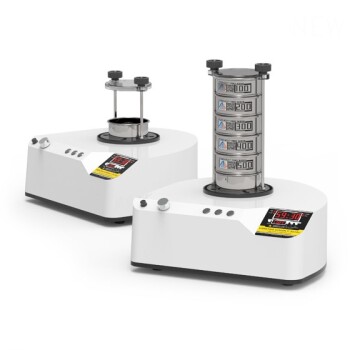
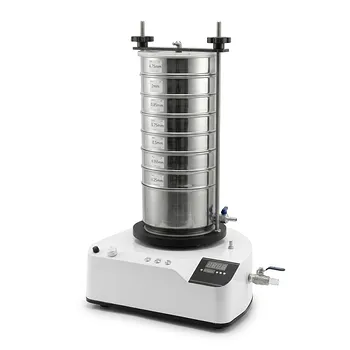
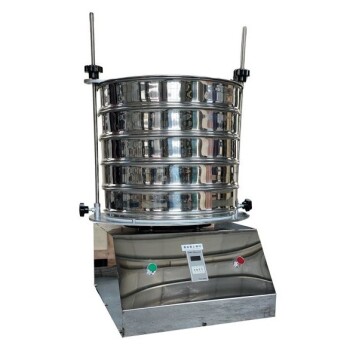
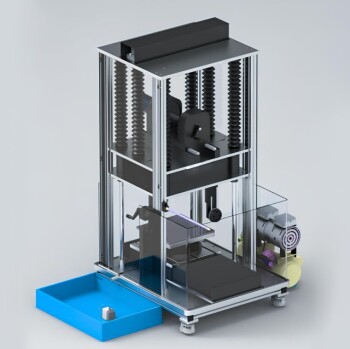
The requirement for a 250 mesh precision sieving system is driven by the critical need to strictly control particle geometry in the final Sulfated Zirconia (SZ) catalyst powder. By grading crushed particles through this specific mesh, you ensure a high degree of particle size uniformity. This physical consistency is the prerequisite for achieving uniform hydrodynamic distribution and maximizing the effective contact area required for efficient hydrocracking reactions.
Precision sieving is more than a sorting step; it is a standardization process that optimizes the trade-off between fluid dynamics and chemical reactivity within the reactor bed.
The Critical Role of Particle Uniformity
Optimizing Hydrodynamic Distribution
In a catalytic reactor, how fluids flow through the powder bed dictates performance. A 250 mesh sieve ensures that particles are uniform, preventing "channeling" where fluids bypass the catalyst.
Uniform packing creates a consistent path for reactants. This ensures the fluid contacts the catalyst evenly across the entire bed during hydrocracking.
Maximizing Effective Contact Area
The primary driver for reaction efficiency is the surface area available to the reactants. The 250 mesh system grades the particles to a size that exposes the maximum amount of active surface.
By eliminating oversized particles, you increase the surface-to-volume ratio. This directly correlates to higher reaction rates and more efficient conversion during the hydrocracking process.
Broader Implications of Precision Sieving
Preventing Internal Diffusion Limitations
While the primary focus is contact area, precise sizing also standardizes the distance reactants must travel inside the particle.
Uniform particle sizes eliminate variations in internal diffusion. This ensures that reaction kinetic data remains accurate and is not skewed by physical transport limitations within larger, irregular chunks.
Stabilizing Reactor Pressure
A catalyst bed with random particle sizes leads to unpredictable pressure drops. Fines can clog gaps, while large chunks create voids.
Sieving creates a predictable void fraction within the packed bed. This maintains a stable bed pressure drop, which is essential for consistent experimental repeatability and safe reactor operation.
Ensuring Uniform Heat Transfer
Chemical reactions often generate or consume significant heat. Irregular particle packing creates "hot spots" or "cold zones" due to uneven thermal conductivity.
A sieving system ensures uniformity that facilitates consistent heat transfer throughout the bed. This protects the catalyst from thermal degradation and ensures the reaction proceeds at the intended temperature.
Understanding the Trade-offs
The Balance of Flow vs. Area
Selecting a 250 mesh screen represents a calculated engineering decision. It balances the need for high surface area against the risk of flow restriction.
If particles are too fine (higher mesh number), the pressure drop across the reactor may become excessive, blocking flow.
The Risk of Oversized Particles
Conversely, if particles are too large (lower mesh number), the flow is easy, but efficiency plummets.
Oversized particles suffer from low effective contact area and potential heat transfer issues, rendering the hydrocracking process inefficient.
Making the Right Choice for Your Goal
To maximize the performance of your Sulfated Zirconia catalyst, apply the sieving criteria based on your specific operational constraints:
- If your primary focus is Reaction Efficiency: Prioritize strict adherence to the 250 mesh standard to maximize surface contact area and hydrodynamic uniformity.
- If your primary focus is Data Accuracy: Ensure the sieving process is rigorous to eliminate diffusion limitations and pressure fluctuations that could skew kinetic data.
Precision in the physical preparation of the catalyst is just as vital as the chemical synthesis itself.
Summary Table:
| Factor | Benefit of 250 Mesh Precision Sieving | Impact on Performance |
|---|---|---|
| Hydrodynamics | Prevents channeling and ensures uniform fluid flow | Consistent reactant contact |
| Surface Area | Maximizes surface-to-volume ratio | Higher reaction & conversion rates |
| Pressure Stability | Maintains predictable void fractions | Prevents clogging and pressure drops |
| Heat Transfer | Eliminates hot/cold spots via uniform packing | Protects catalyst from degradation |
| Kinetics | Standardizes internal diffusion distances | Accurate and repeatable experimental data |
Elevate Your Catalyst Synthesis with KINTEK Precision
Achieving the perfect 250 mesh uniformity for Sulfated Zirconia requires reliable, high-performance equipment. KINTEK specializes in advanced laboratory crushing and milling systems, alongside high-precision sieving equipment designed to meet the rigorous standards of catalyst research and hydrocracking applications.
Whether you are optimizing reactor bed dynamics or ensuring consistent heat transfer, our comprehensive portfolio—from high-temperature muffle furnaces for synthesis to hydraulic pellet presses and high-pressure reactors for testing—provides the end-to-end solutions your lab demands.
Ready to standardize your results and maximize reaction efficiency? Contact KINTEK today for expert guidance and specialized equipment.
References
- Latifah Hauli, Akhmad Syoufian. Hydrocracking of LDPE Plastic Waste into Liquid Fuel over Sulfated Zirconia from a Commercial Zirconia Nanopowder. DOI: 10.13005/ojc/350113
This article is also based on technical information from Kintek Solution Knowledge Base .
Related Products
- Three-dimensional electromagnetic sieving instrument
- Laboratory Vibratory Sieve Shaker Machine for Dry and Wet Three-Dimensional Sieving
- Laboratory Test Sieves and Sieving Machines
- Laboratory Micro Horizontal Jar Mill for Precision Sample Preparation in Research and Analysis
- 12 Inch 24 Inch High Precision Automatic Diamond Wire Cutting Machine Laboratory Saw Precision Wire EDM Cutting Machine
People Also Ask
- Why is sieving equipment essential for the classification of processed bio-activated carbon? Optimize Performance
- What are the limitations of sieving? Understanding the Constraints of Particle Size Analysis
- What are advantages and disadvantages of sieving method? A Guide to Reliable & Cost-Effective Particle Sizing
- How is sieving important? The Critical Role of Particle Size Analysis in Quality Control
- What is sieving and how does it work? A Guide to Accurate Particle Size Analysis