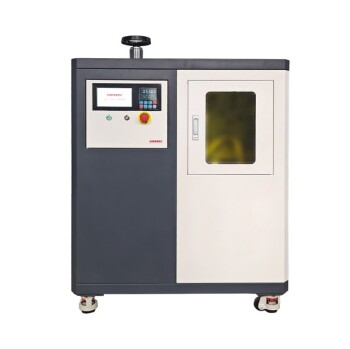
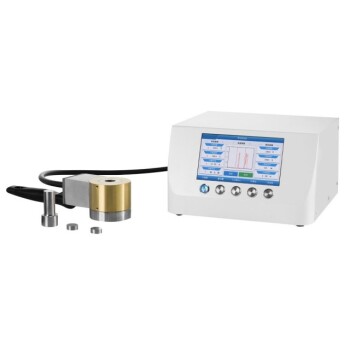
A hot press is utilized primarily to maximize the ionic conductivity of 70Li2S-30P2S5 electrolytes through superior densification. By applying temperature and pressure simultaneously, the process eliminates physical imperfections in the material structure that typically hinder performance in standard cold-pressed samples.
The core purpose of the hot press is to minimize voids and lower grain boundary resistance between particles. This mechanical and thermal consolidation creates a denser, more cohesive material, which is a prerequisite for high room-temperature ionic conductivity.
The Physics of Densification
Simultaneous Application of Heat and Pressure
The defining feature of a hot press is the concurrent application of thermal energy and mechanical force.
This dual approach acts on the 70Li2S-30P2S5 glass phase more effectively than either factor could in isolation.
It forces the material particles to reorganize and bond, creating a physically robust structure.
Reducing Voids
One of the primary barriers to ion transport in solid-state electrolytes is the presence of microscopic voids or gaps between particles.
These voids act as dead zones that disrupt the path of lithium ions.
Hot pressing effectively collapses these voids, ensuring a continuous material medium.
Optimizing Ion Transport
Lowering Grain Boundary Resistance
The interfaces between individual electrolyte particles, known as grain boundaries, often introduce significant resistance to ion flow.
If these boundaries are loose or poorly connected, the battery's overall efficiency drops.
Hot pressing promotes better contact and fusion at these interfaces, significantly reducing grain boundary resistance.
Enhancing Room-Temperature Conductivity
The ultimate metric for these electrolytes is how well they conduct ions at standard operating temperatures.
Because of the improved density and reduced resistance, hot-pressed samples exhibit higher ionic conductivity compared to those processed via other methods.
Understanding the Trade-offs
The Limitations of Cold Pressing
It is common to compare hot pressing against cold pressing (applying pressure without heat).
While cold pressing can shape the material, it often fails to achieve full densification.
The primary trade-off is that cold pressing leaves higher residual porosity and higher resistance, resulting in inferior electrochemical performance compared to the hot-pressed alternative.
Making the Right Choice for Your Goal
To maximize the performance of your solid-state electrolyte, consider your specific fabrication objectives:
- If your primary focus is maximizing ionic conductivity: Utilize hot pressing to achieve high density and ensure optimal lithium-ion transport paths.
- If your primary focus is minimizing internal resistance: Rely on the simultaneous heat and pressure of a hot press to eliminate voids and fuse grain boundaries.
The hot press is not merely a shaping tool; it is a critical processing step for unlocking the full potential of sulfide glass-ceramic electrolytes.
Summary Table:
| Feature | Cold Pressing | Hot Pressing (KINTEK Solution) |
|---|---|---|
| Application | Pressure only | Simultaneous Heat & Pressure |
| Material Density | Lower (residual porosity) | Superior (full densification) |
| Void Presence | High microscopic voids | Minimal to zero voids |
| Grain Boundary Resistance | High resistance | Significantly reduced |
| Ionic Conductivity | Moderate | Maximum performance |
Unlock the Full Potential of Your Solid-State Electrolytes
Precision in densification is the key to high-performance battery research. KINTEK specializes in advanced laboratory equipment, providing the high-performance hot presses and hydraulic pellet presses essential for optimizing 70Li2S-30P2S5 sulfide glass-ceramic electrolytes.
Our comprehensive portfolio supports every stage of your material science workflow—from crushing and milling systems and high-temperature furnaces to battery research tools and consumables. Partner with KINTEK to eliminate voids, reduce grain boundary resistance, and achieve industry-leading ionic conductivity.
Ready to elevate your material processing? Contact our laboratory specialists today for a tailored solution that drives your research forward.
Related Products
- Manual High Temperature Heated Hydraulic Press Machine with Heated Plates for Lab
- Automatic Heated Hydraulic Press Machine with Heated Plates for Laboratory Hot Press
- Touchscreen Automatic Vacuum Heat Press
- Automatic Heated Hydraulic Press Machine with Heated Plates for Laboratory Hot Press 25T 30T 50T
- Heated Hydraulic Press Machine with Heated Plates for Vacuum Box Laboratory Hot Press
People Also Ask
- What is a hot hydraulic press? Harness Heat and Pressure for Advanced Manufacturing
- What is a heated hydraulic press used for? Essential Tool for Curing, Molding, and Laminating
- Why is a heated hydraulic press used for warm pressing NASICON green tapes? Optimize Your Solid Electrolyte Density
- What does a hydraulic heat press do? Achieve Industrial-Scale, Consistent Pressure for High-Volume Production
- Why is a heated laboratory hydraulic press necessary for composite laminates? Achieve Void-Free Structural Integrity