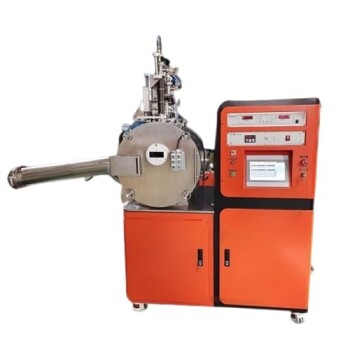
The necessity of a vacuum arc furnace with inert atmosphere protection lies in its ability to prevent the oxidative loss of highly reactive alloying elements. By utilizing a high-purity argon environment, the process shields active elements like chromium (Cr) and molybdenum (Mo) from reacting with oxygen during the melt, ensuring the final alloy retains its intended chemical composition.
Core Insight: Precision in experimental metallurgy is impossible if the raw ingredients burn off during creation. The vacuum arc furnace eliminates oxygen contamination, preserving the exact stoichiometry of the alloy. This creates a high-purity material foundation, which is the absolute prerequisite for accurately studying how specific elements, such as molybdenum, influence material properties.
Preserving Chemical Composition
The primary challenge in preparing cast duplex stainless steel model alloys is maintaining the correct ratio of elements at high temperatures.
Preventing Elemental Loss
Active elements, particularly chromium (Cr) and molybdenum (Mo), have a high affinity for oxygen.
If melted in standard atmospheric conditions, these elements would rapidly oxidize. This results in significant material loss and an unpredictable final composition.
The Role of Inert Atmosphere
To counter oxidation, the furnace employs a high-purity argon gas protection environment.
This inert gas acts as a protective blanket. It isolates the molten metal from environmental oxygen, ensuring that 100% of the added alloying elements remain within the metallic matrix.
Establishing a Research Foundation
For researchers, the validity of a study depends entirely on the quality of the starting material.
Precise Control for Variable Testing
When studying the influence of a specific element—such as the impact of Molybdenum content on corrosion resistance or strength—the base material must be exact.
If the furnace allows oxidation, the researcher cannot verify if property changes are due to the intended design or accidental impurity. The vacuum arc furnace guarantees a precise chemical composition.
Creating High-Purity Ingots
The process produces a "raw material foundation" of exceptional purity.
By eliminating oxides and impurities at the melting stage, the resulting alloy exhibits the intrinsic properties of the metal rather than the defects of the process.
Achieving Structural Uniformity
Beyond chemical protection, the physical operation of the furnace contributes to the quality of the model alloy.
Homogeneity through Process
While the primary protection is chemical (argon), the physical process involves generating high temperatures via an electric arc.
The Importance of Remelting
To ensure the alloying elements are distributed evenly, the process often involves repeated flipping and remelting of the alloy button ingots.
This mechanical repetition, performed under the safety of the inert atmosphere, ensures the button ingot has a highly uniform chemical composition throughout its structure.
Understanding the Trade-offs
While the vacuum arc furnace is superior for purity, it is important to understand the operational context compared to other methods.
Scale vs. Precision
Vacuum arc melting is ideal for creating small, precise "button ingots" for research.
It is distinct from high-frequency induction melting, which relies on electromagnetic induction and inherent stirring for larger-scale homogenization.
Operational Requirements
The requirement for a vacuum system and high-purity gas creates a more complex operational baseline than open-air melting.
However, for chemically sensitive alloys like duplex stainless steel, this complexity is a mandatory cost of quality.
Making the Right Choice for Your Goal
The choice of melting equipment dictates the reliability of your data.
- If your primary focus is fundamental research: You must use a vacuum arc furnace to ensure the exact retention of volatile elements like Cr and Mo for accurate property correlation.
- If your primary focus is structural homogeneity: You should employ a protocol of repeated flipping and remelting within the protected atmosphere to guarantee a uniform ingot.
Ultimately, the vacuum arc furnace is not just a heating tool; it is a containment system that freezes the chemical design of your alloy into physical reality.
Summary Table:
| Feature | Vacuum Arc Furnace (Inert Atmosphere) | Impact on Alloy Quality |
|---|---|---|
| Environment | High-purity Argon Gas | Prevents oxidation of Cr, Mo, and other active elements. |
| Chemical Control | Vacuum-sealed Chamber | Preserves exact stoichiometry and prevents contamination. |
| Uniformity | Repeated Flipping/Remelting | Ensures homogeneous distribution of alloying elements. |
| Material Purity | Oxide-free Melting | Creates a high-purity foundation for accurate research. |
| Application | Small-scale Button Ingots | Ideal for precision experimental metallurgy and model alloys. |
Elevate Your Material Research with KINTEK Precision
Don't let oxidation compromise your experimental data. KINTEK specializes in advanced laboratory equipment designed for the most demanding metallurgical applications. Our range of high-temperature furnaces, including specialized vacuum arc furnaces and atmosphere-controlled systems, ensures your alloys maintain their intended chemical integrity and structural uniformity.
Whether you are developing duplex stainless steel or exploring advanced battery research, KINTEK provides the high-performance tools you need—from crushing and milling systems to high-pressure reactors and dental furnaces.
Ready to achieve superior purity in your next melt? Contact KINTEK today to consult with our experts on the perfect furnace solution for your laboratory.
References
- Shilei Li, Xitao Wang. Influence of Mo Additions on the Mechanical Properties of Cast Duplex Stainless Steels before and after Thermal Aging. DOI: 10.3390/met9030295
This article is also based on technical information from Kintek Solution Knowledge Base .
Related Products
- Vacuum Arc Induction Melting Furnace
- Non Consumable Vacuum Arc Induction Melting Furnace
- Vacuum Induction Melting Spinning System Arc Melting Furnace
- Vacuum Hot Press Furnace Heated Vacuum Press Machine Tube Furnace
- Vacuum Sealed Continuous Working Rotary Tube Furnace Rotating Tube Furnace
People Also Ask
- How do vacuum induction or arc melting furnaces facilitate the synthesis of U-Al-C MAX phases? Precision Heat & Purity
- What core role does a Vacuum Induction Melting furnace play in nickel-free steel production? Achieve High-Purity Alloys
- What is the primary function of a vacuum arc melting furnace in RHEA preparation? Achieving Extreme Thermal Fusion
- What is the function of a vacuum arc melting furnace? Master Homogeneity for Amorphous Alloy Ribbons
- What is the function of a vacuum arc melting furnace? Prepare High-Purity Alx(CrFeNi)1-x High-Entropy Alloys