Knowledge Why is high frequency needed for induction heating? For Precise, Surface-Level Heat Control
Author avatar

Tech Team · Kintek Solution

Updated 1 week ago

Why is high frequency needed for induction heating? For Precise, Surface-Level Heat Control


In short, high frequency is used for induction heating because it allows for precise control over where the heat is generated. A higher frequency concentrates the heating effect on the surface of a metal part, making it ideal for applications like surface hardening, brazing, or heating small components quickly and efficiently.

The core principle to understand is that frequency acts as the primary control for heating depth. Higher frequencies create shallow, precise heat near the surface, while lower frequencies penetrate deeper into the workpiece.
Why is high frequency needed for induction heating? For Precise, Surface-Level Heat Control

The Fundamental Principle: The "Skin Effect"

The relationship between frequency and heating depth is governed by a physical principle known as the "skin effect." Understanding this concept is key to mastering induction heating.

What is the Skin Effect?

When an alternating current (AC) flows through a conductor, it tends to distribute itself unevenly. More of the current flows near the outer surface, or "skin," of the conductor.

This effect becomes more pronounced as the frequency of the current increases.

How Frequency Controls Heating Depth

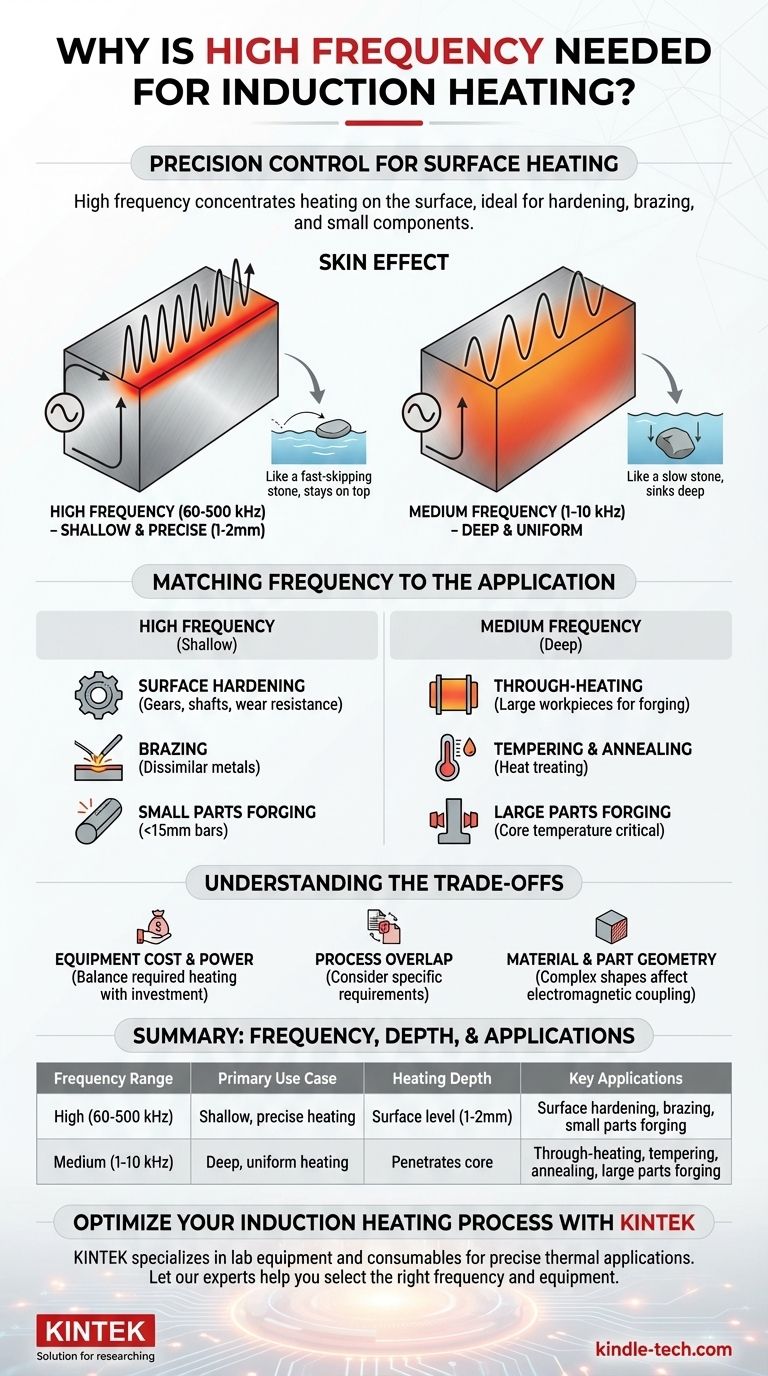
A high-frequency current stays tightly confined to the surface, generating intense heat in a very thin layer. Think of it like a fast-skipping stone that only interacts with the very top of the water.

A low or medium-frequency current penetrates much deeper into the material before generating heat. This is like a slow-moving stone that sinks deep below the surface.

The Result: Precise, Surface-Level Heat

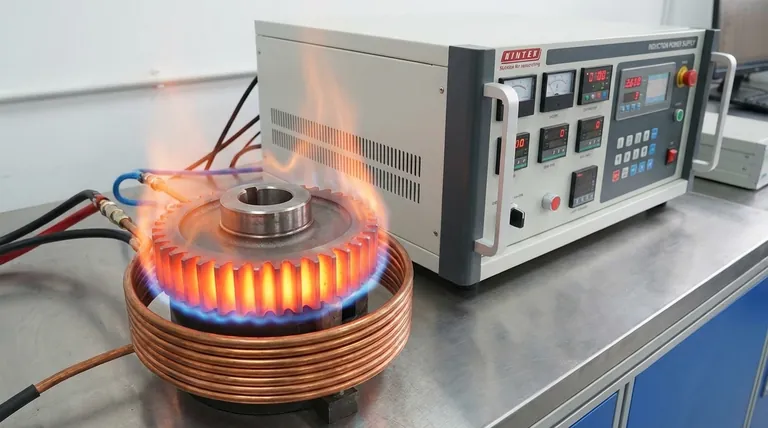
By using high frequencies, engineers can heat just the surface of a gear tooth to harden it, leaving the core tough and ductile. This precision is impossible to achieve with lower frequencies, which would heat the entire gear.

Matching Frequency to the Application

The choice between high and medium frequency is dictated entirely by the size of the part and the desired outcome of the heating process.

High Frequency (Typically 60 kHz - 500 kHz)

High-frequency induction is the tool of choice for shallow and precise heating tasks.

Its primary applications include surface hardening (quenching) where only a thin layer of 1-2mm needs to be heated, brazing dissimilar metals, and the rapid hot forging of very small parts, like bars under 15mm in diameter.

Medium Frequency (Typically 1 kHz - 10 kHz)

Medium-frequency induction is used when heat needs to penetrate deep into a part or heat a large mass uniformly.

This makes it ideal for through-heating large workpieces for forging, tempering, annealing, and any process where the core temperature of the part is just as important as the surface temperature.

Understanding the Trade-offs

Selecting the right frequency is not just a technical decision; it also involves practical and economic considerations.

Equipment Cost and Power

Generally, the equipment required to generate different frequencies comes with different costs and power capabilities. The decision must balance the required heating effect with the capital investment.

Process Overlap

For some workpieces, the lines can blur. A higher-power medium-frequency machine might achieve a similar heating effect as a lower-power high-frequency machine, so the specific process requirements must be carefully considered.

Material and Part Geometry

The material of the workpiece and its specific shape also influence how the electromagnetic field couples with it. What works for a simple steel rod may need to be adjusted for a complex gear with fine teeth.

Making the Right Choice for Your Goal

The optimal frequency is the one that best serves the engineering goal for a specific part and process.

  • If your primary focus is surface hardening, brazing, or heating small parts: High-frequency induction provides the necessary precision and speed.
  • If your primary focus is through-heating, tempering, or forging large parts: Medium-frequency induction ensures the heat penetrates deeply and uniformly.
  • If your primary focus is achieving a specific hardness depth on a complex part: You must balance frequency, power, and heating time to hit the precise target.

Ultimately, selecting the correct frequency is the most critical factor in achieving efficient, repeatable, and successful induction heating results.

Summary Table:

Frequency Range Primary Use Case Heating Depth Key Applications
High (60-500 kHz) Shallow, precise heating Surface level (1-2mm) Surface hardening, brazing, small parts forging
Medium (1-10 kHz) Deep, uniform heating Penetrates core Through-heating, tempering, annealing, large parts forging

Ready to optimize your induction heating process? KINTEK specializes in lab equipment and consumables, providing tailored solutions for precise thermal applications like surface hardening and brazing. Let our experts help you select the right frequency and equipment for your specific needs. Contact us today to enhance your lab's efficiency and achieve repeatable, high-quality results!

Visual Guide
Why is high frequency needed for induction heating? For Precise, Surface-Level Heat Control Visual Guide

Related Products

People Also Ask

Related Products

600T Vacuum Induction Hot Press Furnace for Heat Treat and Sintering

600T Vacuum Induction Hot Press Furnace for Heat Treat and Sintering

Discover the 600T Vacuum Induction Hot Press Furnace, designed for high-temperature sintering experiments in vacuum or protected atmospheres. Its precise temperature and pressure control, adjustable working pressure, and advanced safety features make it ideal for nonmetal materials, carbon composites, ceramics, and metal powders.

1700℃ Laboratory Quartz Tube Furnace with Alumina Tube Tubular Furnace

1700℃ Laboratory Quartz Tube Furnace with Alumina Tube Tubular Furnace

Looking for a high-temperature tube furnace? Check out our 1700℃ Tube Furnace with Alumina Tube. Perfect for research and industrial applications up to 1700C.

Lab-Scale Vacuum Induction Melting Furnace

Lab-Scale Vacuum Induction Melting Furnace

Get precise alloy composition with our Vacuum Induction Melting Furnace. Ideal for aerospace, nuclear energy, and electronic industries. Order now for effective smelting and casting of metals and alloys.

High Pressure Laboratory Vacuum Tube Furnace Quartz Tubular Furnace

High Pressure Laboratory Vacuum Tube Furnace Quartz Tubular Furnace

KT-PTF High Pressure Tube Furnace: Compact split tube furnace with strong positive pressure resistance. Working temp up to 1100°C and pressure up to 15Mpa. Also works under controller atmosphere or high vacuum.

Ultra-High Temperature Graphite Vacuum Graphitization Furnace

Ultra-High Temperature Graphite Vacuum Graphitization Furnace

The ultra-high temperature graphitization furnace utilizes medium frequency induction heating in a vacuum or inert gas environment. The induction coil generates an alternating magnetic field, inducing eddy currents in the graphite crucible, which heats up and radiates heat to the workpiece, bringing it to the desired temperature. This furnace is primarily used for graphitization and sintering of carbon materials, carbon fiber materials, and other composite materials.

Silicon Carbide SiC Thermal Heating Elements for Electric Furnace

Silicon Carbide SiC Thermal Heating Elements for Electric Furnace

Experience the advantages of Silicon Carbide (SiC) Heating Element: Long service life, high corrosion and oxidation resistance, fast heating speed, and easy maintenance. Learn more now!

Graphite Vacuum Furnace IGBT Experimental Graphitization Furnace

Graphite Vacuum Furnace IGBT Experimental Graphitization Furnace

IGBT experimental graphitization furnace, a tailored solution for universities and research institutions, with high heating efficiency, user-friendliness, and precise temperature control.

Graphite Vacuum Furnace High Thermal Conductivity Film Graphitization Furnace

Graphite Vacuum Furnace High Thermal Conductivity Film Graphitization Furnace

The high thermal conductivity film graphitization furnace has uniform temperature, low energy consumption and can operate continuously.

Graphite Vacuum Continuous Graphitization Furnace

Graphite Vacuum Continuous Graphitization Furnace

High-temperature graphitization furnace is a professional equipment for graphitization treatment of carbon materials. It is a key equipment for the production of high-quality graphite products. It has high temperature, high efficiency and uniform heating. It is suitable for various high-temperature treatments and graphitization treatments. It is widely used in metallurgy, electronics, aerospace, etc. industry.

Vacuum Heat Treat and Molybdenum Wire Sintering Furnace for Vacuum Sintering

Vacuum Heat Treat and Molybdenum Wire Sintering Furnace for Vacuum Sintering

A vacuum molybdenum wire sintering furnace is a vertical or bedroom structure, which is suitable for withdrawal, brazing, sintering and degassing of metal materials under high vacuum and high temperature conditions. It is also suitable for dehydroxylation treatment of quartz materials.

Electric Rotary Kiln Small Rotary Furnace Biomass Pyrolysis Plant

Electric Rotary Kiln Small Rotary Furnace Biomass Pyrolysis Plant

Learn about Rotary Biomass Pyrolysis Furnaces & how they decompose organic material at high temps without oxygen. Use for biofuels, waste processing, chemicals & more.

Vacuum Hot Press Furnace Machine for Lamination and Heating

Vacuum Hot Press Furnace Machine for Lamination and Heating

Experience clean and precise lamination with Vacuum Lamination Press. Perfect for wafer bonding, thin-film transformations, and LCP lamination. Order now!

Double Plate Heating Press Mold for Lab

Double Plate Heating Press Mold for Lab

Discover precision in heating with our Double Plate Heating Mold, featuring high-quality steel and uniform temperature control for efficient lab processes. Ideal for various thermal applications.

Dental Porcelain Zirconia Sintering Ceramic Furnace Chairside with Transformer

Dental Porcelain Zirconia Sintering Ceramic Furnace Chairside with Transformer

Experience top-notch sintering with Chairside Sintering Furnace with Transformer. Easy to operate, noise-free pallet, and automatic temperature calibration. Order now!

Three-dimensional electromagnetic sieving instrument

Three-dimensional electromagnetic sieving instrument

KT-VT150 is a desktop sample processing instrument for both sieving and grinding. Grinding and sieving can be used both dry and wet. The vibration amplitude is 5mm and the vibration frequency is 3000-3600 times/min.

Customizable High Pressure Reactors for Advanced Scientific and Industrial Applications

Customizable High Pressure Reactors for Advanced Scientific and Industrial Applications

This laboratory-scale high-pressure reactor is a high-performance autoclave engineered for precision and safety in demanding research and development environments.

Customizable PEM Electrolysis Cells for Diverse Research Applications

Customizable PEM Electrolysis Cells for Diverse Research Applications

Custom PEM test cell for electrochemical research. Durable, versatile, for fuel cells & CO2 reduction. Fully customizable. Get a quote!

Customizable CO2 Reduction Flow Cell for NRR ORR and CO2RR Research

Customizable CO2 Reduction Flow Cell for NRR ORR and CO2RR Research

The cell is meticulously crafted from high-quality materials to ensure chemical stability and experimental accuracy.


Leave Your Message