Knowledge Why is it important to determine the ash content of food? Ensure Quality, Nutrition & Authenticity
Author avatar

Tech Team · Kintek Solution

Updated 6 days ago

Why is it important to determine the ash content of food? Ensure Quality, Nutrition & Authenticity


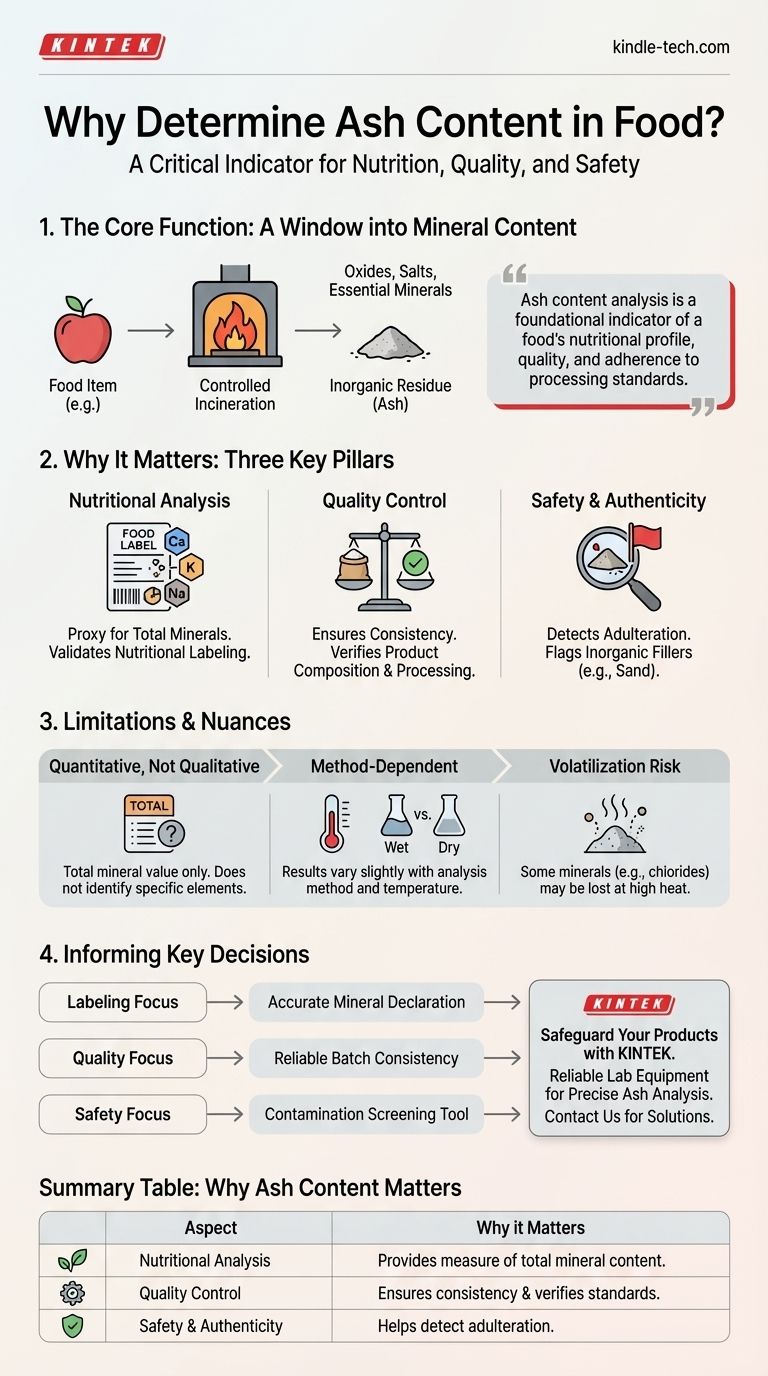
Determining the ash content of food is a fundamental analytical process used to measure the total amount of inorganic, non-combustible material. This measurement serves as a direct indicator of the total mineral content within a foodstuff. It is a critical parameter for nutrition, quality control, and ensuring product authenticity.

Ash content analysis is not simply a measure of minerals; it is a foundational indicator of a food's nutritional profile, quality, and adherence to processing standards. It provides a crucial window into the non-organic components that define a product's character and safety.
Why is it important to determine the ash content of food? Ensure Quality, Nutrition & Authenticity

The Core Function: A Window into Mineral Content

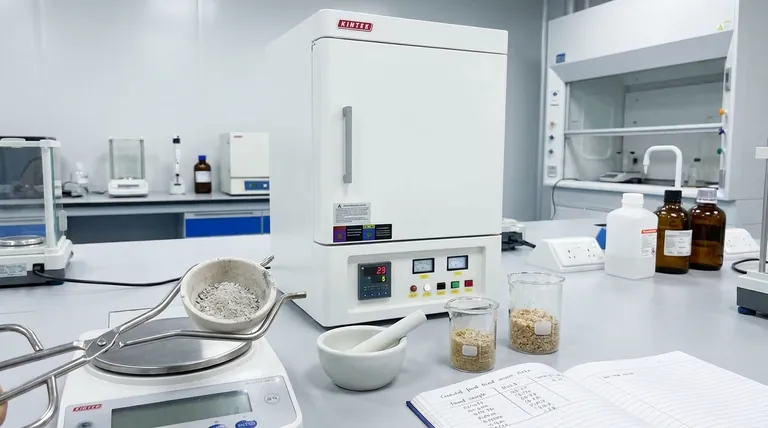
Ash analysis is a process of controlled incineration, where all organic matter (fats, proteins, carbohydrates) is burned away, leaving only the inorganic residue behind. This residue is what we refer to as "ash."

Defining "Ash"

The ash itself is the collection of oxides and salts of the inorganic elements present in the original food. This includes essential minerals like calcium, potassium, sodium, and magnesium, as well as trace elements.

A Proxy for Nutrition

The primary reason for measuring ash is to quantify the nutritional mineral content. While it doesn't identify individual minerals, the total ash value is a crucial starting point for nutritional labeling and for verifying fortification claims.

A Critical Tool for Quality Control and Consistency

Beyond nutrition, ash content is a powerful and surprisingly versatile metric for quality assurance in food production. Its value often serves as a benchmark for product identity and purity.

Verifying Product Composition

Many food products have a specific, expected ash content. For example, in flour milling, a higher ash content indicates more of the bran and germ remain, which affects the flour's quality and baking properties. Mills use this measurement to ensure their refining process is consistent.

Detecting Adulteration

An unusually high ash content can be a red flag for adulteration. The intentional addition of cheap, inorganic fillers—such as sand, chalk, or talc—to increase a product's weight would dramatically and illegally increase the ash value.

Confirming Processing Standards

Changes in processing can alter ash content. For instance, if a fruit is not peeled correctly before being turned into a puree, the resulting product may have a higher ash content due to minerals in the skin. This allows manufacturers to monitor the consistency of their production line.

Understanding the Limitations and Nuances

While incredibly useful, it's important to understand what ash analysis does and does not reveal. Objectivity requires acknowledging its limitations.

It's a Quantitative, Not Qualitative, Measure

The single most important limitation is that ash content gives a total mineral value only. It cannot distinguish between essential minerals like potassium and contaminants like lead. Further, more specific analysis is required to identify and quantify individual elements.

Method-Dependent Results

The final ash value can be slightly influenced by the analysis method used (e.g., dry ashing vs. wet ashing) and the temperature of the furnace. For this reason, consistency in testing protocol is essential for comparing results over time.

Potential for Volatilization

Certain minerals, like chlorides and nitrates, can be lost or "volatilized" at the very high temperatures used in ashing. This can lead to an underestimation of the true total mineral content, a factor that trained analysts must consider.

How Ash Content Informs Key Decisions

The application of ash analysis depends entirely on the specific goal of the test. It is a simple measurement that answers different questions for different professionals.

  • If your primary focus is nutritional labeling: Ash analysis is the first step in validating the total mineral content declared on a food panel.
  • If your primary focus is quality assurance: It serves as a reliable benchmark to ensure product consistency batch after batch, particularly in processed goods like flour, spices, and dairy powders.
  • If your primary focus is food safety and authenticity: An unexpected ash value is a powerful screening tool that can trigger deeper investigation into potential contamination or economic adulteration.

Ultimately, measuring ash content provides a simple yet powerful metric for safeguarding the nutritional value, quality, and integrity of food products.

Summary Table:

Aspect Why Ash Content Matters
Nutritional Analysis Provides a measure of total mineral content for accurate labeling.
Quality Control Ensures product consistency and verifies processing standards (e.g., in flour milling).
Safety & Authenticity Helps detect adulteration with inorganic fillers like sand or chalk.

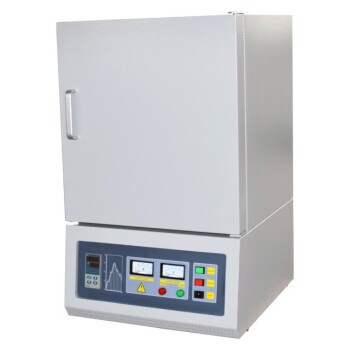
Ensure the quality and safety of your food products with precise ash content analysis. KINTEK specializes in providing reliable lab equipment for accurate food testing. Our muffle furnaces and consumables are designed to deliver consistent results for your quality control and nutritional labeling needs. Contact our experts today to find the perfect solution for your laboratory!

Visual Guide
Why is it important to determine the ash content of food? Ensure Quality, Nutrition & Authenticity Visual Guide

Related Products

People Also Ask

Related Products

1800℃ Muffle Oven Furnace for Laboratory

1800℃ Muffle Oven Furnace for Laboratory

KT-18 muffle furnace with Japan Al2O3 polycrystalline fibe and Silicon Molybdenum heating element, up to 1900℃, PID temperature control and 7" smart touch screen. Compact design, low heat loss, and high energy efficiency. Safety interlock system and versatile functions.

1700℃ Muffle Oven Furnace for Laboratory

1700℃ Muffle Oven Furnace for Laboratory

Get superior heat control with our 1700℃ Muffle Furnace. Equipped with intelligent temperature microprocessor, TFT touch screen controller & advanced insulation materials for precise heating up to 1700C. Order now!

Laboratory Muffle Oven Furnace Bottom Lifting Muffle Furnace

Laboratory Muffle Oven Furnace Bottom Lifting Muffle Furnace

Efficiently produce batches with excellent temperature uniformity using our Bottom Lifting Furnace. Features two electric lifting stages and advanced temperature control up to 1600℃.

High Temperature Muffle Oven Furnace for Laboratory Debinding and Pre Sintering

High Temperature Muffle Oven Furnace for Laboratory Debinding and Pre Sintering

KT-MD High temperature debinding and pre-sintering furnace for ceramic materials with various molding processes. Ideal for electronic components such as MLCC and NFC.

1400℃ Muffle Oven Furnace for Laboratory

1400℃ Muffle Oven Furnace for Laboratory

Get precise high-temperature control up to 1500℃ with KT-14M Muffle furnace. Equipped with a smart touch screen controller and advanced insulation materials.

Multi Zone Laboratory Quartz Tube Furnace Tubular Furnace

Multi Zone Laboratory Quartz Tube Furnace Tubular Furnace

Experience precise, efficient thermal testing with our Multi Zone Tube Furnace. Independent heating zones and temperature sensors allow for controlled high-temperature gradient heating fields. Order now for advanced thermal analysis!

Small Vacuum Heat Treat and Tungsten Wire Sintering Furnace

Small Vacuum Heat Treat and Tungsten Wire Sintering Furnace

The small vacuum tungsten wire sintering furnace is a compact experimental vacuum furnace specially designed for universities and scientific research institutes. The furnace features a CNC welded shell and vacuum piping to ensure leak-free operation. Quick-connect electrical connections facilitate relocation and debugging, and the standard electrical control cabinet is safe and convenient to operate.

Laboratory Vacuum Tilt Rotary Tube Furnace Rotating Tube Furnace

Laboratory Vacuum Tilt Rotary Tube Furnace Rotating Tube Furnace

Discover the versatility of Laboratory Rotary Furnace: Ideal for calcination, drying, sintering, and high-temperature reactions. Adjustable rotating and tilting functions for optimal heating. Suitable for vacuum and controlled atmosphere environments. Learn more now!

Graphite Vacuum Furnace High Thermal Conductivity Film Graphitization Furnace

Graphite Vacuum Furnace High Thermal Conductivity Film Graphitization Furnace

The high thermal conductivity film graphitization furnace has uniform temperature, low energy consumption and can operate continuously.

Graphite Vacuum Continuous Graphitization Furnace

Graphite Vacuum Continuous Graphitization Furnace

High-temperature graphitization furnace is a professional equipment for graphitization treatment of carbon materials. It is a key equipment for the production of high-quality graphite products. It has high temperature, high efficiency and uniform heating. It is suitable for various high-temperature treatments and graphitization treatments. It is widely used in metallurgy, electronics, aerospace, etc. industry.

Ultra-High Temperature Graphite Vacuum Graphitization Furnace

Ultra-High Temperature Graphite Vacuum Graphitization Furnace

The ultra-high temperature graphitization furnace utilizes medium frequency induction heating in a vacuum or inert gas environment. The induction coil generates an alternating magnetic field, inducing eddy currents in the graphite crucible, which heats up and radiates heat to the workpiece, bringing it to the desired temperature. This furnace is primarily used for graphitization and sintering of carbon materials, carbon fiber materials, and other composite materials.

Rotary Tube Furnace Split Multi Heating Zone Rotating Tube Furnace

Rotary Tube Furnace Split Multi Heating Zone Rotating Tube Furnace

Multi zone rotary furnace for high-precision temperature control with 2-8 independent heating zones. Ideal for lithium ion battery electrode materials and high-temperature reactions. Can work under vacuum and controlled atmosphere.

Vacuum Dental Porcelain Sintering Furnace

Vacuum Dental Porcelain Sintering Furnace

Get precise and reliable results with KinTek's Vacuum Porcelain Furnace. Suitable for all porcelain powders, it features hyperbolic ceramic furnace function, voice prompt, and automatic temperature calibration.

600T Vacuum Induction Hot Press Furnace for Heat Treat and Sintering

600T Vacuum Induction Hot Press Furnace for Heat Treat and Sintering

Discover the 600T Vacuum Induction Hot Press Furnace, designed for high-temperature sintering experiments in vacuum or protected atmospheres. Its precise temperature and pressure control, adjustable working pressure, and advanced safety features make it ideal for nonmetal materials, carbon composites, ceramics, and metal powders.

Vacuum Sealed Continuous Working Rotary Tube Furnace Rotating Tube Furnace

Vacuum Sealed Continuous Working Rotary Tube Furnace Rotating Tube Furnace

Experience efficient material processing with our vacuum-sealed rotary tube furnace. Perfect for experiments or industrial production, equipped with optional features for controlled feeding and optimized results. Order now.

2200 ℃ Tungsten Vacuum Heat Treat and Sintering Furnace

2200 ℃ Tungsten Vacuum Heat Treat and Sintering Furnace

Experience the ultimate refractory metal furnace with our Tungsten vacuum furnace. Capable of reaching 2200℃, perfect for sintering advanced ceramics and refractory metals. Order now for high-quality results.

Vacuum Heat Treat Furnace with Ceramic Fiber Liner

Vacuum Heat Treat Furnace with Ceramic Fiber Liner

Vacuum furnace with polycrystalline ceramic fiber insulation liner for excellent heat insulation and uniform temperature field. Choose from 1200℃ or 1700℃ max. working temperature with high vacuum performance and precise temperature control.

Vacuum Hot Press Furnace Machine for Lamination and Heating

Vacuum Hot Press Furnace Machine for Lamination and Heating

Experience clean and precise lamination with Vacuum Lamination Press. Perfect for wafer bonding, thin-film transformations, and LCP lamination. Order now!

Molybdenum Vacuum Heat Treat Furnace

Molybdenum Vacuum Heat Treat Furnace

Discover the benefits of a high-configuration molybdenum vacuum furnace with heat shield insulation. Ideal for high-purity, vacuum environments like sapphire crystal growth and heat treatment.

Vacuum Heat Treat and Molybdenum Wire Sintering Furnace for Vacuum Sintering

Vacuum Heat Treat and Molybdenum Wire Sintering Furnace for Vacuum Sintering

A vacuum molybdenum wire sintering furnace is a vertical or bedroom structure, which is suitable for withdrawal, brazing, sintering and degassing of metal materials under high vacuum and high temperature conditions. It is also suitable for dehydroxylation treatment of quartz materials.


Leave Your Message