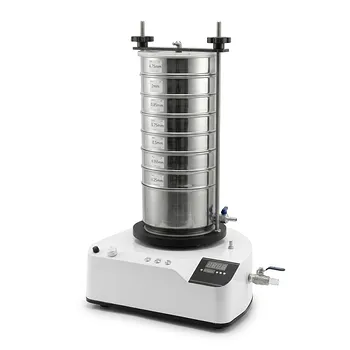
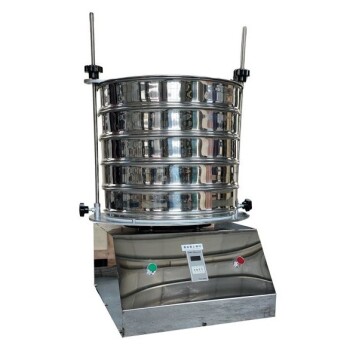
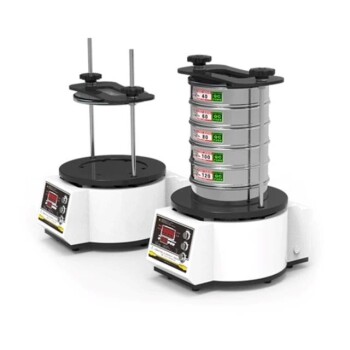
The use of standard sieving systems is necessary to rigorously enforce a particle size limit, typically 0.25 mm or less. By mechanically pulverizing and screening the corn stover to this precise specification, the process significantly increases the material's specific surface area. This physical standardization is the fundamental prerequisite for ensuring that subsequent chemical and biological reactions occur efficiently.
Core Insight: The primary value of sieving is not merely size reduction, but the maximization of accessible surface area. This ensures uniform contact between the biomass and reagents, which is the single most important factor for accelerating reaction rates and achieving consistent lignin degradation.
The Physical Mechanics of Preparation
Maximizing Specific Surface Area
The primary obstacle in degrading corn stover is the robust structure of the plant cell wall. Using a high-precision sieving system to achieve a particle size of 0.25 mm or less exposes a vastly larger surface area compared to coarser materials.
This increase in specific surface area exposes more lignin to the surrounding environment. It transforms the raw material from a resistant physical structure into a highly accessible substrate.
Ensuring Particle Uniformity
Standard sieving does not just reduce size; it homogenizes the material. Without sieving, the feedstock would contain a mix of dust and large chunks.
This lack of uniformity leads to unpredictable processing. By standardizing the particle size, you ensure that every unit of mass behaves similarly during treatment.
Impact on Chemical and Biological Reactions
Facilitating Enzyme and Reagent Contact
Lignin degradation, whether through liquid fermentation or chemical hydrolysis, relies on contact. Enzymes and chemical reagents cannot react with material they cannot touch.
Sieving ensures that these agents achieve uniform and sufficient contact with the corn stover. The small particle size eliminates the "core" of the material that would otherwise remain untouched by the reagents.
Enhancing Reaction Rates
When the surface area is maximized and contact is uniform, the overall reaction rate increases significantly. There are fewer physical barriers slowing down the diffusion of enzymes into the biomass structure.
This speed is critical for process efficiency. It reduces the time required to achieve the desired level of degradation.
Improving Degradation Consistency
Uniformity in input leads to uniformity in output. Because the particles are mechanically standardized, the uniformity of lignin degradation is enhanced across the entire batch.
This prevents scenarios where some parts of the batch are over-processed while others remain under-processed, ensuring a reliable and reproducible result.
Understanding the Operational Trade-offs
Process Complexity vs. Reaction Efficiency
While sieving is essential for degradation efficiency, it introduces an additional processing step. Achieving high-precision screening to 0.25 mm requires specific equipment and energy input for pulverization.
However, skipping this step usually results in longer fermentation times or higher chemical usage later in the process. The upfront effort in physical preparation pays off in downstream reaction kinetics.
Material Handling Considerations
Handling material pulverized to such a fine degree requires care. The transition from raw stover to fine powder changes the flow characteristics of the biomass.
You must ensure your downstream vessels are designed to handle fine particulates without clogging or clumping, which could negate the benefits of the increased surface area.
Making the Right Choice for Your Goal
To optimize your lignin degradation process, align your sieving protocol with your specific outcomes:
- If your primary focus is Reaction Speed: Prioritize sieving to the strictly defined 0.25 mm threshold to maximize surface area and minimize the time reagents need to penetrate the biomass.
- If your primary focus is Process Reproducibility: Focus on the standardization aspect of the sieving system to ensure every batch of raw material has identical physical properties before fermentation begins.
Effective lignin degradation begins not in the reactor, but in the rigorous physical preparation of the raw material.
Summary Table:
| Particle Size Requirement | Primary Benefit | Impact on Degradation |
|---|---|---|
| ≤ 0.25 mm | Maximized Specific Surface Area | Increases reaction speed and enzyme accessibility |
| Standardized Uniformity | Homogeneous Feedstock | Prevents inconsistent processing and under-treatment |
| Mechanical Pulverization | Physical Wall Breakdown | Transforms resistant structures into accessible substrates |
| Precision Screening | Uniform Reagent Contact | Ensures consistent lignin breakdown across the entire batch |
Elevate Your Biomass Research with KINTEK Precision
Achieving the critical 0.25 mm particle threshold is essential for reproducible lignin degradation. At KINTEK, we specialize in the high-performance laboratory equipment needed to prepare your raw materials with absolute precision.
From our robust crushing and milling systems to high-accuracy sieving equipment, we provide the tools necessary to maximize your material's surface area and reaction kinetics. Beyond preparation, we support your entire workflow with high-temperature high-pressure reactors, centrifuges, and ULT freezers designed for the most demanding research environments.
Ready to optimize your feedstock preparation? Contact our laboratory specialists today to find the perfect sieving and milling solution for your corn stover and biomass projects!
References
- Zhicai Zhang, Keping Chen. Lignin degradation in corn stalk by combined method of H2O2 hydrolysis and Aspergillus oryzae CGMCC5992 liquid-state fermentation. DOI: 10.1186/s13068-015-0362-4
This article is also based on technical information from Kintek Solution Knowledge Base .
Related Products
- Three-dimensional electromagnetic sieving instrument
- Laboratory Vibratory Sieve Shaker Machine for Dry and Wet Three-Dimensional Sieving
- Laboratory Test Sieves and Sieving Machines
- Laboratory Wet Three-Dimensional Vibratory Sieve Shaker Machine
- Custom PTFE Teflon Parts Manufacturer for PTFE Mesh F4 Sieve
People Also Ask
- Why is sieving equipment essential for the classification of processed bio-activated carbon? Optimize Performance
- What are the limitations of sieving? Understanding the Constraints of Particle Size Analysis
- What are advantages and disadvantages of sieving method? A Guide to Reliable & Cost-Effective Particle Sizing
- How is sieving important? The Critical Role of Particle Size Analysis in Quality Control
- What is sieving and how does it work? A Guide to Accurate Particle Size Analysis