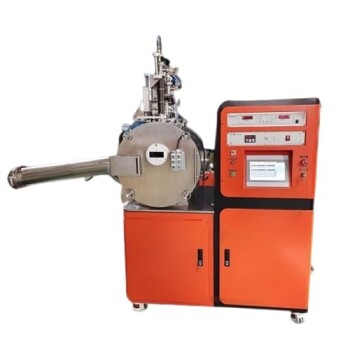
Maintaining a minimum argon pressure of 0.3 atm is a mandatory process control measure to physically suppress the evaporation of volatile elements during the melting of Alumina-Forming Austenitic (AFA) steel. Without this specific back-pressure, the intense heat of the vacuum arc furnace would cause elements with high vapor pressures, particularly chromium (Cr), to vaporize and escape the melt.
Core Takeaway While a vacuum environment is generally used to remove impurities, AFA steel requires a "partial pressure" regime (minimum 0.3 atm). This pressure acts as a physical barrier that counterbalances the vapor pressure of volatile alloying elements, ensuring the final chemical composition remains true to the design specifications.
The Mechanics of Vapor Suppression
Counteracting High Vapor Pressure
In a standard vacuum environment, the boiling point of metals decreases significantly.
When the furnace pressure is too low, the vapor pressure of the molten metal can exceed the environmental pressure. This causes the metal to evaporate rapidly rather than simply melting.
The Specific Vulnerability of Chromium
Different elements have different vapor pressures. In AFA steel, chromium (Cr) is particularly susceptible to evaporation at melting temperatures.
The 0.3 atm argon atmosphere provides enough force to keep chromium atoms within the molten pool. This prevents the "boiling off" of this critical alloying element.
Ensuring Compositional Integrity
Stabilizing Design Ratios
AFA steel relies on a precise balance of Iron, Nickel, Aluminum, and Chromium.
If chromium is lost to evaporation, the ratio of elements shifts uncontrollably. The final alloy will no longer match the intended chemical design, compromising its material properties.
Managing High-Temperature Volatility
As noted in supporting documentation, arc furnaces generate extremely high temperatures to fully melt the alloy components.
Higher temperatures exponentially increase the rate of evaporation. Consequently, the high heat necessary for uniformity makes the 0.3 atm pressure cap even more critical to retain the mass of the alloy.
Understanding the Trade-offs
Vacuum vs. Partial Pressure
There is often a misconception that "higher vacuum" (lower pressure) is always better for purity.
While high vacuum is excellent for removing dissolved gases, it is detrimental when melting alloys containing volatile elements like chromium or manganese. You must trade maximum degassing capability for compositional retention by using partial pressure.
The Role of Inert Gas
It is not enough to simply have pressure; the medium must be inert.
Using argon prevents the oxidation of active metals like Aluminum (Al) and Niobium (Nb). A reactive gas at 0.3 atm would maintain pressure but effectively destroy the alloy through immediate oxidation.
Making the Right Choice for Your Goal
To ensure the successful fabrication of AFA steel, align your process parameters with your compositional requirements:
- If your primary focus is Compositional Accuracy: strictly maintain argon pressure at $\ge$ 0.3 atm to prevent the loss of chromium and deviations from the design ratio.
- If your primary focus is Inclusion Control: utilize high-purity argon and ensure repeated flipping/remelting of the ingot to promote uniformity without risking oxidation.
Process control is not just about melting metal; it is about creating an environment where the chemistry remains stable under stress.
Summary Table:
| Factor | Requirement | Purpose in AFA Steel Melting |
|---|---|---|
| Atmosphere | Argon (Inert Gas) | Prevents oxidation of Aluminum (Al) and Niobium (Nb). |
| Minimum Pressure | 0.3 atm | Physically suppresses the evaporation of volatile Chromium (Cr). |
| Furnace Type | Vacuum Arc Furnace | Provides intense heat for melting while allowing pressure control. |
| Key Outcome | Compositional Integrity | Ensures the final alloy matches design ratios and material properties. |
Optimize Your Alloy Production with KINTEK Precision
Don't let volatile element loss compromise your material research. KINTEK specializes in advanced laboratory equipment, providing high-performance vacuum arc furnaces, induction melting systems, and high-temperature furnaces designed for precise atmosphere control. Whether you are developing Alumina-Forming Austenitic (AFA) steels or complex superalloys, our technical expertise ensures your melts maintain perfect compositional integrity.
Ready to elevate your lab's capabilities?
- Explore our range of crushing, milling, and hydraulic pellet presses for sample preparation.
- Discover our high-pressure reactors and specialized consumables like ceramics and crucibles.
Contact KINTEK Experts Today to Discuss Your Project
References
- O.M. Velikodny, O.C. Tortika. STRUCTURE AND PROPERTIES OF AFA STEEL FE-NI-CR-AL WITH VARIABLE ALUMINUM CONTENT. DOI: 10.46813/2024-150-062
This article is also based on technical information from Kintek Solution Knowledge Base .
Related Products
- Vacuum Arc Induction Melting Furnace
- Non Consumable Vacuum Arc Induction Melting Furnace
- Vacuum Induction Melting Spinning System Arc Melting Furnace
- Vacuum Hot Press Furnace Heated Vacuum Press Machine Tube Furnace
- Vacuum Sealed Continuous Working Rotary Tube Furnace Rotating Tube Furnace
People Also Ask
- How do vacuum induction or arc melting furnaces facilitate the synthesis of U-Al-C MAX phases? Precision Heat & Purity
- What core role does a Vacuum Induction Melting furnace play in nickel-free steel production? Achieve High-Purity Alloys
- What is the primary function of a vacuum arc melting furnace in RHEA preparation? Achieving Extreme Thermal Fusion
- What is the function of vacuum arc melting equipment? Creating High-Purity Ferrochrome (CrFe) Alloys
- What is the function of a vacuum arc melting furnace? Prepare High-Purity Alx(CrFeNi)1-x High-Entropy Alloys