The Illusion of Emptiness
We have a bias for the visible. When we think of heat treatment, we picture the glowing orange of hot metal. We focus on temperature, time, and the physical shape of the part. We often forget the most influential factor in the process: the invisible, seemingly empty space surrounding the component.
This space is not empty. It's a turbulent atmosphere of reactive gases. At 1000°C, the familiar air we breathe becomes a hostile environment, eager to attack and degrade the very materials we are trying to improve.
The fundamental challenge of heat treatment isn’t just about applying heat; it’s about controlling this invisible world. The choice between a vacuum furnace and an inert gas furnace is not a choice between two machines. It's a choice between two distinct philosophies of control.
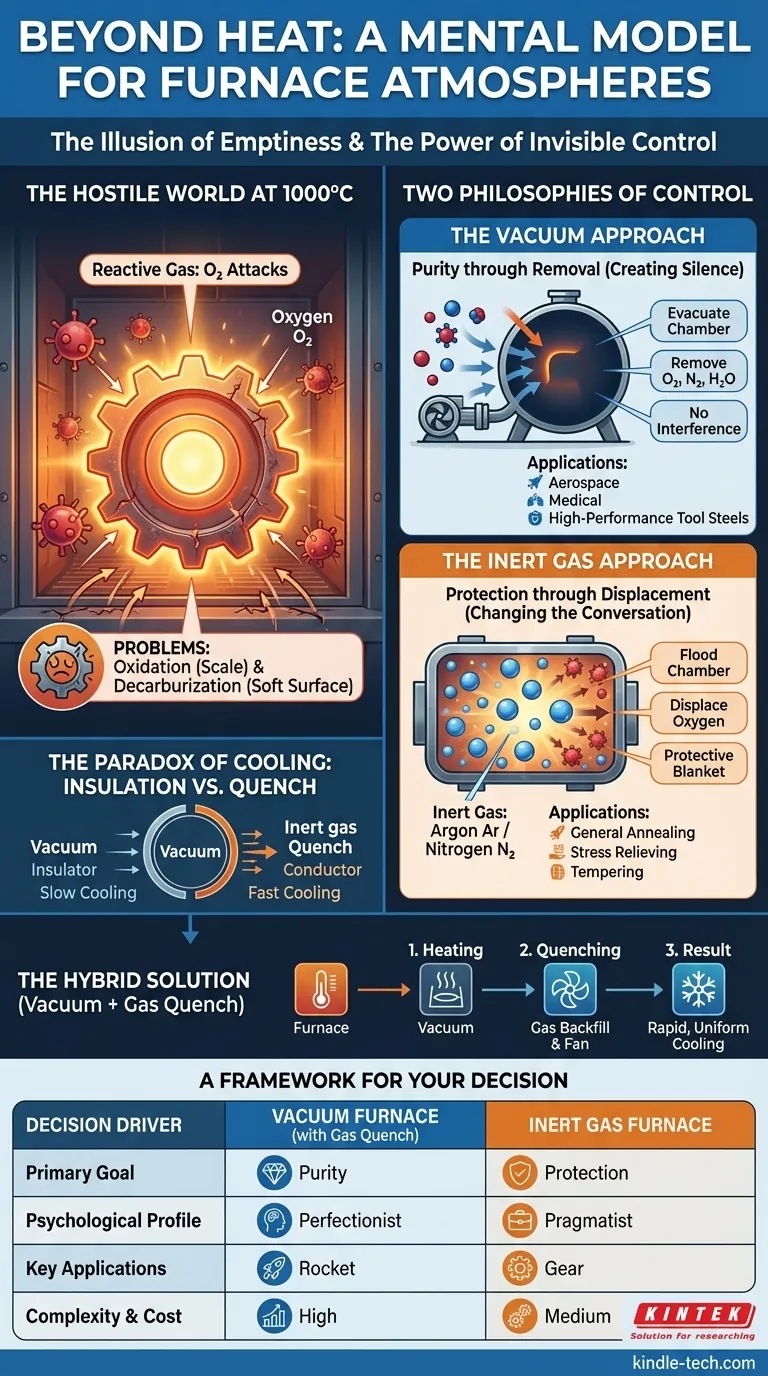
The Hostile World at 1000°C
Imagine a precision-machined gear, crafted from high-carbon tool steel. Its flawless surface and sharp-edged teeth are the result of hours of meticulous work. Now, place it in a simple furnace and heat it.
At high temperatures, the steel's atoms vibrate with immense energy. The surface becomes hyper-reactive. The oxygen in the air, normally benign, becomes a voracious attacker, bonding with the iron to form a dark, brittle scale (oxidation).
Worse, the oxygen plucks carbon atoms directly from the steel's surface (decarburization), leaving behind a soft, weak layer that will doom the gear to premature failure. The part emerges from the furnace fundamentally compromised, its value destroyed by an invisible chemical assault.
This is the problem we must solve.
Two Philosophies of Control
To prevent this molecular chaos, we must either remove the attackers or make them powerless. This is the core difference between the two types of furnaces.
The Vacuum Approach: Creating Perfect Silence
A vacuum furnace operates on a philosophy of purity through removal. It doesn't try to manage the atmosphere; it eliminates it.
Powerful pumps evacuate the chamber, pulling out the oxygen, nitrogen, and water vapor until an near-perfect vacuum remains. It's like trying to have a critical conversation by first removing everyone else from the building. No interference, no unwanted reactions.
This is why vacuum furnaces produce parts with an impeccably bright, clean finish. They are the ideal choice for materials where even the slightest surface contamination is unacceptable.
- Aerospace components
- Medical implants
- High-performance tool steels
For these applications, the pursuit of purity is absolute.
The Inert Gas Approach: Changing the Conversation
An inert gas furnace takes a different approach. Instead of creating a void, it changes the environment's nature.
The furnace chamber is flooded with a non-reactive gas, like argon or nitrogen, which displaces all the oxygen. It’s like filling the room with a language the steel doesn't understand. The argon atoms surround the hot part, forming a protective blanket, but they refuse to react.
This is a philosophy of protection through displacement. It is an elegant, pragmatic, and cost-effective way to prevent the most common forms of atmospheric attack, making it perfect for a wide range of general-purpose applications.
The Paradox of Cooling
Here, our intuition can lead us astray. A vacuum is a superb thermal insulator. This property is a great benefit during the heating cycle, as it helps concentrate energy efficiently on the part.
But when it's time to cool, this insulation becomes a critical liability.
For many metallurgical processes, such as hardening, the speed of cooling (quenching) is everything. It's the rapid quench that locks the material's crystal structure into a state of high strength and hardness. Cooling slowly in a vacuum would completely fail to achieve this.
The Hybrid Solution: An Engineer's Masterstroke
Modern high-performance vacuum furnaces solve this paradox with an elegant twist: they use the inert gas system not as an alternative, but as a tool.
- Heating: The part is heated in the pristine purity of a deep vacuum.
- Quenching: The heating cycle ends, and the chamber is instantly backfilled with high-pressure argon or nitrogen.
- Forced Convection: A powerful internal fan circulates this gas at high velocity, stripping heat from the component with incredible speed and uniformity.
This hybrid approach delivers the best of both worlds: the absolute purity of a vacuum during the critical heating phase and the controllable, rapid cooling of a high-pressure gas quench.
A Framework for Your Decision
Choosing the right furnace is less about technical specifications and more about understanding your process goals and your tolerance for risk.
| Decision Driver | Vacuum Furnace (with Gas Quench) | Inert Gas Furnace |
|---|---|---|
| Primary Goal | Ultimate purity, bright finish, controlled rapid cooling. | Effective oxidation protection on a budget. |
| Psychological Profile | Perfectionist. For applications where failure is not an option. | Pragmatist. For applications where "good enough" is excellent. |
| Key Applications | Aerospace, medical, high-end tooling, brazing. | General annealing, stress relieving, tempering. |
| Complexity & Cost | Higher initial investment and operational complexity. | Simpler, more affordable, and often higher throughput. |
Your choice is a reflection of your material's needs. For general laboratory use, an inert gas furnace provides robust protection. For developing advanced materials or mission-critical components, the superior control of a vacuum furnace is essential.
Navigating these choices requires a deep understanding of both material science and equipment capabilities. KINTEK's range of laboratory furnaces, from versatile inert gas models to advanced vacuum systems, provides the precise atmospheric control your work demands.
To ensure your results are defined by intention, not by chance, you need the right instrument. For help selecting the perfect furnace for your laboratory's critical processes, Contact Our Experts.
Visual Guide
Related Products
- Graphite Vacuum Furnace High Thermal Conductivity Film Graphitization Furnace
- High Temperature Muffle Oven Furnace for Laboratory Debinding and Pre Sintering
- 1700℃ Controlled Atmosphere Furnace Nitrogen Inert Atmosphere Furnace
- Vertical High Temperature Graphite Vacuum Graphitization Furnace
- 1700℃ Muffle Oven Furnace for Laboratory
Related Articles
- Optimizing Performance with Graphite Vacuum Furnaces: A Comprehensive Guide
- Maximizing Efficiency and Precision with Vacuum Graphite Furnaces
- Unveiling Vacuum Graphite Furnaces: Performance, Applications, and Expert Insights
- The Hidden Enemy in Your Furnace: Why Your Heat-Treated Parts Have Scale and Discoloration—And How to Fix It for Good
- Why Your Furnace Experiments Fail: The Hidden Mismatch in Your Lab