The Allure of the Maximum Number
When specifying a new piece of lab equipment, a powerful cognitive bias takes hold: the allure of the maximum number. We see a spec sheet for a tube furnace and our eyes are immediately drawn to the highest temperature. A 1200°C furnace is good, a 1600°C furnace is better, and an 1800°C furnace must be the best.
This is a trap. It's a fundamental misunderstanding of what a furnace is.
A furnace isn't a simple device that just gets hot. It's an engineered system, a delicate balance of materials science, thermodynamics, and electrical engineering. Its true performance isn't defined by a single peak number, but by its ability to reliably and safely sustain a specific temperature within a specific atmosphere. The real question is not "how hot can it get?" but "which system is designed for my specific process?"
The Heart of the Heat: A Story of Materials
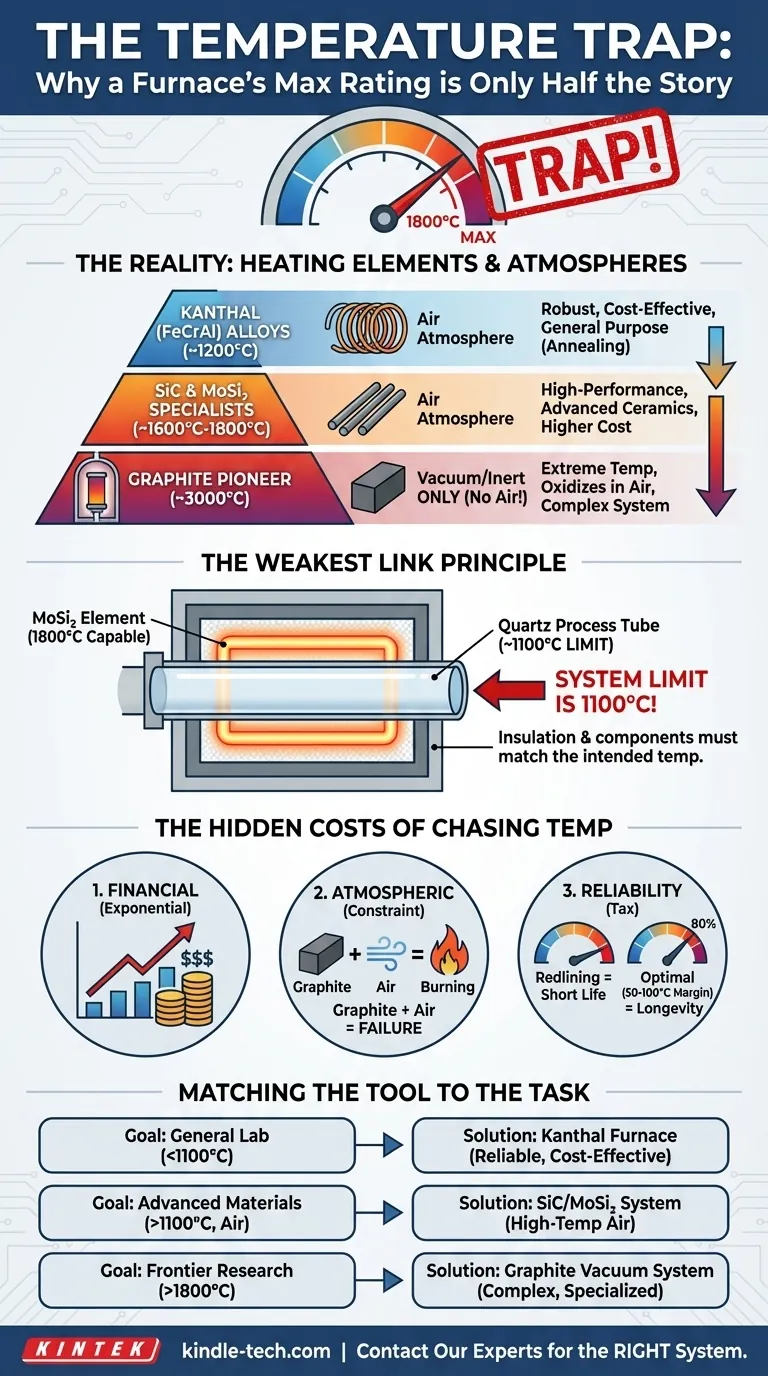
The maximum operating temperature of a furnace is dictated, first and foremost, by its heating element—the component that converts electricity into heat. The material choice here is a story of trade-offs, where each step up in temperature introduces new complexities.
-
Kanthal (FeCrAl) Alloys: The Dependable Workhorse For temperatures up to 1200°C, these iron-chromium-aluminum alloys are the undisputed champions. They are robust, cost-effective, and—critically—they thrive in an air atmosphere. They are the foundation of countless general-purpose lab applications, from annealing to binder burnout.
-
Silicon Carbide (SiC) & Molybdenum Disilicide (MoSi₂): The High-Performance Specialists To push past 1200°C and into the realm of advanced ceramics and metal sintering, you need more specialized materials. SiC and MoSi₂ elements can operate consistently in air at temperatures up to 1600°C and 1800°C, respectively. They enable cutting-edge materials science, but demand more from the furnace's overall design and budget.
-
Graphite: The Extreme Pioneer To reach the blistering temperatures required for graphitization or aerospace materials testing—up to 3000°C—graphite is the answer. But it comes with a non-negotiable condition. Graphite readily oxidizes and disintegrates in the presence of oxygen. It can only survive in a vacuum or an inert atmosphere of argon or nitrogen. An extreme strength is paired with a critical weakness.
A System Is Only As Strong As Its Weakest Link
The heating element sets the theoretical limit, but the practical limit is determined by the entire system.
Imagine an 1800°C furnace equipped with high-end MoSi₂ elements. If the process tube holding your sample is made of quartz, the system's functional limit is not 1800°C; it's the ~1100°C that the quartz can withstand before softening.
The same principle applies to insulation. Without high-purity ceramic fiber insulation capable of containing the heat, the furnace's outer shell would become a safety hazard and the energy loss would make sustaining high temperatures impossible. Every component must be matched to the intended operating conditions.
The Hidden Costs of Chasing Temperature
Choosing a furnace with a higher temperature rating than you need doesn't just add unnecessary cost upfront; it introduces compounding complexities and risks. There are three hidden costs to consider.
1. The Financial Cost
The relationship between maximum temperature and cost is not linear—it's exponential. The materials required for higher temperatures are rarer, more difficult to manufacture, and demand more sophisticated control systems.
| Element Material | Max Temp (Air) | Relative Cost & Complexity |
|---|---|---|
| Kanthal (FeCrAl) | ~1200°C | Base |
| Silicon Carbide (SiC) | ~1600°C | High |
| MoSi₂ | ~1800°C | Very High |
| Graphite | N/A (Inert) | Extreme (Requires Vacuum/Gas) |
2. The Atmospheric Constraint
This is the most common and costly pitfall. A graphite furnace operated in an air-filled lab is not a high-temperature furnace; it's a very expensive fire starter. If your process requires an air atmosphere, your choice is immediately limited to furnaces with FeCrAl, SiC, or MoSi₂ elements, capping your practical maximum temperature around 1800°C. Forgetting this constraint can render your investment useless.
3. The Reliability Tax
Every furnace has a rated continuous operating temperature. Running a furnace at its absolute maximum limit is like redlining a car engine everywhere you go. It will dramatically shorten the lifespan of the heating elements and insulation. True engineering wisdom lies in selecting a furnace whose continuous rating is 50-100°C above your required process temperature. This margin is not waste; it's an investment in longevity and reliability.
Matching the Tool to the Task
Ultimately, selecting the right furnace is an exercise in precise self-awareness about your goals.
- For general lab work, annealing, and synthesis below 1100°C: A standard furnace with robust Kanthal elements is the most reliable and cost-effective tool.
- For processing advanced ceramics or alloys up to 1700°C in air: You must invest in a high-temperature system built around SiC or MoSi₂ elements.
- For frontier research above 1800°C: Your decision is no longer about just a furnace. You need a complete processing system: a graphite or tungsten furnace integrated with the vacuum pumps and gas controllers it needs to survive.
Navigating these trade-offs requires more than a spec sheet; it requires understanding the interplay between materials, atmosphere, and your scientific goals. At KINTEK, we provide the specialized lab equipment that forms the backbone of research and development. We believe in supplying the right system for the job.
Choosing the right furnace is a critical decision that impacts your research's reliability and budget. To ensure you're selecting a system, not just a number, Contact Our Experts.
Visual Guide
Related Products
- Graphite Vacuum Furnace High Thermal Conductivity Film Graphitization Furnace
- High Temperature Muffle Oven Furnace for Laboratory Debinding and Pre Sintering
- 1700℃ Controlled Atmosphere Furnace Nitrogen Inert Atmosphere Furnace
- Vertical High Temperature Graphite Vacuum Graphitization Furnace
- 1700℃ Muffle Oven Furnace for Laboratory
Related Articles
- Optimizing Performance with Graphite Vacuum Furnaces: A Comprehensive Guide
- Maximizing Efficiency and Precision with Vacuum Graphite Furnaces
- Unveiling Vacuum Graphite Furnaces: Performance, Applications, and Expert Insights
- The Hidden Enemy in Your Furnace: Why Your Heat-Treated Parts Have Scale and Discoloration—And How to Fix It for Good
- Why Your Furnace Experiments Fail: The Hidden Mismatch in Your Lab