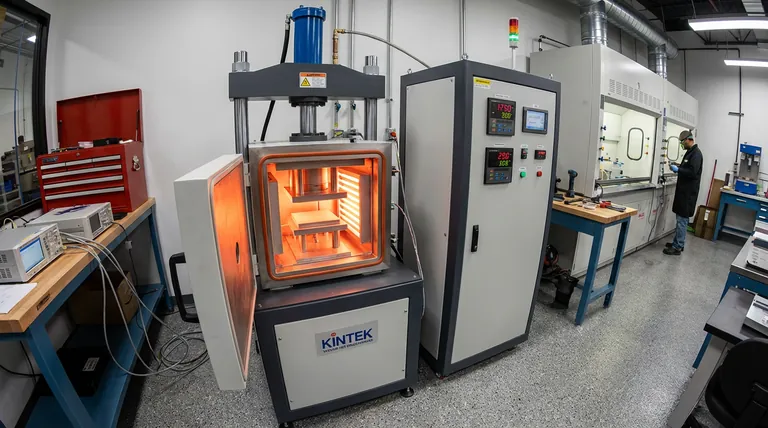
Where Failure is Not an Option
Imagine a high-speed train braking from 300 km/h. Or a multi-ton wind turbine blade adjusting its pitch in a gale. In these moments, the performance of a single component is all that stands between smooth operation and catastrophic failure.
These components don't survive by accident. They are engineered to be nearly perfect.
Their resilience comes from a manufacturing philosophy that is both brutal and elegant: hot pressing. It’s a process designed to fight a material's most fundamental enemy—the empty space within it.
The Tyranny of the Void
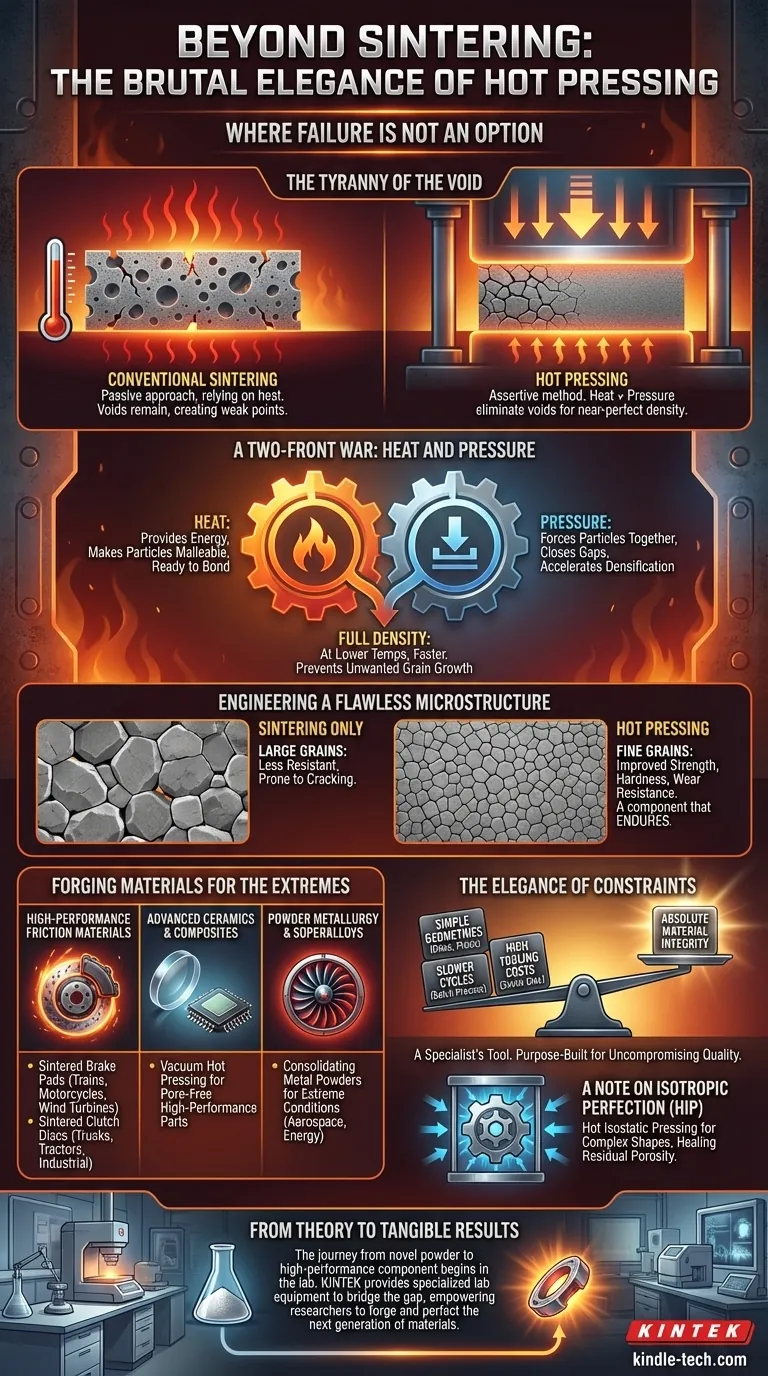
In material science, every void, every microscopic pore, is a potential point of failure. It's an engraved invitation for a crack to form and spread under stress. Conventional sintering—heating a powder until it fuses—can reduce these voids, but it rarely eliminates them entirely.
This is a psychological problem as much as a physical one. Relying on heat alone is a passive approach, hoping atoms will arrange themselves perfectly. Engineers needed a more assertive method.
Hot pressing is that assertion. By applying immense mechanical pressure during the heating cycle, it forces the material into a state of near-perfect density.
A Two-Front War: Heat and Pressure
The genius of hot pressing lies in its synergy.
- Heat gives the material's particles the energy to move, making them malleable and ready to bond.
- Pressure acts as the commander, forcing those mobile particles together, closing any gaps, and accelerating the densification process.
This two-pronged attack achieves full density at lower temperatures and in less time than sintering alone. This not only saves energy but also prevents a critical flaw: unwanted grain growth.
Engineering a Flawless Microstructure
By inhibiting grain growth, hot pressing preserves a fine, uniform microstructure. Think of it as building a wall with small, perfectly interlocking stones instead of large, irregular boulders.
A wall of small stones is far more resistant to cracking. In materials, this fine-grained structure dramatically improves strength, hardness, and resistance to wear. The result is a component that doesn't just perform; it endures.
Forging Materials for the Extremes
Because of its ability to create exceptionally robust materials, hot pressing is the go-to process for components that operate in the most demanding environments.
High-Performance Friction Materials
This is the classic application. The immense stress and heat generated by braking and clutch engagement require materials that will not degrade.
- Sintered Brake Pads: For high-speed trains, performance motorcycles, and wind turbines.
- Sintered Clutch Discs: For heavy-duty trucks, tractors, and industrial machinery.
Advanced Ceramics and Composites
Some advanced materials, like certain ceramics, are notoriously difficult to densify. Their atoms are stubborn and don't diffuse easily. Vacuum hot pressing is the only practical way to forge them into the pore-free state required for high-performance optical, thermal, or electronic components.
Powder Metallurgy and Superalloys
In sectors like aerospace and energy, consolidating metal powders into solid, high-strength parts is critical. Hot pressing creates superalloy components that can withstand the extreme conditions inside a jet engine or a power plant.
The Elegance of Constraints
Hot pressing is not a universal solution. It is a specialist's tool, and its power comes with deliberate trade-offs.
- Simple Geometries: The process uses rigid dies, limiting parts to shapes like discs, plates, and cylinders. You cannot create a complex turbine blade this way.
- Slower Cycles: It is a batch process, far slower than automated, high-volume methods.
- High Tooling Costs: The dies must be made from exotic materials capable of withstanding punishing heat and pressure, making them expensive.
These are not weaknesses, but a reflection of its purpose. You don't use a scalpel for a task that requires a sledgehammer. Hot pressing is chosen when absolute material integrity in a simple form outweighs the need for speed or geometric complexity.
A Note on Isotropic Perfection
For complex shapes, engineers turn to a related process: Hot Isostatic Pressing (HIP). Instead of applying pressure from one direction, HIP uses a high-pressure gas to squeeze a part equally from all sides. This allows for the densification of intricate geometries and is often used to heal residual porosity in critical cast components like medical implants or aerospace parts.
From Theory to Tangible Results
Understanding the principles of thermal consolidation is one thing. Applying them to create new materials is another. The journey from a novel powder composition to a high-performance component begins in the laboratory.
This is where the theoretical meets the practical. Developing new friction materials, pioneering transparent ceramics, or testing novel superalloys requires precise, repeatable, and scalable equipment. The ability to control temperature, pressure, and atmosphere in a laboratory setting is paramount to innovation.
KINTEK provides the specialized lab equipment and consumables that bridge this gap. Our advanced laboratory hot presses and material processing solutions empower researchers and engineers to move beyond theory, allowing them to forge, test, and perfect the next generation of high-performance materials.
If you are working to conquer the limits of material science and create components that refuse to fail, the right tools are essential. Contact Our Experts
Visual Guide
Related Products
- Automatic Heated Hydraulic Press Machine with Heated Plates for Laboratory Hot Press 25T 30T 50T
- Manual High Temperature Heated Hydraulic Press Machine with Heated Plates for Lab
- Touchscreen Automatic Vacuum Heat Press
- 30T 40T Split Automatic Heated Hydraulic Press Machine with Heated Plates for Laboratory Hot Press
- Vacuum Hot Press Furnace Machine Heated Vacuum Press
Related Articles
- Why Your Composite and Polymer Parts Keep Failing: The Secret Is Simultaneous Heat and Pressure
- The Physics of Flawless Materials: Deconstructing the Hydraulic Hot Press
- Precision Under Pressure: The Physics and Psychology of the Hydraulic Hot Press
- Hydraulic Hot Press: Principles, Components, Features, Advantages, and Applications
- Comprehensive Guide to Hydraulic Hot Press: Function, Features and Applications