Blog Beyond Torr: The Pursuit of Material Purity in a Vacuum Furnace
Beyond Torr: The Pursuit of Material Purity in a Vacuum Furnace

Beyond Torr: The Pursuit of Material Purity in a Vacuum Furnace

5 hours ago

The Allure of Nothing

We are control-seeking creatures. In a world of infinite variables, we crave environments where the unpredictable can be eliminated. The search for a perfect vacuum inside a furnace is not just a technical exercise; it's a quest for a perfect outcome, a manufactured universe where materials can become their ideal selves.

But our desire for simplicity often leads us to ask the wrong question. We ask, "What's the vacuum level?" as if it were a single, static number on a spec sheet. This is a psychological trap. The real question is not about the number, but about the quality of the emptiness we create.

The Ideal vs. The Reality

Every vacuum system has two distinct personalities: the theoretical ideal and the working reality.

Ultimate Vacuum: The Sound of Silence

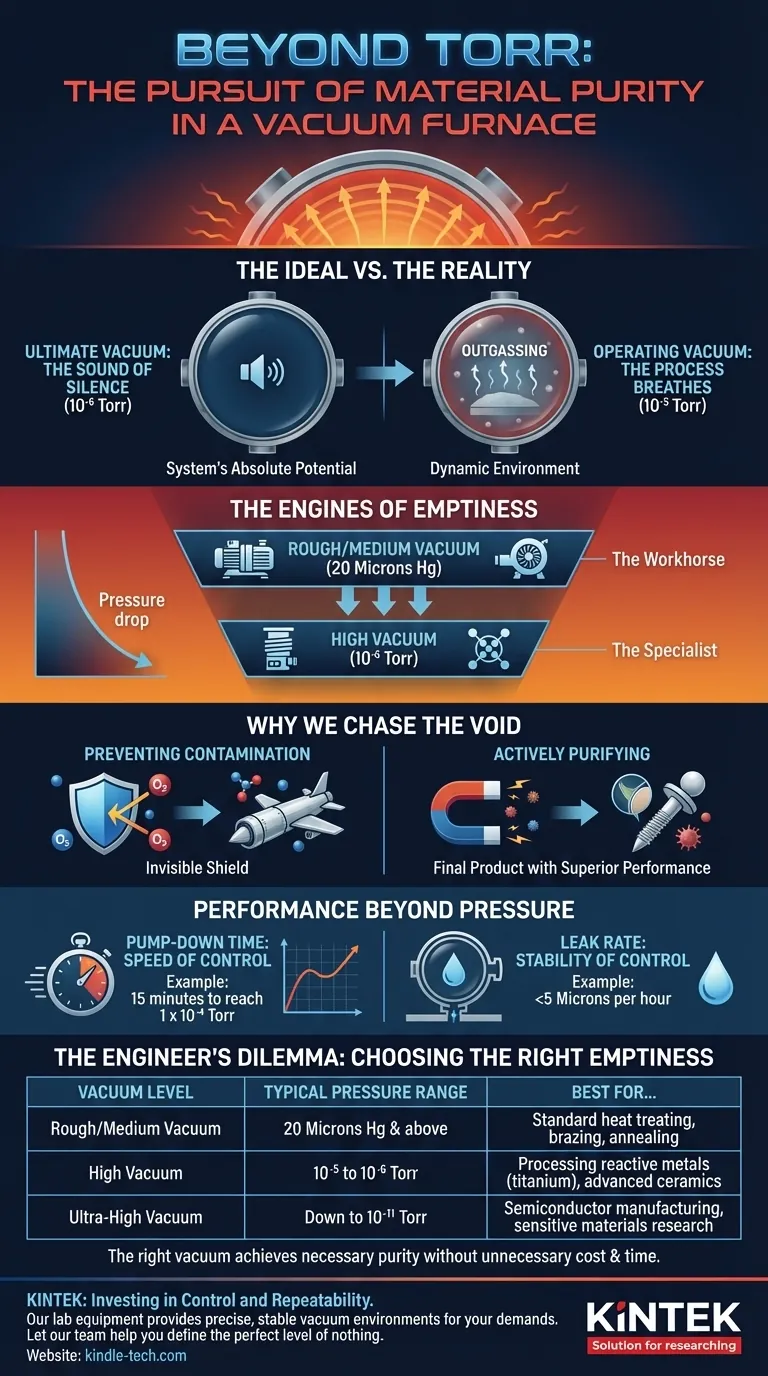
Ultimate vacuum is the lowest pressure the pumping system can achieve in a pristine, empty chamber. It’s the system's absolute potential, like a perfectly soundproofed room. For a high-vacuum furnace with a diffusion pump, this might be 10⁻⁶ Torr. It is a benchmark of the machine's capability.

Operating Vacuum: The Process Breathes

Operating vacuum is the pressure maintained during the actual heating process. It's always a higher pressure (e.g., 10⁻⁵ Torr) because the material being heated begins to "breathe." Trapped gases and volatile elements escape in a process called outgassing, subtly changing the environment.

Understanding this difference is crucial. You aren't just buying a number; you are engineering a dynamic environment that must withstand the reality of your materials.

The Engines of Emptiness

The journey to lower pressures is a staged descent, managed by increasingly sophisticated machinery.

A basic mechanical pump and blower combination is the workhorse, creating a rough or medium vacuum (around 20 Microns Hg). This is often sufficient for many standard processes.

To venture into the realm of high vacuum, a diffusion pump is added. This is the specialist, a second stage that captures stray molecules and pushes the environment into the 10⁻⁶ Torr range, creating a profoundly different world for the material inside.

Why We Chase the Void

Creating a near-perfect vacuum is about one thing: protecting and purifying the workpiece. The air we breathe is a corrosive agent at high temperatures.

By removing it, we accomplish two goals:

  1. Preventing Contamination: The vacuum acts as an invisible shield, preventing oxygen and other reactive gases from causing oxidation and decarburization. This preserves the surface integrity and strength of the material, which is non-negotiable for aerospace or medical components.

  2. Actively Purifying: A high vacuum doesn't just protect; it cleanses. It pulls impurities and low-temperature by-products out of the material, resulting in a final product with higher density, fewer defects, and superior performance.

Performance Beyond Pressure

A low Torr number is meaningless if the system can't get there quickly or stay there reliably. Two other metrics reveal the furnace's true character.

  • Pump-Down Time: This is the speed of control. How quickly can the furnace establish its ideal environment? A specification like "15 minutes to reach 1 x 10⁻⁴ Torr" is a measure of operational efficiency.

  • Leak Rate: This is the stability of control. How well does the system hold its vacuum? A low leak rate, like less than 5 Microns per hour, proves the integrity of the chamber. It assures you that the pristine universe you've created isn't being silently poisoned by the outside world.

The Engineer's Dilemma: Choosing the Right Emptiness

The temptation is to pursue the highest possible vacuum. But the cost and complexity rise exponentially for diminishing returns. The wisest choice is not the lowest pressure, but the appropriate pressure for the job.

The selection process is a trade-off between material needs, process time, and cost.

Vacuum Level Typical Pressure Range Best For...
Rough/Medium Vacuum 20 Microns Hg & above Standard heat treating, brazing, annealing.
High Vacuum 10⁻⁵ to 10⁻⁶ Torr Processing reactive metals (titanium), advanced ceramics.
Ultra-High Vacuum (UHV) Down to 10⁻¹¹ Torr Semiconductor manufacturing, sensitive materials research.

The right vacuum level is the one that achieves the necessary material purity without adding unnecessary cycle time or cost. It’s a decision that requires a deep understanding of the interplay between the machine, the material, and the mission.

At KINTEK, we understand that you're not just buying a furnace; you're investing in control and repeatability. Our range of lab equipment is designed to provide the precise, stable vacuum environment your specific application demands, from routine processes to cutting-edge research. Let our team help you define the perfect level of nothing for your work. Contact Our Experts

Visual Guide
Beyond Torr: The Pursuit of Material Purity in a Vacuum Furnace Visual Guide

Related Products

Related Articles

Related Products

Molybdenum Vacuum Heat Treat Furnace

Molybdenum Vacuum Heat Treat Furnace

Discover the benefits of a high-configuration molybdenum vacuum furnace with heat shield insulation. Ideal for high-purity, vacuum environments like sapphire crystal growth and heat treatment.

Vacuum Heat Treat Furnace and Levitation Induction Melting Furnace

Vacuum Heat Treat Furnace and Levitation Induction Melting Furnace

Experience precise melting with our Vacuum Levitation Melting Furnace. Ideal for high melting point metals or alloys, with advanced technology for effective smelting. Order now for high-quality results.

2200 ℃ Tungsten Vacuum Heat Treat and Sintering Furnace

2200 ℃ Tungsten Vacuum Heat Treat and Sintering Furnace

Experience the ultimate refractory metal furnace with our Tungsten vacuum furnace. Capable of reaching 2200℃, perfect for sintering advanced ceramics and refractory metals. Order now for high-quality results.

Vacuum Heat Treat Sintering Brazing Furnace

Vacuum Heat Treat Sintering Brazing Furnace

A vacuum brazing furnace is a type of industrial furnace used for brazing, a metalworking process that joins two pieces of metal using a filler metal that melts at a lower temperature than the base metals. Vacuum brazing furnaces are typically used for high-quality applications where a strong, clean joint is required.

Vacuum Heat Treat Furnace with Ceramic Fiber Liner

Vacuum Heat Treat Furnace with Ceramic Fiber Liner

Vacuum furnace with polycrystalline ceramic fiber insulation liner for excellent heat insulation and uniform temperature field. Choose from 1200℃ or 1700℃ max. working temperature with high vacuum performance and precise temperature control.

Graphite Vacuum Furnace High Thermal Conductivity Film Graphitization Furnace

Graphite Vacuum Furnace High Thermal Conductivity Film Graphitization Furnace

The high thermal conductivity film graphitization furnace has uniform temperature, low energy consumption and can operate continuously.

2200 ℃ Graphite Vacuum Heat Treat Furnace

2200 ℃ Graphite Vacuum Heat Treat Furnace

Discover the power of the KT-VG Graphite Vacuum Furnace - with a maximum working temperature of 2200℃, it's perfect for vacuum sintering of various materials. Learn more now.

Vacuum Heat Treat and Molybdenum Wire Sintering Furnace for Vacuum Sintering

Vacuum Heat Treat and Molybdenum Wire Sintering Furnace for Vacuum Sintering

A vacuum molybdenum wire sintering furnace is a vertical or bedroom structure, which is suitable for withdrawal, brazing, sintering and degassing of metal materials under high vacuum and high temperature conditions. It is also suitable for dehydroxylation treatment of quartz materials.

Vertical Laboratory Tube Furnace

Vertical Laboratory Tube Furnace

Elevate your experiments with our Vertical Tube Furnace. Versatile design allows for operation under various environments and heat treatment applications. Order now for precise results!

Vacuum Heat Treat and Sintering Furnace with 9MPa Air Pressure

Vacuum Heat Treat and Sintering Furnace with 9MPa Air Pressure

The air pressure sintering furnace is a high-tech equipment commonly used for the sintering of advanced ceramic materials. It combines vacuum sintering and pressure sintering techniques to achieve high-density and high-strength ceramics.

Vacuum Hot Press Furnace Heated Vacuum Press Machine Tube Furnace

Vacuum Hot Press Furnace Heated Vacuum Press Machine Tube Furnace

Reduce forming pressure & shorten sintering time with Vacuum Tube Hot Press Furnace for high-density, fine-grain materials. Ideal for refractory metals.

1200℃ Controlled Atmosphere Furnace Nitrogen Inert Atmosphere Furnace

1200℃ Controlled Atmosphere Furnace Nitrogen Inert Atmosphere Furnace

Discover our KT-12A Pro Controlled atmosphere furnace - high precision, heavy duty vacuum chamber, versatile smart touch screen controller, and excellent temperature uniformity up to 1200C. Ideal for both laboratory and industrial application.

1700℃ Controlled Atmosphere Furnace Nitrogen Inert Atmosphere Furnace

1700℃ Controlled Atmosphere Furnace Nitrogen Inert Atmosphere Furnace

KT-17A Controlled atmosphere furnace: 1700℃ heating, vacuum sealing technology, PID temperature control, and versatile TFT smart touch screen controller for laboratory and industrial use.

Laboratory High Pressure Vacuum Tube Furnace

Laboratory High Pressure Vacuum Tube Furnace

KT-PTF High Pressure Tube Furnace: Compact split tube furnace with strong positive pressure resistance. Working temp up to 1100°C and pressure up to 15Mpa. Also works under controller atmosphere or high vacuum.

600T Vacuum Induction Hot Press Furnace for Heat Treat and Sintering

600T Vacuum Induction Hot Press Furnace for Heat Treat and Sintering

Discover the 600T Vacuum Induction Hot Press Furnace, designed for high-temperature sintering experiments in vacuum or protected atmospheres. Its precise temperature and pressure control, adjustable working pressure, and advanced safety features make it ideal for nonmetal materials, carbon composites, ceramics, and metal powders.

Graphite Vacuum Furnace IGBT Experimental Graphitization Furnace

Graphite Vacuum Furnace IGBT Experimental Graphitization Furnace

IGBT experimental graphitization furnace, a tailored solution for universities and research institutions, with high heating efficiency, user-friendliness, and precise temperature control.

Ultra-High Temperature Graphite Vacuum Graphitization Furnace

Ultra-High Temperature Graphite Vacuum Graphitization Furnace

The ultra-high temperature graphitization furnace utilizes medium frequency induction heating in a vacuum or inert gas environment. The induction coil generates an alternating magnetic field, inducing eddy currents in the graphite crucible, which heats up and radiates heat to the workpiece, bringing it to the desired temperature. This furnace is primarily used for graphitization and sintering of carbon materials, carbon fiber materials, and other composite materials.

Vacuum Dental Porcelain Sintering Furnace

Vacuum Dental Porcelain Sintering Furnace

Get precise and reliable results with KinTek's Vacuum Porcelain Furnace. Suitable for all porcelain powders, it features hyperbolic ceramic furnace function, voice prompt, and automatic temperature calibration.

Vacuum Sealed Continuous Working Rotary Tube Furnace Rotating Tube Furnace

Vacuum Sealed Continuous Working Rotary Tube Furnace Rotating Tube Furnace

Experience efficient material processing with our vacuum-sealed rotary tube furnace. Perfect for experiments or industrial production, equipped with optional features for controlled feeding and optimized results. Order now.

1400℃ Controlled Atmosphere Furnace with Nitrogen and Inert Atmosphere

1400℃ Controlled Atmosphere Furnace with Nitrogen and Inert Atmosphere

Achieve precise heat treatment with KT-14A controlled atmosphere furnace. Vacuum sealed with a smart controller, it's ideal for lab and industrial use up to 1400℃.


Leave Your Message