The Boiler Room Paradox
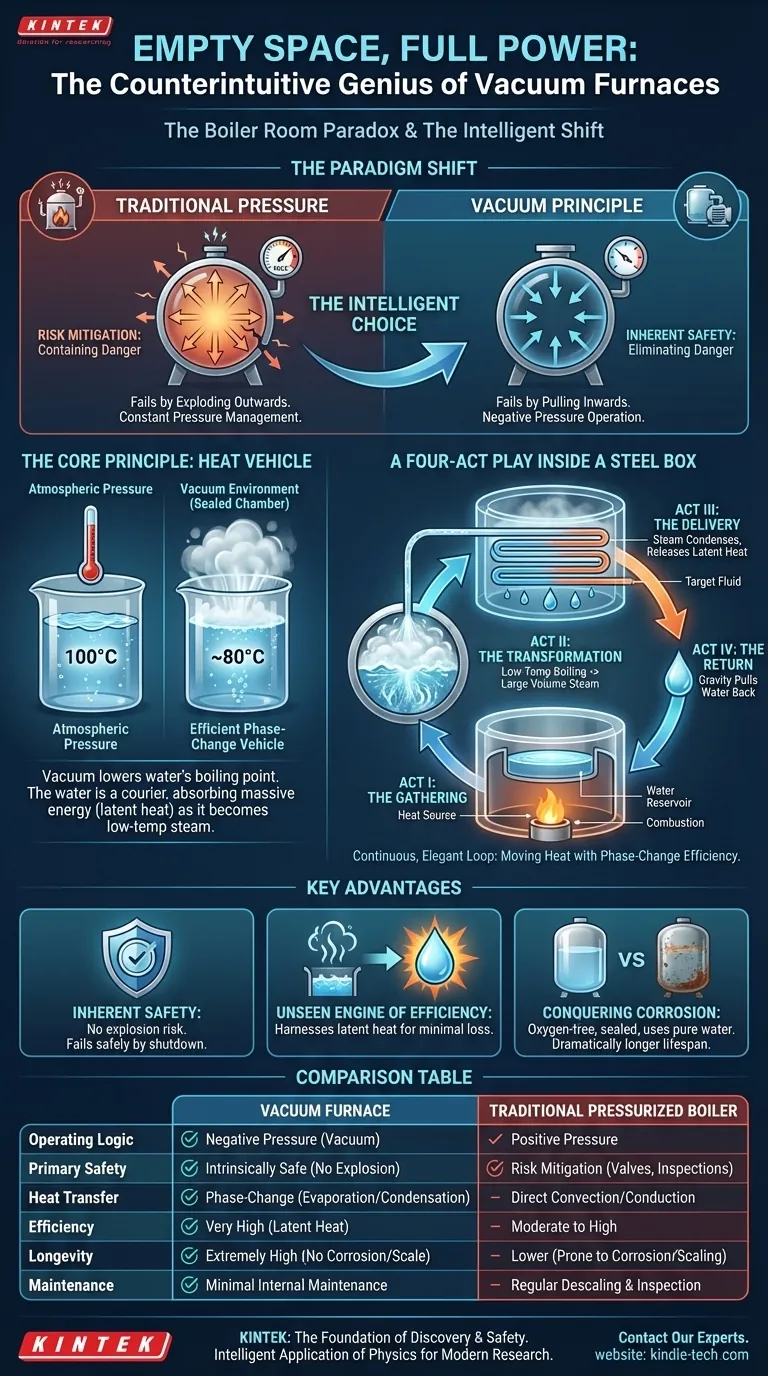
Think of a traditional boiler. The image that comes to mind is often one of immense pressure and contained power—a steel beast hissing in a basement, diligently managed to prevent a catastrophic failure. For over a century, our approach to high-power heating has been to manage this inherent risk. We build stronger walls, add more safety valves, and conduct rigorous inspections.
But this is a psychological trap. We focus so intently on containing the danger that we forget to ask a more fundamental question: What if we could eliminate the danger entirely?
This question is the philosophical starting point for the vacuum furnace. It doesn’t just improve upon the old design; it inverts the core principle. Instead of fighting against high pressure, it embraces the complete absence of it.
The Principle: A Vehicle for Heat
The genius of a vacuum furnace isn't the vacuum itself, but what the vacuum does to a familiar substance: water.
Under normal atmospheric pressure, water boils at 100°C. By removing the air from a sealed chamber, a vacuum furnace creates an environment where water's boiling point plummets to as low as 80°C.
The small reserve of pure water inside the furnace isn't the substance being heated. It is the heat transfer medium—an incredibly efficient vehicle. When it turns to steam at this low temperature, it absorbs a massive amount of energy (latent heat of vaporization) and becomes a courier, ready to deliver that energy with near-perfect efficiency.
A Four-Act Play Inside a Steel Box
The process is a continuous, elegant loop. It’s less a machine and more a self-contained physical system performing a four-act play.
Act I: The Gathering
Fuel is burned in a combustion chamber, separate from the main vessel. The hot exhaust gases heat the small reservoir of water at the bottom of the vacuum chamber, transferring their thermal energy.
Act II: The Transformation
As the water warms, it quickly reaches its artificially low boiling point. It flashes into a large volume of low-temperature steam, instantly filling the entire empty space of the chamber. The energy is now mobile.
Act III: The Delivery
This steam makes contact with a heat exchanger—a series of tubes through which the target fluid (e.g., lab process water) flows. The steam immediately condenses on the cooler surface of these tubes, releasing its stored latent heat directly into the target fluid. This is where the useful work happens.
Act IV: The Return
Having delivered its energy payload, the steam transforms back into liquid water. Gravity simply pulls it back to the reservoir at the bottom, where it is reheated, and the cycle begins anew, silently and ceaselessly.
The Psychology of System Design: Trading Pressure for Purity
This design represents a fundamental shift in engineering philosophy. It trades the brute-force problem of managing pressure for the more elegant challenge of maintaining purity and integrity.
The Promise of Inherent Safety
This is the system's most profound advantage. A pressurized boiler fails by exploding outwards. A vacuum furnace, operating at negative pressure, fails by pulling outside air inwards. The result is not an explosion, but a simple shutdown. The design has eliminated the risk, not just mitigated it.
The Unseen Engine of Efficiency
Phase-change heat transfer is nature’s express lane for moving energy. By harnessing the evaporation-condensation cycle, the furnace moves vast amounts of heat with minimal thermal loss. The energy is locked within the steam until the precise moment it’s delivered.
The Enemy Within: Conquering Corrosion
Two things destroy conventional boilers from the inside: rust (oxidation) and scale (mineral buildup). The sealed, oxygen-free vacuum environment starves corrosion of its primary fuel. The use of pure, deaerated water prevents scale. This results in a system with a dramatically longer lifespan and nearly zero internal maintenance.
The One Non-Negotiable: Sanctity of the Seal
The system's greatest strength is also its primary operational demand. The vessel must remain perfectly sealed. A well-maintained vacuum pump is the silent guardian that ensures the low-pressure state is constant.
A loss of vacuum doesn't create a hazard; it simply stops the low-temperature boiling cycle. The furnace becomes inert until the seal is restored. This turns the focus from managing constant danger to the simpler discipline of ensuring system integrity.
Making the Intelligent Choice for the Lab
For demanding environments like a laboratory, where safety, precision, and long-term reliability are non-negotiable, the vacuum furnace isn't just a better option—it's the logical conclusion. The risks associated with pressurized systems are often an unacceptable liability.
| Feature | Vacuum Furnace | Traditional Pressurized Boiler |
|---|---|---|
| Operating Logic | Negative Pressure (Vacuum) | Positive Pressure |
| Primary Safety | Intrinsically Safe (No Explosion Risk) | Risk Mitigation (Valves, Inspections) |
| Heat Transfer | Phase-Change (Evaporation/Condensation) | Direct Convection/Conduction |
| Efficiency | Very High (Latent Heat of Vaporization) | Moderate to High |
| Longevity | Extremely High (No Corrosion or Scale) | Lower (Prone to Corrosion and Scaling) |
| Maintenance | Minimal Internal Maintenance | Regular Descaling and Inspection Needed |
At KINTEK, we understand that laboratory equipment is the foundation of discovery and safety. Our advanced vacuum furnaces are engineered for precisely these environments, providing the unparalleled safety, efficiency, and durability that modern research demands. By shifting from a brute-force approach to an intelligent application of physics, you create a safer and more reliable operational core for your work.
To explore how this technology can transform your facility's thermal management, Contact Our Experts.
Visual Guide
Related Products
- Vacuum Hot Press Furnace Heated Vacuum Press Machine Tube Furnace
- 600T Vacuum Induction Hot Press Furnace for Heat Treat and Sintering
- Vacuum Hot Press Furnace Machine Heated Vacuum Press
- Vacuum Heat Treat Furnace and Levitation Induction Melting Furnace
- 2200 ℃ Tungsten Vacuum Heat Treat and Sintering Furnace
Related Articles
- The Purity Paradox: Choosing the Heart of Your Vacuum Hot Press Furnace
- Comprehensive Guide to Vacuum Hot Press Furnace Application
- Vacuum Hot Press Furnace: A Comprehensive Guide
- Forging Perfection in a Void: The Physics of Ultra-Dense Materials
- Defeating the Void: The Quiet Power of Vacuum Hot Pressing