A jet engine turbine blade spins at 10,000 RPM, its surface temperature exceeding the melting point of the metal it's made from. A surgical implant is placed into a human body, expected to perform flawlessly for decades without rejection. An EV battery dissipates enormous heat, demanding perfect thermal contact to prevent failure.
These are not just engineering marvels. They are acts of trust.
We trust that the materials at the heart of our most advanced technologies will not fail. This trust isn't built on hope; it's forged in a vacuum. The multi-billion dollar vacuum furnace market exists to solve a single, fundamental problem: at high temperatures, nature wants to corrupt and weaken our strongest materials.
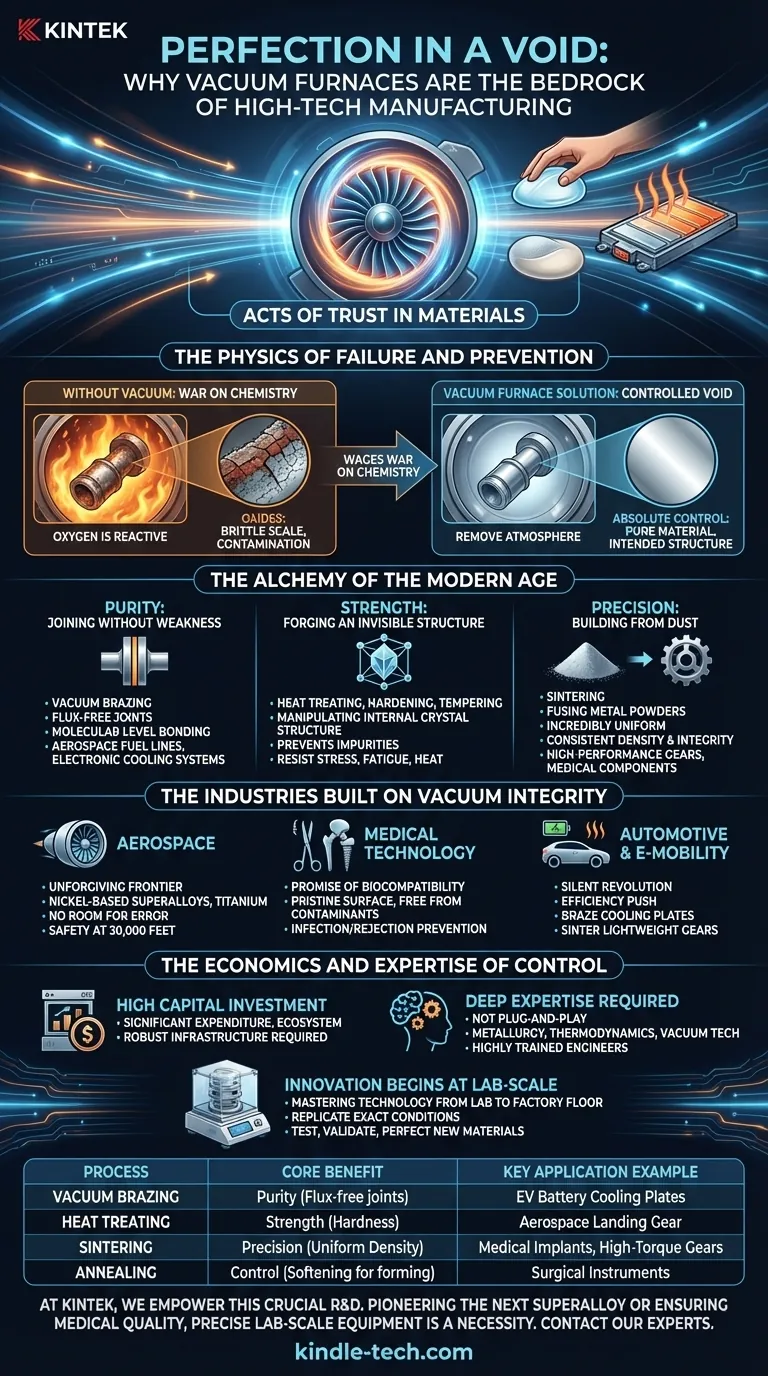
The Physics of Failure and Prevention
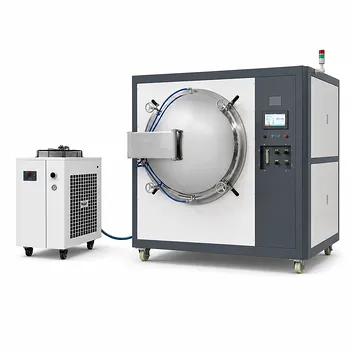
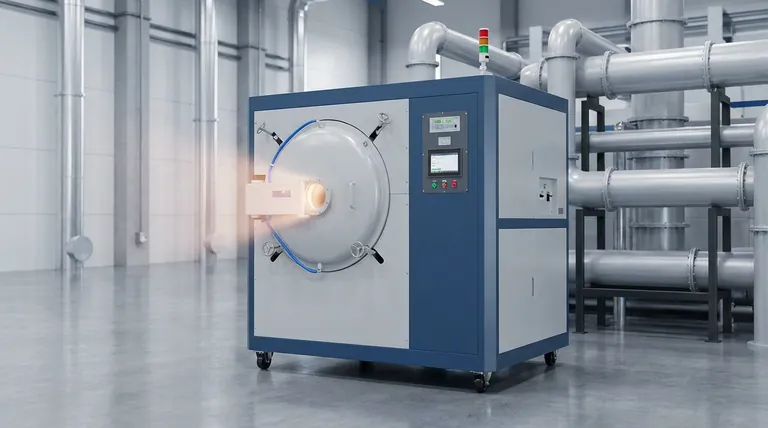
At its core, a vacuum furnace is a chamber that wages war on chemistry.
When you heat metal in the open air, you invite oxygen to the party. Oxygen is reactive. It bonds with the metal's surface, creating oxides—a delicate, brittle scale. This contamination compromises everything: the material's strength, its surface finish, and its predictable, engineered properties.
The vacuum furnace's solution is profoundly simple: remove the atmosphere.
By pumping out the air before applying heat, the furnace creates an environment where unwanted chemical reactions can't happen. It's not just about heating; it's about heating with absolute control, ensuring the material remains pure and its internal structure is exactly what the designer intended.
The Alchemy of the Modern Age
In this controlled void, processes that seem like alchemy become routine, reliable science. The benefits branch into three distinct categories of perfection.
Purity: Joining Without Weakness
Processes like vacuum brazing allow engineers to join complex parts without using corrosive flux. Think of it as welding at a molecular level, creating a clean, powerful bond that is often as strong as the parent materials. This is critical for everything from aerospace fuel lines to intricate electronic cooling systems.
Strength: Forging an Invisible Structure
Heat treating, hardening, and tempering are about manipulating a metal's internal crystal structure. Doing this in a vacuum prevents the introduction of impurities that create microscopic points of failure. The process realigns the material's very essence to resist stress, fatigue, and heat, resulting in superior mechanical properties.
Precision: Building from Dust
Sintering is the process of taking fine metal powders and fusing them into a solid, intricate part under heat and pressure. In a vacuum, this process is incredibly uniform, creating components with consistent density and structural integrity—essential for high-performance gears and durable medical components.
The Industries Built on Vacuum Integrity
The demand for this technology is not abstract. It is a direct consequence of the life-or-death, mission-critical requirements of our most advanced sectors.
Aerospace: The Unforgiving Frontier
For nickel-based superalloys and titanium components in jet engines and airframes, there is no room for error. Vacuum heat treatment is the only way to achieve the metallurgical properties that can withstand extreme temperatures and mechanical stress, ensuring safety at 30,000 feet.
Medical Technology: The Promise of Biocompatibility
When a material is placed inside the human body, its surface must be pristine. Vacuum processing ensures that titanium hip implants and stainless steel surgical tools are free from contaminants that could cause infection or rejection. The vacuum guarantees purity.
Automotive & E-Mobility: The Silent Revolution
The push for efficiency is relentless. Vacuum furnaces are used to braze the complex cooling plates for EV batteries, ensuring longevity and safety. They are also used to sinter high-strength, lightweight gears that make transmissions more efficient and quiet.
The Economics and Expertise of Control
Achieving this level of perfection comes with its own challenges, shaping the industry landscape.
- High Capital Investment: A vacuum furnace is a significant expenditure. It’s not just a machine but an ecosystem requiring robust power, cooling, and safety infrastructure. This high barrier to entry underscores the critical value of the process.
- Deep Expertise Required: This is not "plug-and-play" equipment. Operating a vacuum furnace demands a deep understanding of metallurgy, thermodynamics, and vacuum technology. It is a craft practiced by highly trained engineers and technicians.
These challenges highlight a crucial point: every major material breakthrough, from the lab bench to the factory floor, relies on mastering this technology. The journey for the next generation of superalloys or biocompatible materials begins not in a massive industrial furnace, but in a smaller, high-precision laboratory model.
This is where innovation is born. Researchers must replicate the exact vacuum conditions of full-scale production to test, validate, and perfect new materials. The principles of purity, strength, and precision are universal, whether forging a 1-ton turbine disk or a 10-gram test sample.
| Process | Core Benefit | Key Application Example |
|---|---|---|
| Vacuum Brazing | Purity (Flux-free joints) | |
| EV Battery Cooling Plates | ||
| Heat Treating | Strength (Hardness) | Aerospace Landing Gear |
| Sintering | Precision (Uniform Density) | Medical Implants, High-Torque Gears |
| Annealing | Control (Softening for forming) | Surgical Instruments |
At KINTEK, we specialize in providing the high-performance laboratory equipment that empowers this crucial R&D. Whether you are pioneering the next superalloy or ensuring the quality of medical-grade titanium, the principles of vacuum processing are fundamental. For researchers and engineers working at the frontier of material science, having precise, reliable lab-scale equipment is not a luxury—it's a necessity. Contact Our Experts
Visual Guide
Related Products
- Vacuum Hot Press Furnace Heated Vacuum Press Machine Tube Furnace
- 600T Vacuum Induction Hot Press Furnace for Heat Treat and Sintering
- Vacuum Hot Press Furnace Machine Heated Vacuum Press
- Vacuum Heat Treat Furnace and Levitation Induction Melting Furnace
- 2200 ℃ Tungsten Vacuum Heat Treat and Sintering Furnace
Related Articles
- The Purity Paradox: Choosing the Heart of Your Vacuum Hot Press Furnace
- Comprehensive Guide to Vacuum Hot Press Furnace Application
- Vacuum Hot Press Furnace: A Comprehensive Guide
- Forging Perfection in a Void: The Physics of Ultra-Dense Materials
- Defeating the Void: The Quiet Power of Vacuum Hot Pressing