Chemistry is relentless.
If you heat a piece of titanium in a standard room, nature takes over. Oxygen rushes in. Nitrogen reacts. The surface scales, discolors, and becomes brittle. The material, quite literally, attacks itself.
In high-stakes engineering—aerospace turbines, medical implants, or semiconductors—this chemical chaos is unacceptable.
The vacuum furnace is the engineer’s answer to this chaos. It is a specialized chamber that does not just provide heat; it provides a sanctuary.
By removing the atmosphere, we stop chemistry in its tracks. We create a "clean slate" where the only thing that happens to your material is exactly what you intended.
Here is the logic behind the technology.
The Invisible Shield
We often think of manufacturing as a process of adding things. We add heat. We add pressure. We add coatings.
But in advanced metallurgy, value often comes from subtraction.
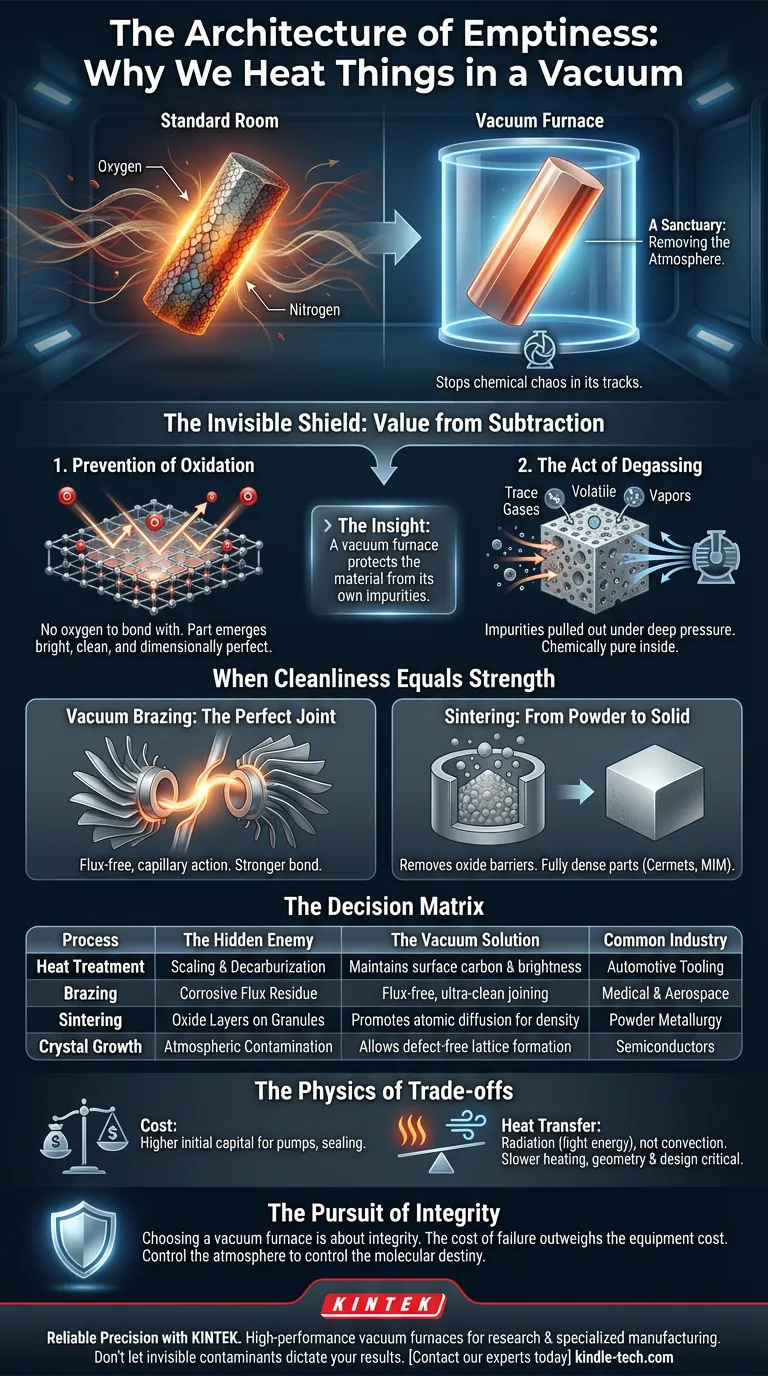
The primary function of a vacuum furnace is to mechanically remove air and contaminants before the heating cycle begins. This absence of matter creates two critical outcomes that no atmospheric furnace can replicate.
1. The Prevention of Oxidation
When metals are heated, their surface energy increases. They become desperate to bond with oxygen.
In a vacuum, there is no oxygen to bond with. The result is a part that emerges bright, clean, and dimensionally perfect. There is no scaling. There is no surface degradation.
2. The Act of Degassing
Materials are not solid blocks of perfection; they breathe. They trap trace gases and vapors within their structure.
Under the deep pressure of a vacuum, these volatile elements are actively pulled out of the material. This process, called degassing, ensures the final product is not just clean on the outside, but chemically pure on the inside.
The Insight: A vacuum furnace doesn't just protect the material from the room; it protects the material from its own impurities.
When Cleanliness Equals Strength
The application of vacuum technology is rarely a choice of convenience. It is a choice of necessity.
It is used when the margin for error is zero.
Vacuum Brazing: The Perfect Joint
In standard brazing, you need chemical flux to clean the metal so the filler will flow. Flux is messy. It creates corrosion risks.
In a vacuum, the environment is so clean that the filler metal flows like water over the surface without any flux at all. It is drawn into the capillaries of complex joints—like those in X-ray tubes or jet engine fuel lines—creating a bond that is often stronger than the parent material.
Sintering: From Powder to Solid
Sintering fuses powder particles into dense objects. If oxygen sits between those particles, they will never bond truly.
Vacuum sintering removes those oxide barriers. It is the only way to create fully dense cermets or Metal Injection Molded (MIM) parts that can withstand the stresses of industrial use.
The Decision Matrix
To understand where vacuum furnaces fit in the industrial landscape, consider this breakdown:
| Process | The Hidden Enemy | The Vacuum Solution | Common Industry |
|---|---|---|---|
| Heat Treatment | Scaling & Decarburization | Maintains surface carbon and brightness | Automotive Tooling |
| Brazing | Corrosive Flux Residue | Flux-free, ultra-clean joining | Medical & Aerospace |
| Sintering | Oxide Layers on Granules | Promotes atomic diffusion for density | Powder Metallurgy |
| Crystal Growth | Atmospheric Contamination | Allows defect-free lattice formation | Semiconductors |
The Physics of Trade-offs
If vacuum furnaces are superior, why doesn't everyone use them?
Because "nothing" is expensive to produce.
Creating a deep vacuum requires complex pump systems, rigorous sealing, and robust pressure vessels. This drives up the initial capital cost significantly compared to a standard atmospheric oven.
There is also the physics of heat transfer.
In a standard oven, heat moves via convection—hot air blowing over the part. In a vacuum, there is no air to blow. Heat must travel via radiation (light energy).
This changes the rules:
- Heating can be slower.
- Geometry matters. Shadows prevent heating.
- Design is critical. Parts must be placed precisely to ensure uniformity.
The Pursuit of Integrity
Choosing a vacuum furnace is rarely about speed. It is about integrity.
It is an acknowledgement that the cost of failure—a failed medical implant, a cracked turbine blade, a contaminated sensor—far outweighs the cost of the equipment.
If your goal is simply to get a metal hot, a standard furnace will suffice. But if your goal is to control the molecular destiny of a material, you need to control the atmosphere.
Reliable Precision with KINTEK
At KINTEK, we understand the engineer’s need for control.
We specialize in high-performance vacuum furnaces designed for the rigorous demands of laboratory research and specialized manufacturing. Whether you are sintering advanced ceramics or developing the next generation of biocompatible materials, our equipment provides the emptiness you need to create something solid.
Don't let invisible contaminants dictate your results.
Contact our experts today to discuss how KINTEK can help you achieve the ultimate level of material purity.
Visual Guide
Related Products
- Vacuum Hot Press Furnace Heated Vacuum Press Machine Tube Furnace
- 600T Vacuum Induction Hot Press Furnace for Heat Treat and Sintering
- Vacuum Hot Press Furnace Machine Heated Vacuum Press
- Vacuum Heat Treat Furnace and Levitation Induction Melting Furnace
- 2200 ℃ Tungsten Vacuum Heat Treat and Sintering Furnace
Related Articles
- The Purity Paradox: Choosing the Heart of Your Vacuum Hot Press Furnace
- Comprehensive Guide to Vacuum Hot Press Furnace Application
- Vacuum Hot Press Furnace: A Comprehensive Guide
- Forging Perfection in a Void: The Physics of Ultra-Dense Materials
- Defeating the Void: The Quiet Power of Vacuum Hot Pressing