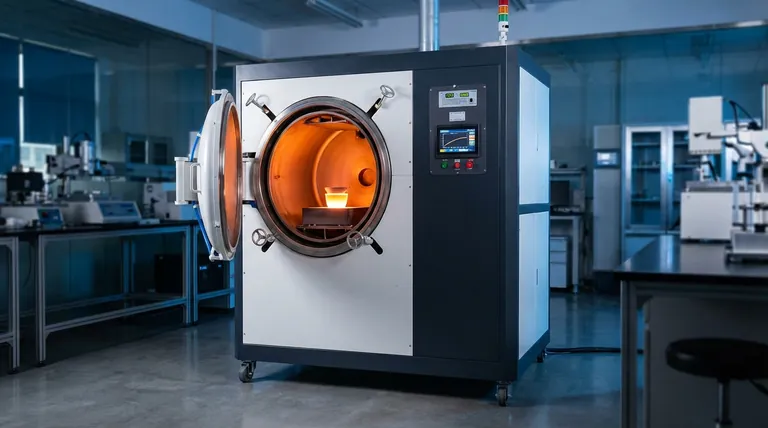
The Paradox of Atmosphere
The air we breathe is a constant. It sustains us. Yet, in the world of material science, this same atmosphere is a relentless contaminant.
At high temperatures, oxygen and other gases aggressively react with materials, causing oxidation and impurities that compromise integrity, strength, and performance.
To achieve metallurgical perfection, you cannot simply fight the atmosphere. You must eliminate it. This is the purpose of a vacuum furnace: to create a controlled pocket of nothingness, a pristine stage where materials can be fundamentally transformed.
It’s not just a hot box. It's an architectural marvel of interlocking systems, each playing a critical role in mastering the void.
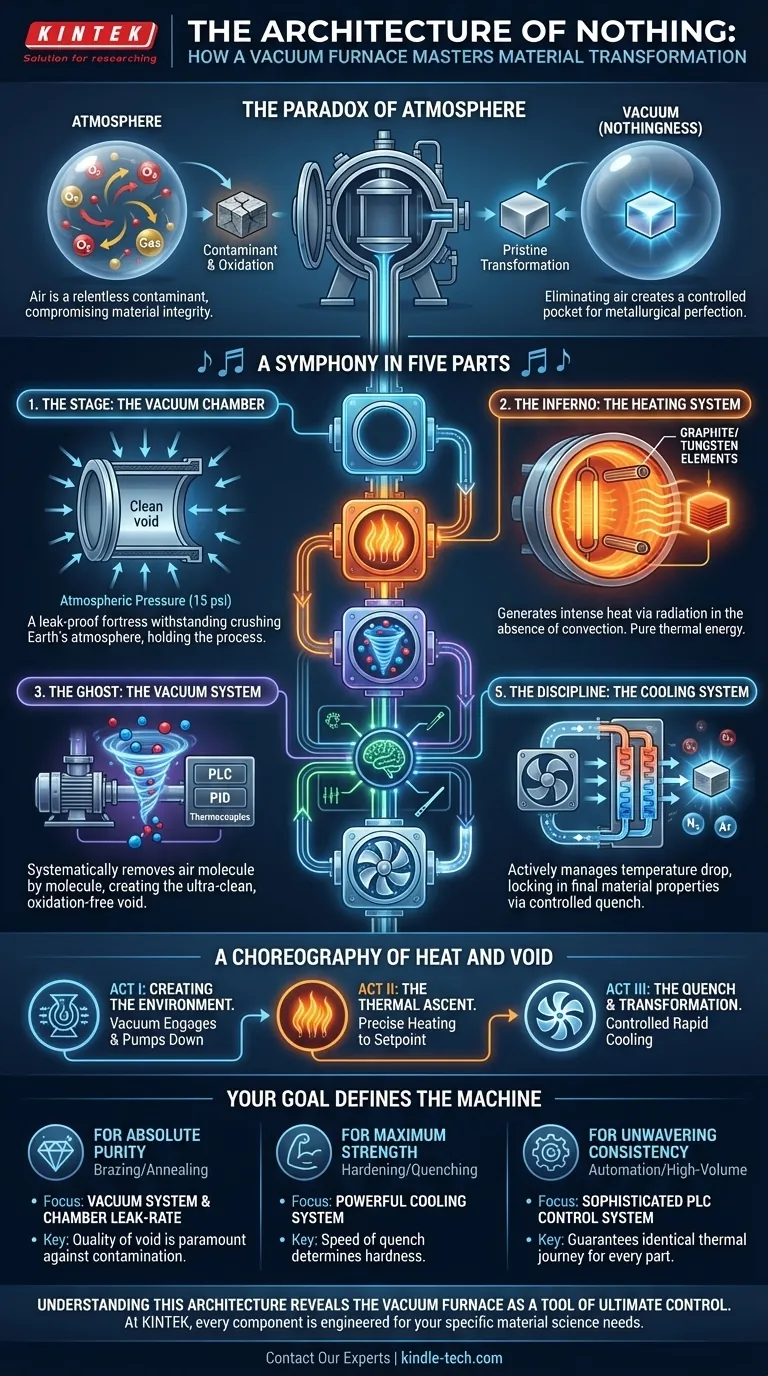
A Symphony in Five Parts
Viewing a vacuum furnace as a single entity misses the elegance of its design. It's better understood as an orchestra with five sections, each essential for the final performance. When they work in harmony, they produce results impossible to achieve in open air.
H3: The Stage: The Vacuum Chamber
This is the physical vessel, the fortress that contains the entire process. Its role is deceptively simple: to be a perfect, leak-proof barrier.
But consider the physics at play. When a deep vacuum is pulled, the chamber isn't just holding a void; it is actively withstanding the crushing force of Earth’s entire atmosphere—nearly 15 pounds on every square inch of its surface—trying to get back in. It must do this while also enduring extreme internal temperatures.
H3: The Inferno: The Heating System
Inside the chamber lies the source of energy. The heating system, often constructed from exotic materials like graphite, molybdenum, or tungsten, is designed to generate intense heat without destroying itself.
In the absence of air, there is no convection. Heat is transferred primarily through radiation. This requires elements that can glow at thousands of degrees, bathing the target material in pure thermal energy.
H3: The Ghost: The Vacuum System
This is the heart of the furnace's unique power. A series of pumps work to systematically remove the air, molecule by molecule.
This act of removal is more critical than the application of heat. It is what prevents oxidation, pulls impurities out of the material itself (outgassing), and creates the ultra-clean environment that defines vacuum processing. The vacuum system makes the "impossible" possible.
H3: The Conductor: The Control System
Precision without intelligence is chaos. The control system is the brain, the conductor of this thermal symphony.
Using sensors like thermocouples, it constantly monitors the temperature. Sophisticated controllers, from PID to full PLC systems, act as the maestro, adjusting power to the heating elements to follow a precise, pre-programmed thermal recipe of heating, soaking, and cooling. This ensures repeatability, cycle after cycle.
H3: The Discipline: The Cooling System
Heating is only half the story. The way a material cools is what locks in its final properties, such as hardness and grain structure.
This is not a passive process. The cooling system actively manages the temperature drop. Often, it involves backfilling the chamber with an inert gas like nitrogen or argon and circulating it with a powerful fan to pull heat away at a controlled, often rapid, rate. This disciplined quench is the final, critical act of transformation.
A Choreography of Heat and Void
These five systems execute a precise and sequential process, a dance between creating a void and applying energy.
- Act I: Creating the Environment. The chamber is sealed. The vacuum system engages, pumping down the atmosphere to create the clean, low-pressure stage.
- Act II: The Thermal Ascent. Once the vacuum level is stable, the control system signals the heating system to begin, raising the temperature at a specific rate to a precise setpoint.
- Act III: The Quench and Transformation. After the material soaks at temperature, the control system shuts off the heaters and activates the cooling system, executing the quench that solidifies the material's new properties.
Your Goal Defines the Machine
The relative importance of each system depends entirely on your goal. This is the psychology of selection: understanding your primary intent dictates your most critical component.
- For Absolute Purity (Brazing, Annealing): Your focus is on the vacuum system and the leak-rate of the chamber. Contamination is the enemy, so the quality of your void is paramount.
- For Maximum Strength (Hardening, Quenching): Your focus is on the power and efficiency of the cooling system. The speed of the quench determines the hardness, making this system the hero.
- For Unwavering Consistency (Automation, High-Volume): Your focus is on the sophistication of the PLC-based control system. It guarantees every part experiences the exact same thermal journey, eliminating human error.
| System | Primary Function | Key Components |
|---|---|---|
| Vacuum Chamber | Sealed vessel to contain the process | Robust, leak-proof shell |
| Heating System | Generates thermal energy | Graphite, molybdenum, or tungsten elements |
| Vacuum System | Removes air and gases | Pumps and measurement gauges |
| Control System | Manages heating/cooling cycles | PLC/PID controllers, thermocouples |
| Cooling System | Cools material at a controlled rate | Gas quench (N₂, Ar), fans, heat exchangers |
Understanding this architecture reveals the vacuum furnace for what it is: a tool of ultimate control. At KINTEK, we provide laboratory-scale vacuum furnaces where every component is engineered to work in perfect concert, delivering the precise environment your materials need. Whether for research or production, we help you select an integrated system built for your specific goal.
Achieving perfection in material science begins with creating the perfect environment. Contact Our Experts
Visual Guide
Related Products
- Vacuum Hot Press Furnace Heated Vacuum Press Machine Tube Furnace
- 600T Vacuum Induction Hot Press Furnace for Heat Treat and Sintering
- Vacuum Hot Press Furnace Machine Heated Vacuum Press
- Vacuum Heat Treat Furnace and Levitation Induction Melting Furnace
- Vacuum Heat Treat and Pressure Sintering Furnace for High Temperature Applications
Related Articles
- The Purity Paradox: Choosing the Heart of Your Vacuum Hot Press Furnace
- Comprehensive Guide to Vacuum Hot Press Furnace Application
- Vacuum Hot Press Furnace: A Comprehensive Guide
- Forging Perfection in a Void: The Physics of Ultra-Dense Materials
- Defeating the Void: The Quiet Power of Vacuum Hot Pressing



















