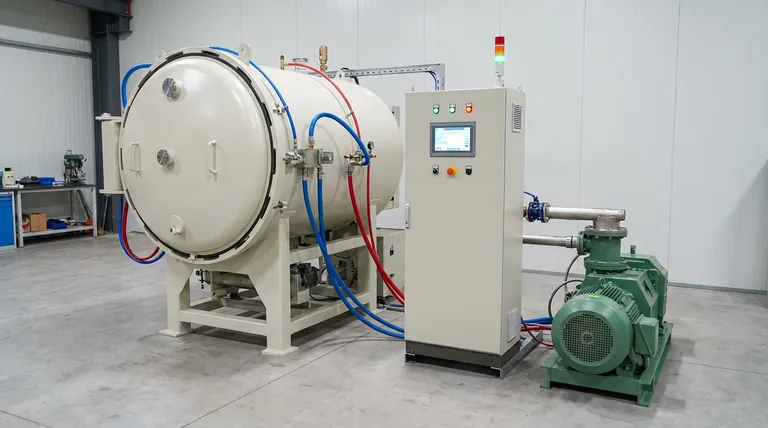
The War Against Entropy
In materials science, the atmosphere is a bully.
We tend to think of air as neutral space. But when you raise the temperature to 1,000°C, the air around us transforms into a chaotic soup of reactive gases. Oxygen, nitrogen, and hydrogen stop being passive bystanders and start attacking the surface of your metal.
They create scale. They induce discoloration. They compromise structural integrity.
This is the fundamental problem of heat treatment: How do you add energy without adding chaos?
The answer lies in the art of subtraction. You don't add more chemicals to fight the reaction. You remove the battlefield entirely.
This is the philosophy behind the vacuum furnace. It is not merely an oven; it is a contamination-free sanctuary. It transforms heat treatment from a rough industrial process into a precise exercise in materials engineering.
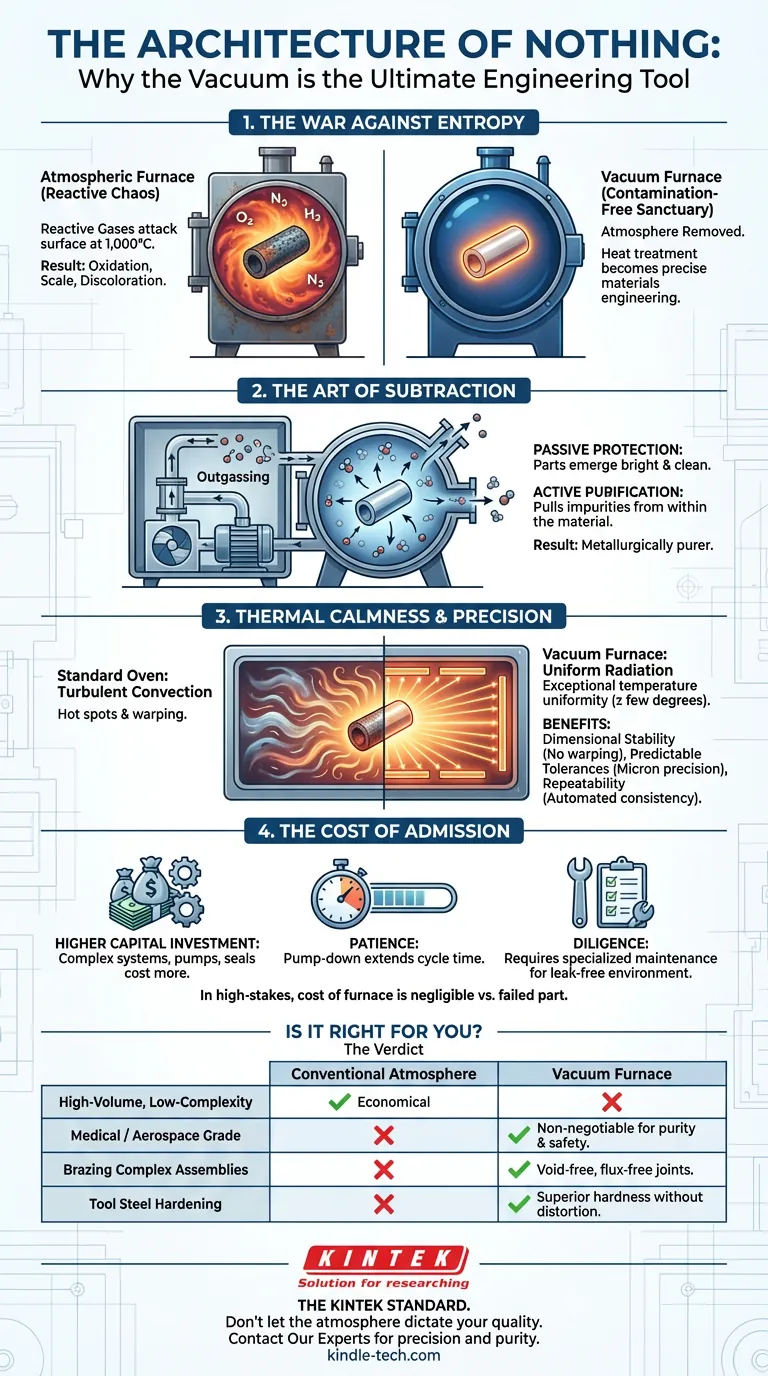
The Art of Subtraction
The primary advantage of a vacuum furnace is what isn't there.
In a conventional furnace, the oxygen reacts with the hot surface of a part. The result is oxidation—a crusty, discolored "skin" that ruins the tolerance and requires aggressive post-processing to clean.
A vacuum furnace eliminates the atmosphere before the heat is applied. This creates two distinct advantages that feel like engineering magic:
- Passive Protection: By removing reactive gases, parts emerge from the cycle bright, clean, and dimensionally identical to how they went in.
- Active Purification: The vacuum doesn't just protect the outside; it cleans the inside. Through a process called outgassing, the vacuum pumping system pulls volatile impurities and trapped gases out of the metal itself.
The result is a material that is metallurgically purer than when it started.
Thermal Calmness and Precision
There is a certain romance to how heat travels in a vacuum.
In a standard oven, heat moves via convection—turbulent air currents swirling around the chamber. This can lead to hot spots and warping.
In a vacuum, convection is impossible. Heat moves primarily through radiation.
This allows for exceptional temperature uniformity. Whether you are operating at 800°C or 2,800°C, the temperature can be controlled within a few degrees across the entire workload.
For an engineer, this means:
- Dimensional Stability: No thermal shock means no warping.
- Predictable Tolerances: Critical for aerospace and medical components where a micron of distortion is a failure.
- Repeatability: The process is automated and computer-controlled. You get the exact same metallurgical result, batch after batch.
The Cost of Admission
Perfection is not free.
Morgan Housel often notes that everything has a price, but not all prices appear on price tags. The "price" of a vacuum furnace is complexity.
These systems require:
- Higher Capital Investment: Complex seals, chambers, and high-performance pumps cost more than simple brick ovens.
- Patience: Creating a deep vacuum takes time. The pump-down phase extends the cycle time compared to some atmospheric processes.
- Diligence: Maintaining a leak-free environment requires specialized maintenance.
However, in high-stakes industries, the cost of the furnace is negligible compared to the cost of a failed part.
Is It Right for You?
The choice between a vacuum furnace and a conventional one comes down to the "Cost of Failure" vs. the "Cost of Process."
| If you need... | The Verdict |
|---|---|
| High-Volume, Low-Complexity | Conventional atmosphere furnaces are likely more economical. |
| Medical / Aerospace Grade | The vacuum is non-negotiable for purity and safety. |
| Brazing Complex Assemblies | Vacuum brazing ensures void-free, flux-free joints. |
| Tool Steel Hardening | Vacuum provides superior hardness without distortion. |
The KINTEK Standard
At KINTEK, we understand that a furnace is more than a heater. It is a vessel for value creation.
Whether you are sintering ceramics or hardening tool steel, the environment defines the outcome. Our vacuum furnace solutions are designed to give you that critical "nothingness"—the perfect, controlled void required to push your materials to their highest potential.
Don't let the atmosphere dictate your quality.
Contact Our Experts to discuss how KINTEK can bring precision and purity to your laboratory's heat treatment processes.
Visual Guide
Related Products
- Vacuum Hot Press Furnace Heated Vacuum Press Machine Tube Furnace
- 600T Vacuum Induction Hot Press Furnace for Heat Treat and Sintering
- Vacuum Hot Press Furnace Machine Heated Vacuum Press
- Vacuum Heat Treat Furnace and Levitation Induction Melting Furnace
- 2200 ℃ Tungsten Vacuum Heat Treat and Sintering Furnace
Related Articles
- The Purity Paradox: Choosing the Heart of Your Vacuum Hot Press Furnace
- Comprehensive Guide to Vacuum Hot Press Furnace Application
- Vacuum Hot Press Furnace: A Comprehensive Guide
- Forging Perfection in a Void: The Physics of Ultra-Dense Materials
- Defeating the Void: The Quiet Power of Vacuum Hot Pressing



















