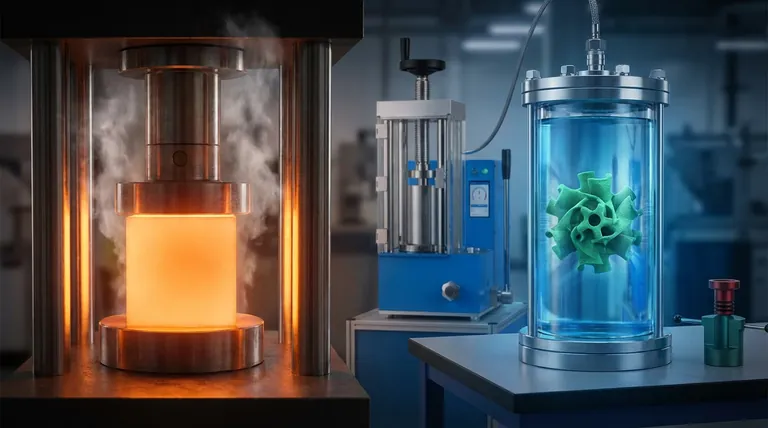
The Illusion of Simple Force
We think we understand pressure. It’s the force you feel when you squeeze something in your hand, or the weight of water when you dive deep into a pool.
But in the world of advanced materials, pressure is not a simple, monolithic concept. How you apply it—the geometry of the force—is as important as how much you apply.
This distinction is more than a technical detail. It’s a philosophical choice between targeted efficiency and absolute uniformity. For an engineer, it's the difference between a material that is merely strong and one that is flawlessly reliable. The most dangerous flaw, after all, is the one you can't see.
A Vise or the Ocean: Two Philosophies of Consolidation
At the heart of powder metallurgy and ceramics are two fundamentally different ways of thinking about pressure: directed force and uniform force.
Hot Pressing: The Power of a Focused Vise
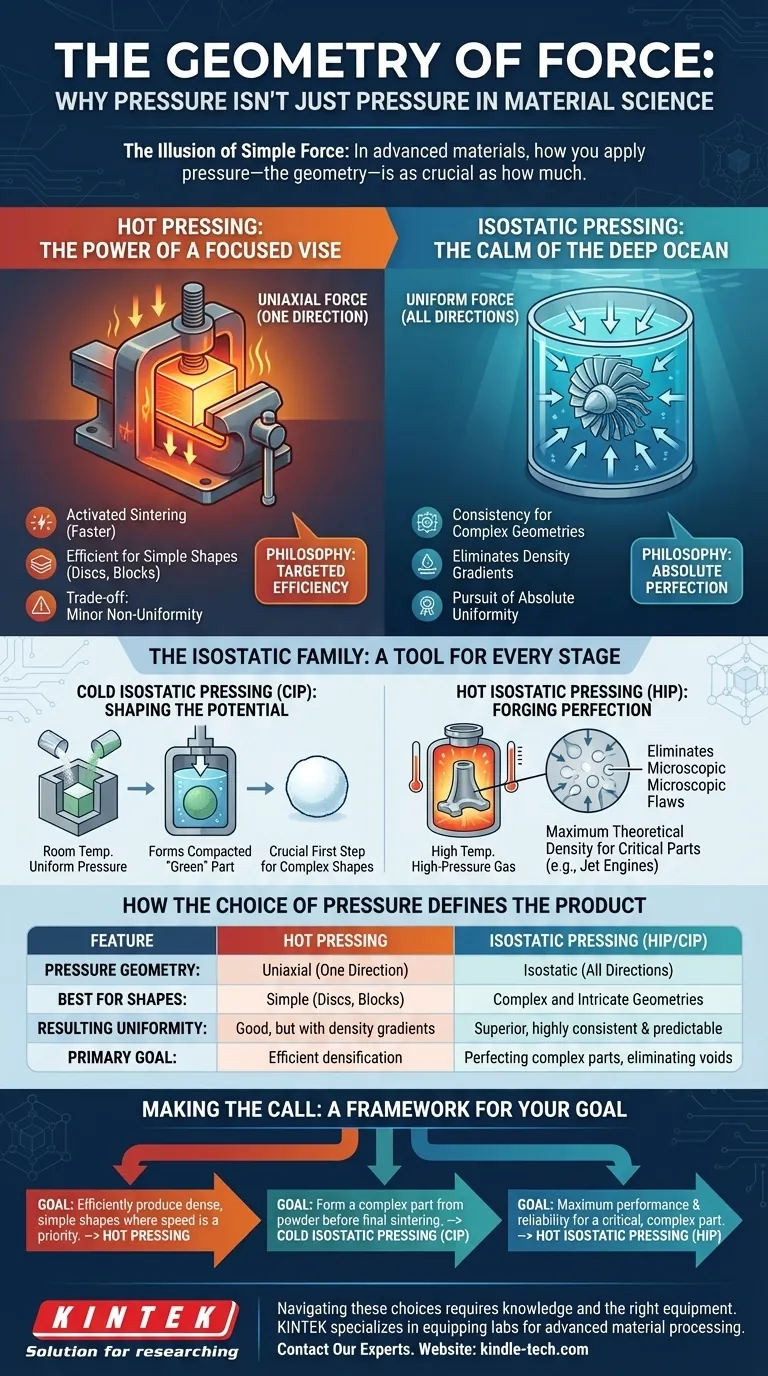
Hot pressing applies force uniaxially—from a single direction. Imagine a powerful, heated vise squeezing a powder in a die.
This combination of heat and direct pressure creates an "activated sintering process." The focused force is aggressive and efficient, breaking down surface oxides on powder particles and accelerating consolidation.
It's a process driven by a desire for efficiency. For simple shapes like discs or blocks, it is a fast and effective way to achieve high density. It accepts minor non-uniformity as a reasonable trade-off for speed.
Isostatic Pressing: The Calm of the Deep Ocean
Isostatic pressing applies force from all directions at once. The component is submerged in a fluid medium (liquid or gas) that is then pressurized. The experience is like being at the bottom of the Mariana Trench—the pressure is immense, but it is perfectly equal everywhere.
This method is born from a demand for perfection. It eliminates the variables of directional force, ensuring that density and microstructure are consistent throughout the entire part, regardless of its complexity. It is the pursuit of absolute uniformity.
The Isostatic Family: A Tool for Every Stage
"Isostatic pressing" isn't a single process but a category of techniques, each with a distinct purpose.
Cold Isostatic Pressing (CIP): Shaping the Potential
CIP applies uniform pressure at room temperature, typically using water or oil. Its goal is not to create a finished part, but to form a compacted powder component—known as a "green" part.
Think of it as perfectly packing a snowball. The green part has enough integrity to be handled and even machined, but its final strength will only come from a subsequent sintering process. CIP is the crucial first step for creating complex shapes from powder.
Hot Isostatic Pressing (HIP): Forging Perfection
HIP uses a high-pressure inert gas (like argon) at extreme temperatures. It is not typically used to form a shape, but to perfect it.
HIP is a finishing step that takes an already-formed part—like a metal casting or a 3D-printed component—and hunts down its internal flaws. The immense, uniform pressure collapses microscopic voids and internal porosity, elevating the material to its maximum theoretical density. This is the process used for parts where failure is not an option, like jet engine turbine blades and medical implants.
How the Choice of Pressure Defines the Product
The decision between a uniaxial vise and an isostatic ocean has profound and tangible consequences for the final component.
| Feature | Hot Pressing | Isostatic Pressing (HIP/CIP) |
|---|---|---|
| Pressure Geometry | Uniaxial (One Direction) | Isostatic (All Directions) |
| Best for Shapes | Simple (Discs, Blocks, Plates) | Complex and Intricate Geometries |
| Resulting Uniformity | Good, but with potential density gradients | Superior, highly consistent and predictable |
| Primary Goal | Efficient densification of simple forms | Perfecting complex parts, eliminating all voids (HIP) |
Integrity of Shape
Hot pressing is for straightforward geometries. Its directional force can cause distortion in complex parts, much like trying to carve a delicate sculpture with a sledgehammer.
Isostatic pressing, by contrast, respects the part's initial geometry. The uniform pressure conforms to every surface without warping it, making it essential for intricate designs.
Density vs. Predictability
Both processes produce highly dense parts. But HIP delivers something more valuable: predictability.
By eliminating microscopic defects, HIP removes the random, invisible stress points where a crack might begin. It transforms a material from simply "strong" to "unfailingly reliable." This psychological assurance is critical for any high-performance application.
Making the Call: A Framework for Your Goal
Choosing the right process is not about which is "better," but which is right for your objective.
-
Your Goal: Maximum performance and reliability for a critical, complex part. Your path is Hot Isostatic Pressing (HIP) for final densification.
-
Your Goal: Efficiently produce dense, simple shapes where speed is a priority. Your path is Hot Pressing.
-
Your Goal: Form a complex part from powder before a final sintering step. Your path begins with Cold Isostatic Pressing (CIP).
Navigating these choices requires not only knowledge but also the right laboratory equipment to test, validate, and produce results. At KINTEK, we specialize in equipping labs for exactly these kinds of advanced material processing challenges. If you're weighing the options for your next project, our team can help you select the ideal technology to achieve your goals. Contact Our Experts
Visual Guide
Related Products
- Automatic Heated Hydraulic Press Machine with Heated Plates for Laboratory Hot Press 25T 30T 50T
- Manual High Temperature Heated Hydraulic Press Machine with Heated Plates for Lab
- Touchscreen Automatic Vacuum Heat Press
- 30T 40T Split Automatic Heated Hydraulic Press Machine with Heated Plates for Laboratory Hot Press
- Vacuum Hot Press Furnace Machine Heated Vacuum Press
Related Articles
- Why Your Composite and Polymer Parts Keep Failing: The Secret Is Simultaneous Heat and Pressure
- The Physics of Flawless Materials: Deconstructing the Hydraulic Hot Press
- Precision Under Pressure: The Physics and Psychology of the Hydraulic Hot Press
- Hydraulic Hot Press: Principles, Components, Features, Advantages, and Applications
- Comprehensive Guide to Hydraulic Hot Press: Function, Features and Applications