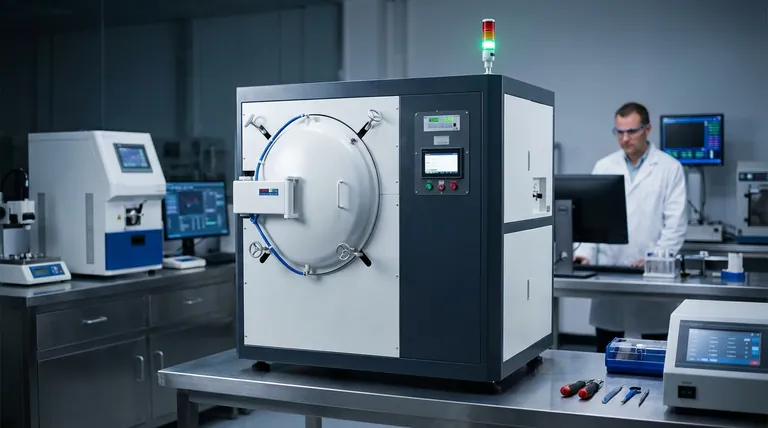
The Illusion of Simple Heat
When we think of heating something, we picture a kitchen oven or a forge. We put an object in, turn up the heat, and a transformation occurs. But this transformation is never just about temperature. It’s a chaotic conversation between the material and the atmosphere around it.
Oxygen, nitrogen, and water vapor are aggressive participants in this conversation. They react, they corrode, they contaminate. For a chef, this is called the Maillard reaction—a feature. For a material scientist, it's a catastrophic failure—a bug.
The fundamental challenge in advanced material processing isn't just achieving a target temperature. It's eliminating the unwanted variables. It's about achieving absolute control. This psychological drive for certainty is where the vacuum furnace transforms from a simple oven into an instrument of precision. Its primary job is not to add heat, but to first take something away: the air itself.
Anatomy of a Controlled Universe
A vacuum furnace is less a box for heating and more a self-contained, controllable environment. Its design is a testament to the engineering required to master "nothing."
The Vessel: A Boundary Against Chaos
The process begins with the vacuum chamber. This is not just a container; it's a fortress, engineered to withstand the crushing force of atmospheric pressure from the outside while containing extreme temperatures on the inside. It defines the boundary of the controlled world.
The Great Exhale: Achieving the Void
Creating the vacuum is a deliberate, two-act play.
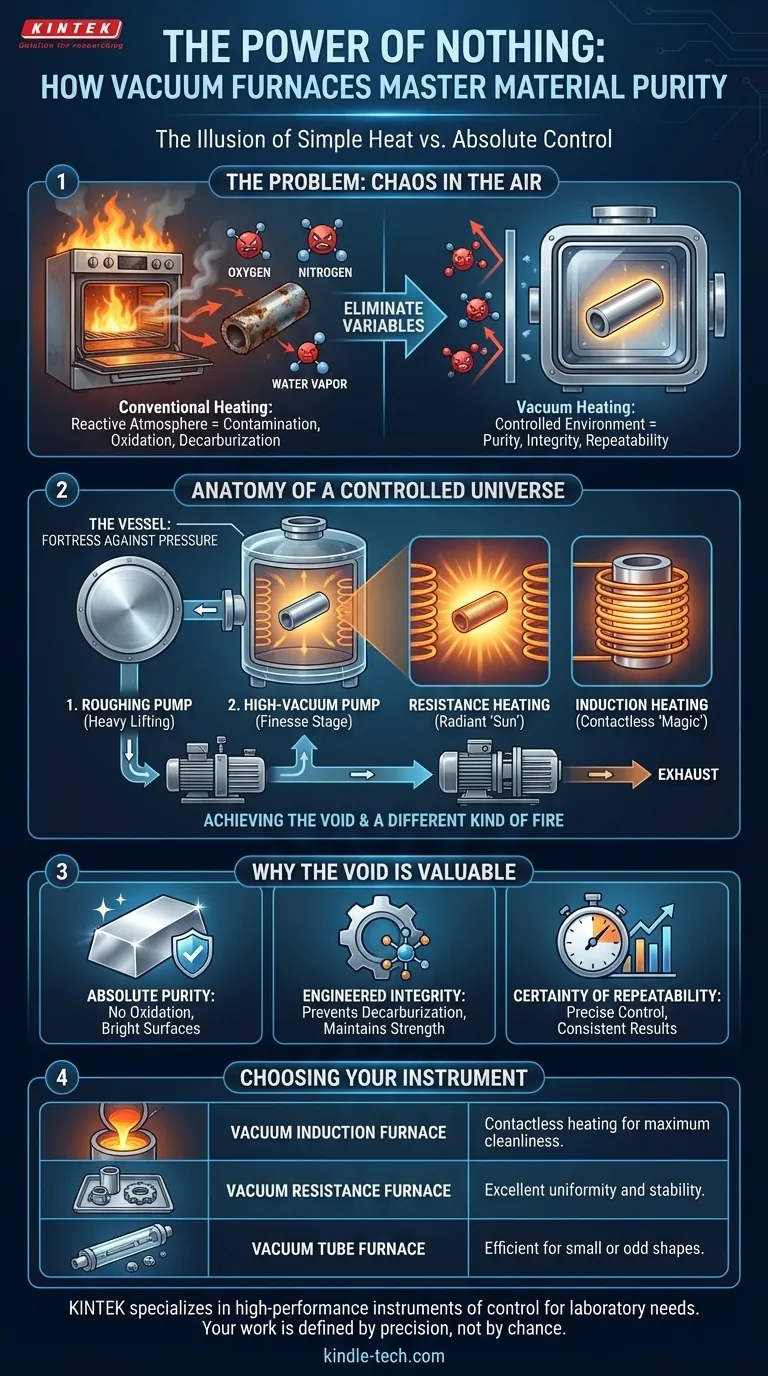
- The Roughing Pump: A mechanical pump acts first, removing the vast majority of the air. It does the heavy lifting, taking the chamber from atmospheric pressure to a rough vacuum.
- The High-Vacuum Pump: Once the roughing pump hits its limit, a diffusion or turbomolecular pump takes over. This is the finesse stage, capturing stray molecules to achieve the profound emptiness required for high-purity work.
A Different Kind of Fire
Heating in a near-vacuum is a challenge. With no air, you can't rely on convection. Instead, heat must be transferred through more fundamental forces.
- Resistance Heating: This is the equivalent of placing a small sun inside the chamber. Electric current flows through robust elements made of graphite or molybdenum, causing them to glow intensely. Heat radiates across the void, evenly soaking the workpiece. It is deliberate, steady, and uniform.
- Induction Heating: This method is more like magic. It uses a powerful electromagnetic field generated by a coil that never touches the material. This field induces electrical eddy currents directly within the metal, causing it to heat rapidly and cleanly from the inside out. It's a contactless, surgically precise way to deliver energy.
Why the Void is So Valuable
The complexity of a vacuum furnace is justified by the profound benefits of the environment it creates. It addresses the deepest anxieties of a metallurgist or engineer.
The Promise of Absolute Purity
This is the primary goal. Without oxygen, high-performance alloys can be heated to their annealing or brazing temperatures without a hint of oxidation or scaling. The surface remains bright, clean, and chemically unchanged. You are working with the material you designed, not an unintended, contaminated version of it.
Preserving Engineered Integrity
For high-carbon steels, a conventional atmosphere can leach carbon from the surface in a process called decarburization, softening the material and compromising its engineered properties. A vacuum completely eliminates this threat, ensuring the material’s strength and hardness remain exactly as intended.
The Certainty of Repeatability
By removing the volatile, unpredictable variable of air, the process becomes pure science. Heating rates, soak times, and cooling curves (often using a controlled backfill of inert gas like argon) can be programmed and executed with perfect fidelity. The result is not just a high-quality part, but the ability to produce that exact same part, every single time.
Choosing Your Instrument of Control
The right vacuum furnace is determined by your specific goal. The choice reflects the nature of the control you need. For laboratories dedicated to pushing the boundaries of material science, having the right instrument is paramount.
| Application Focus | Recommended Technology | Key Advantage |
|---|---|---|
| Melting & Casting Pure Alloys | Vacuum Induction Furnace | Contactless heating ensures maximum cleanliness. |
| Heat Treating & Brazing | Vacuum Resistance Furnace | Excellent temperature uniformity and stability. |
| Processing Small or Odd Shapes | Vacuum Tube Furnace | Efficient and tailored for specific geometries. |
Ultimately, working with a vacuum furnace is an exercise in appreciating the immense power of absence. It proves that to create a material with perfect integrity, you must first give it a space with perfect emptiness.
KINTEK specializes in providing these high-performance instruments of control for laboratory needs, ensuring your work is defined by precision, not by chance. If achieving this level of purity is critical to your research, Contact Our Experts.
Visual Guide
Related Products
- Vacuum Hot Press Furnace Heated Vacuum Press Machine Tube Furnace
- 600T Vacuum Induction Hot Press Furnace for Heat Treat and Sintering
- Vacuum Hot Press Furnace Machine Heated Vacuum Press
- Vacuum Heat Treat Furnace and Levitation Induction Melting Furnace
- 2200 ℃ Tungsten Vacuum Heat Treat and Sintering Furnace
Related Articles
- The Purity Paradox: Choosing the Heart of Your Vacuum Hot Press Furnace
- Comprehensive Guide to Vacuum Hot Press Furnace Application
- Vacuum Hot Press Furnace: A Comprehensive Guide
- Forging Perfection in a Void: The Physics of Ultra-Dense Materials
- Defeating the Void: The Quiet Power of Vacuum Hot Pressing



















