A Flaw You Can't See
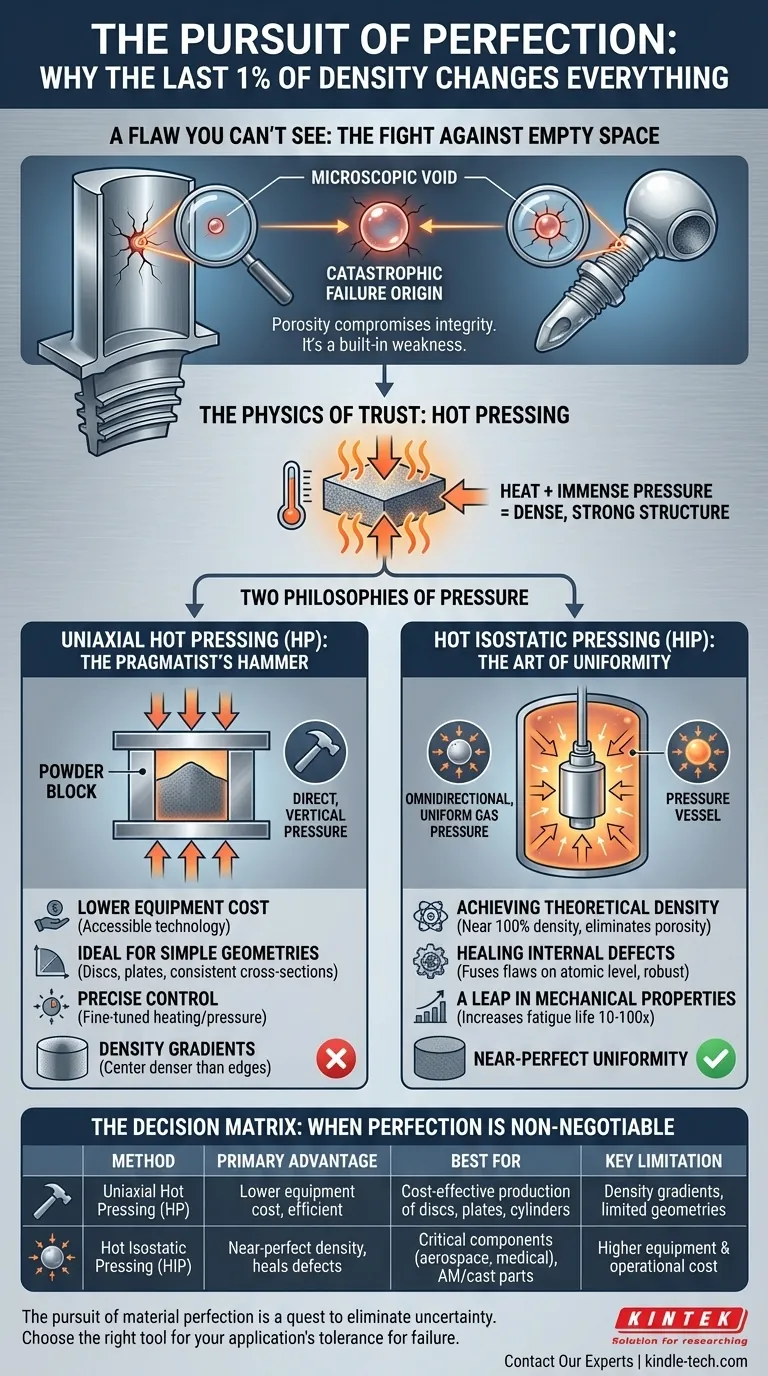
Imagine a turbine blade spinning at 10,000 RPM. Or a medical implant designed to last a lifetime. Their strength isn't just a feature; it's the foundation of their function. But deep within the metal, a microscopic void—a tiny bubble of nothingness left over from manufacturing—can become the origin point of a catastrophic failure.
This is the central challenge in advanced materials manufacturing: the fight against empty space.
The integrity of a high-performance component is determined not by its visible shape, but by its internal uniformity. Porosity, even at a microscopic level, compromises everything. It's a built-in weakness.
The Physics of Trust
This is where hot pressing comes in. The principle is elegantly simple: apply high temperature and immense pressure simultaneously.
The heat softens the material, making it pliable. The pressure collapses the internal voids, forcing the material's atoms into a dense, tightly-packed structure. The result is a component that is dramatically stronger, less porous, and more trustworthy than one made by other methods.
But how you apply that pressure creates two fundamentally different outcomes. This choice is a critical fork in the road, defining the part's cost, complexity, and ultimate performance.
Two Philosophies of Pressure
The decision boils down to a single question: is pressure applied from one direction, or from every direction at once?
Uniaxial Hot Pressing (HP): The Pragmatist's Hammer
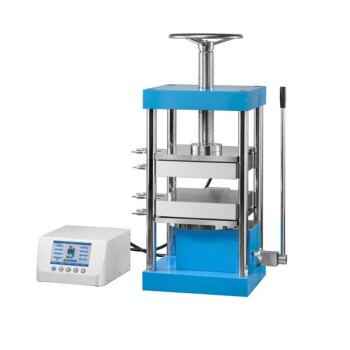
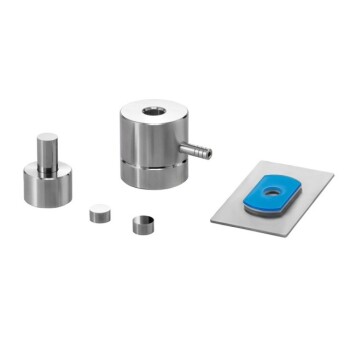
This is the workhorse of densification. Powder is placed in a die, and pressure is applied vertically, like a powerful, precise hammer.
It’s a direct and efficient approach, making it an excellent choice for specific applications.
- Lower Equipment Cost: The machinery is less complex than its isostatic counterpart, making it a more accessible technology for many labs and manufacturers.
- Ideal for Simple Geometries: It excels at producing parts with consistent cross-sections, like the large sputtering targets, plates, and discs common in research and industry.
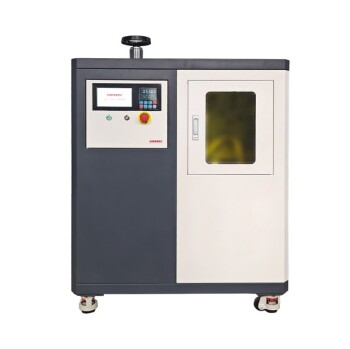
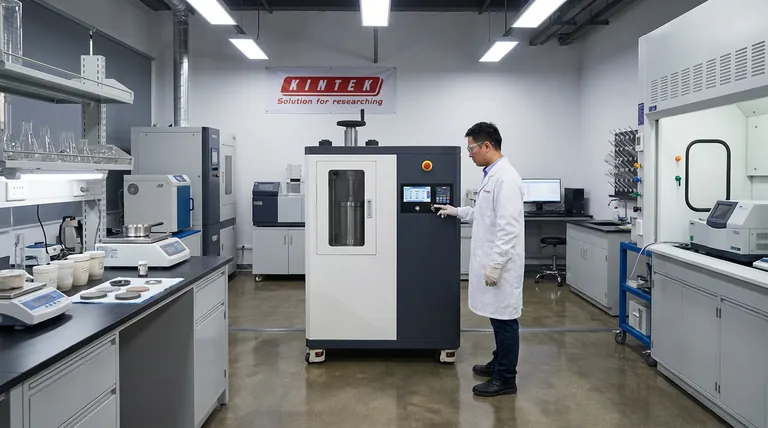
- Precise Control: Modern uniaxial presses, like those from KINTEK, offer fine-tuned control over heating and pressure cycles, allowing engineers to optimize the densification process for specific materials.
But its directness is also its limitation. Like squeezing a handful of snow, the pressure is never perfectly uniform. Friction against the die walls can create slight density gradients—the center may be denser than the edges. For many applications, this is acceptable. For critical ones, it is not.
Hot Isostatic Pressing (HIP): The Art of Uniformity
HIP is a more profound process. A component is placed inside a high-pressure vessel and heated. Then, an inert gas like argon is used to apply immense, perfectly uniform pressure from all directions simultaneously.
It’s like sending the part to the bottom of the deepest ocean. There is no "up" or "down"—only an relentless, equalizing force.
This uniformity unlocks a new level of material perfection.
- Achieving Theoretical Density: HIP can eliminate virtually all internal porosity, bringing a part to nearly 100% of its theoretical maximum density.
- Healing Internal Defects: It is uniquely capable of healing microscopic flaws inside castings or additively manufactured (3D printed) parts, fusing the material back together on an atomic level. This transforms a part with potential weaknesses into a uniformly robust component.
- A Leap in Mechanical Properties: By erasing internal defects, HIP can increase a component's fatigue life by a factor of 10 to 100. Wear resistance, ductility, and reliability see dramatic improvements.
The Decision Matrix: When Perfection is Non-Negotiable
Choosing between these two methods is a matter of understanding your application's tolerance for failure.
- For critical components where failure is not an option (aerospace, medical, defense), Hot Isostatic Pressing (HIP) is the definitive choice. It is the process you use to build ultimate trust into the material.
- For cost-effective production of simpler, high-quality shapes like lab consumables or industrial plates, Uniaxial Hot Pressing (HP) offers a powerful and balanced solution.
- For unlocking the potential of 3D printed or cast parts, HIP is an essential post-processing step that heals the inherent porosity of those methods, elevating their performance to that of wrought materials.
A Summary of Trade-offs
| Hot Pressing Method | Primary Advantage | Best For | Key Limitation |
|---|---|---|---|
| Uniaxial Hot Pressing (HP) | Lower equipment cost, efficient for simple shapes | Cost-effective production of discs, plates, cylinders | Density gradients, limited to simple geometries |
| Hot Isostatic Pressing (HIP) | Near-perfect density, heals internal defects | Critical components in aerospace, medical, AM/cast parts | Higher equipment and operational cost |
The pursuit of material perfection is a quest to eliminate uncertainty. Whether you require the pragmatic efficiency of uniaxial pressing or the absolute reliability offered by HIP, having the right laboratory equipment is the first step toward achieving your goals. At KINTEK, we provide the specialized equipment to navigate these complex material science challenges.
To find the optimal solution for your R&D and production needs, Contact Our Experts.
Visual Guide
Related Products
- Automatic Heated Hydraulic Press Machine with Heated Plates for Laboratory Hot Press 25T 30T 50T
- Manual High Temperature Heated Hydraulic Press Machine with Heated Plates for Lab
- Touchscreen Automatic Vacuum Heat Press
- 30T 40T Split Automatic Heated Hydraulic Press Machine with Heated Plates for Laboratory Hot Press
- Vacuum Hot Press Furnace Machine Heated Vacuum Press
Related Articles
- Why Your Composite and Polymer Parts Keep Failing: The Secret Is Simultaneous Heat and Pressure
- The Physics of Flawless Materials: Deconstructing the Hydraulic Hot Press
- Precision Under Pressure: The Physics and Psychology of the Hydraulic Hot Press
- Hydraulic Hot Press: Principles, Components, Features, Advantages, and Applications
- Comprehensive Guide to Hydraulic Hot Press: Function, Features and Applications