Knowledge Does black PVD fade? Discover the Truth About Its Unbeatable Color Stability
Author avatar

Tech Team · Kintek Solution

Updated 6 days ago

Does black PVD fade? Discover the Truth About Its Unbeatable Color Stability


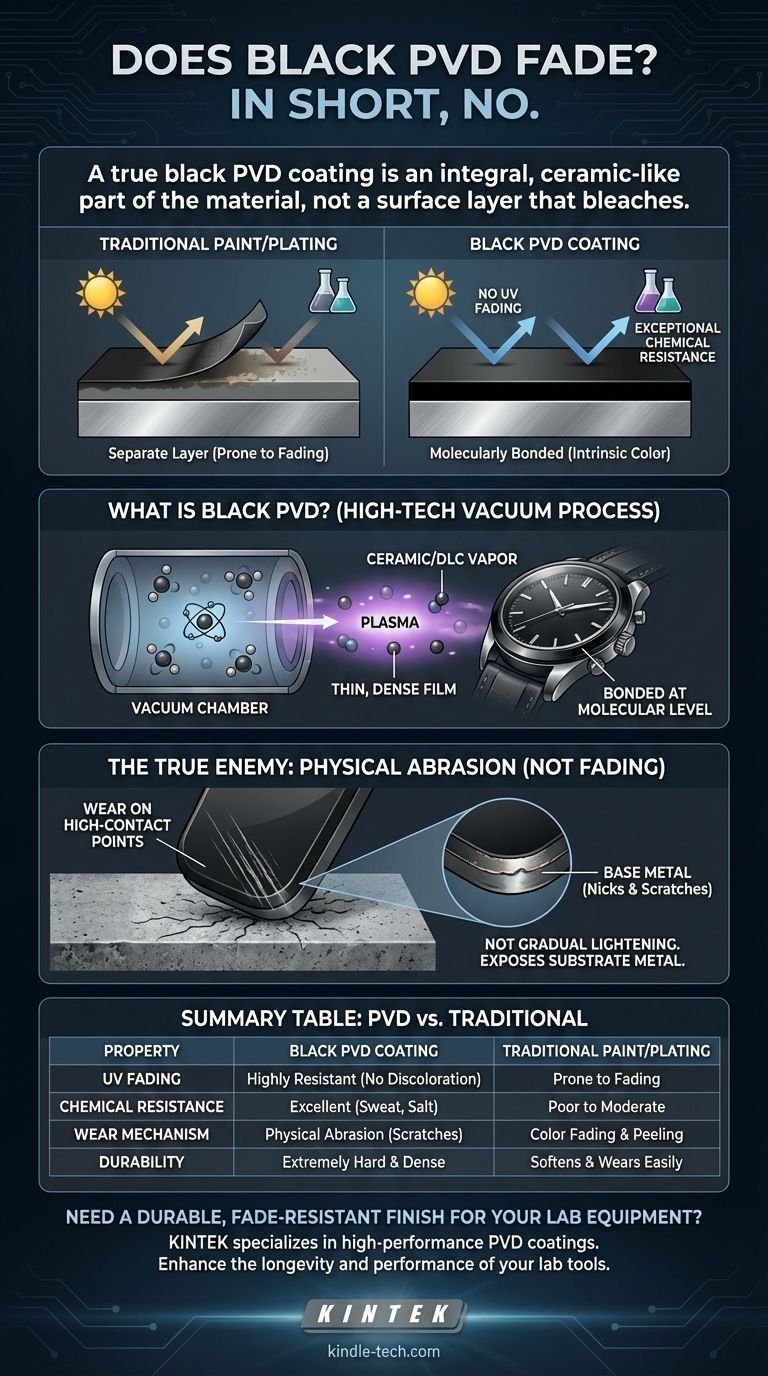
In short, no. A true black PVD coating does not "fade" in the way paint or a dye would. The color is not a separate layer that can be bleached by the sun; it is an integral part of a hard, ceramic-like material bonded to the base metal. However, it is not indestructible and can wear away over time through physical abrasion, revealing the metal underneath.

PVD's exceptional durability means its primary vulnerability is not color fading from UV light or chemicals, but rather long-term physical wear and scratching that can expose the substrate metal on high-contact points.
Does black PVD fade? Discover the Truth About Its Unbeatable Color Stability

What Exactly is Black PVD?

To understand why PVD (Physical Vapor Deposition) doesn't fade, you must first understand that it isn't a paint, powder coat, or traditional plating. It is a fundamentally different and far more advanced process.

A High-Tech Vacuum Process

PVD is a process conducted in a high-vacuum chamber where a solid material—often a ceramic like Titanium Nitride or Diamond-Like Carbon (DLC)—is vaporized into a plasma of atoms.

These atoms are then deposited onto the target object (like a watch case or faucet), bonding to it on a molecular level.

A Thin Film, Not a Wet Coating

This process creates an extremely thin yet incredibly hard and dense film over the substrate metal. The black color is an intrinsic property of the deposited material itself, not a pigment that can break down.

Why PVD Excels in Color Stability

The molecular structure of a PVD coating makes it inherently resistant to the environmental factors that cause other finishes to fail.

Immunity to UV Fading

Because the color is part of a stable, ceramic-like atomic structure, it is not susceptible to being broken down by ultraviolet (UV) radiation from the sun. It will not discolor or lose its vibrancy over time.

Exceptional Chemical Resistance

PVD coatings are highly inert. They can easily withstand exposure to sweat, salt water, and common household chemicals that would tarnish or discolor lesser finishes.

Understanding the Real-World Wear and Tear

While PVD is incredibly tough, it is not invincible. The perception of "fading" almost always comes from a misunderstanding of how it wears.

The True Enemy: Abrasion

The primary threat to a PVD coating is physical abrasion. This means scraping it against hard, rough surfaces like concrete, brick, sand, or even other hardened metals.

Over many years, this type of contact will gradually wear the coating away, particularly on sharp edges and high-contact points like a watch clasp or bracelet links.

How Wear Actually Appears

You will not see a gradual lightening of the black color. Instead, you will eventually see small nicks, scratches, or worn patches where the thin PVD layer has been completely removed, revealing the silver-colored stainless steel or titanium base metal underneath.

Durability Is Not Invincibility

Think of PVD as armor for your product. It provides a massive upgrade in scratch resistance compared to bare steel, but a hard enough impact or a significant scrape will eventually get through any armor.

The Proof Is in Its Removal

The extreme durability of PVD is underscored by the difficulty of removing it. Stripping a PVD coating requires specialized industrial processes, a testament to how strongly it is bonded and how resistant it is to everyday wear.

Making the Right Choice for Your Goal

Understanding how PVD performs allows you to set realistic expectations for your product's long-term appearance.

  • If your primary focus is daily wear and color stability: PVD is an outstanding choice. It will not fade from sun or sweat and offers superior scratch resistance for everyday situations.
  • If your primary focus is a pristine, flawless look forever: Recognize that no finish is permanent. A black PVD-coated item that is used heavily will eventually show signs of its history through scratches and wear on the edges.
  • If you are choosing between PVD and cheaper "blackened" metals: PVD offers vastly superior longevity and durability, making it a far better investment for any item you intend to keep for years.

By understanding that PVD's challenge is physical wear rather than color fading, you can better predict its long-term performance and value.

Summary Table:

Property Black PVD Coating Traditional Paint/Plating
UV Fading Highly Resistant Prone to Fading
Chemical Resistance Excellent (sweat, salt water) Poor to Moderate
Wear Mechanism Physical Abrasion (scratches) Color Fading & Peeling
Durability Extremely Hard & Dense Softens and Wears Easily

Need a Durable, Fade-Resistant Finish for Your Laboratory Equipment?
KINTEK specializes in high-performance PVD coatings for lab equipment and consumables. Our advanced coating technology ensures your products withstand harsh environments, chemicals, and daily wear without losing their aesthetic appeal. Enhance the longevity and performance of your lab tools – contact our experts today to discuss your specific needs!

Visual Guide
Does black PVD fade? Discover the Truth About Its Unbeatable Color Stability Visual Guide

Related Products

People Also Ask

Related Products

Custom CVD Diamond Coating for Lab Applications

Custom CVD Diamond Coating for Lab Applications

CVD Diamond Coating: Superior Thermal Conductivity, Crystal Quality, and Adhesion for Cutting Tools, Friction, and Acoustic Applications

RF PECVD System Radio Frequency Plasma-Enhanced Chemical Vapor Deposition RF PECVD

RF PECVD System Radio Frequency Plasma-Enhanced Chemical Vapor Deposition RF PECVD

RF-PECVD is an acronym for "Radio Frequency Plasma-Enhanced Chemical Vapor Deposition." It deposits DLC (Diamond-like carbon film) on germanium and silicon substrates. It is utilized in the 3-12um infrared wavelength range.

Vacuum Hot Press Furnace Machine for Lamination and Heating

Vacuum Hot Press Furnace Machine for Lamination and Heating

Experience clean and precise lamination with Vacuum Lamination Press. Perfect for wafer bonding, thin-film transformations, and LCP lamination. Order now!

Vacuum Dental Porcelain Sintering Furnace

Vacuum Dental Porcelain Sintering Furnace

Get precise and reliable results with KinTek's Vacuum Porcelain Furnace. Suitable for all porcelain powders, it features hyperbolic ceramic furnace function, voice prompt, and automatic temperature calibration.

Multi Zone Laboratory Quartz Tube Furnace Tubular Furnace

Multi Zone Laboratory Quartz Tube Furnace Tubular Furnace

Experience precise, efficient thermal testing with our Multi Zone Tube Furnace. Independent heating zones and temperature sensors allow for controlled high-temperature gradient heating fields. Order now for advanced thermal analysis!

Rotating Platinum Disk Electrode for Electrochemical Applications

Rotating Platinum Disk Electrode for Electrochemical Applications

Upgrade your electrochemical experiments with our Platinum Disc Electrode. High-quality and reliable for accurate results.

1400℃ Laboratory Quartz Tube Furnace with Alumina Tube Tubular Furnace

1400℃ Laboratory Quartz Tube Furnace with Alumina Tube Tubular Furnace

Looking for a tube furnace for high-temperature applications? Our 1400℃ Tube Furnace with Alumina Tube is perfect for research and industrial use.

Hexagonal Boron Nitride HBN Thermocouple Protection Tube

Hexagonal Boron Nitride HBN Thermocouple Protection Tube

Hexagonal boron nitride ceramics is an emerging industrial material. Because of its similar structure to graphite and many similarities in performance, it is also called "white graphite".

Vertical Laboratory Quartz Tube Furnace Tubular Furnace

Vertical Laboratory Quartz Tube Furnace Tubular Furnace

Elevate your experiments with our Vertical Tube Furnace. Versatile design allows for operation under various environments and heat treatment applications. Order now for precise results!

1200℃ Split Tube Furnace with Quartz Tube Laboratory Tubular Furnace

1200℃ Split Tube Furnace with Quartz Tube Laboratory Tubular Furnace

KT-TF12 split tube furnace: high-purity insulation, embedded heating wire coils, and max. 1200C. Widely used for new materials and chemical vapour deposition.

1700℃ Controlled Atmosphere Furnace Nitrogen Inert Atmosphere Furnace

1700℃ Controlled Atmosphere Furnace Nitrogen Inert Atmosphere Furnace

KT-17A Controlled atmosphere furnace: 1700℃ heating, vacuum sealing technology, PID temperature control, and versatile TFT smart touch screen controller for laboratory and industrial use.

Silicon Carbide SiC Thermal Heating Elements for Electric Furnace

Silicon Carbide SiC Thermal Heating Elements for Electric Furnace

Experience the advantages of Silicon Carbide (SiC) Heating Element: Long service life, high corrosion and oxidation resistance, fast heating speed, and easy maintenance. Learn more now!

1400℃ Controlled Atmosphere Furnace with Nitrogen and Inert Atmosphere

1400℃ Controlled Atmosphere Furnace with Nitrogen and Inert Atmosphere

Achieve precise heat treatment with KT-14A controlled atmosphere furnace. Vacuum sealed with a smart controller, it's ideal for lab and industrial use up to 1400℃.

Graphite Vacuum Furnace IGBT Experimental Graphitization Furnace

Graphite Vacuum Furnace IGBT Experimental Graphitization Furnace

IGBT experimental graphitization furnace, a tailored solution for universities and research institutions, with high heating efficiency, user-friendliness, and precise temperature control.

1700℃ Laboratory Quartz Tube Furnace with Alumina Tube Tubular Furnace

1700℃ Laboratory Quartz Tube Furnace with Alumina Tube Tubular Furnace

Looking for a high-temperature tube furnace? Check out our 1700℃ Tube Furnace with Alumina Tube. Perfect for research and industrial applications up to 1700C.

Laboratory Muffle Oven Furnace Bottom Lifting Muffle Furnace

Laboratory Muffle Oven Furnace Bottom Lifting Muffle Furnace

Efficiently produce batches with excellent temperature uniformity using our Bottom Lifting Furnace. Features two electric lifting stages and advanced temperature control up to 1600℃.

High Temperature Muffle Oven Furnace for Laboratory Debinding and Pre Sintering

High Temperature Muffle Oven Furnace for Laboratory Debinding and Pre Sintering

KT-MD High temperature debinding and pre-sintering furnace for ceramic materials with various molding processes. Ideal for electronic components such as MLCC and NFC.

Graphite Vacuum Continuous Graphitization Furnace

Graphite Vacuum Continuous Graphitization Furnace

High-temperature graphitization furnace is a professional equipment for graphitization treatment of carbon materials. It is a key equipment for the production of high-quality graphite products. It has high temperature, high efficiency and uniform heating. It is suitable for various high-temperature treatments and graphitization treatments. It is widely used in metallurgy, electronics, aerospace, etc. industry.

Platinum Sheet Electrode for Laboratory and Industrial Applications

Platinum Sheet Electrode for Laboratory and Industrial Applications

Elevate your experiments with our Platinum Sheet Electrode. Crafted with quality materials, our safe and durable models can be tailored to fit your needs.

Isostatic Molding Pressing Molds for Lab

Isostatic Molding Pressing Molds for Lab

Explore high-performance isostatic pressing molds for advanced material processing. Ideal for achieving uniform density and strength in manufacturing.


Leave Your Message