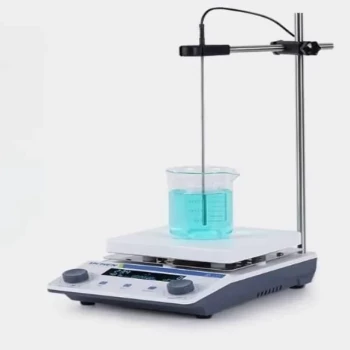
A magnetic stirrer hotplate serves as the primary driver for the chemical activation of carbonized aluminum-based metal-organic frameworks (Al-MOFs). By simultaneously maintaining a temperature of approximately 95°C and providing vigorous mechanical agitation, it enables a sodium hydroxide (NaOH) solution to effectively etch away impurities. This process dissolves residual aluminum and aluminum oxides, unblocking the material’s porous structure to maximize its utility.
The core function of this equipment is to facilitate "wet etching," a process that chemically strips away non-carbon components. By ensuring consistent heat and uniform chemical contact, the stirrer hotplate transforms a blocked, raw carbonized product into a highly porous material with superior adsorption performance.
The Role of Thermal Energy in Activation
Driving the Etching Reaction
The chemical removal of aluminum species is an endothermic process that requires sustained thermal energy. The hotplate must maintain the solution at roughly 95°C to ensure the reaction proceeds efficiently.
Dissolving Impurities
At this elevated temperature, the strong sodium hydroxide solution becomes highly reactive. It targets and dissolves residual aluminum metal and aluminum oxide impurities that are trapped within the carbon matrix.
Clearing the Pore Structure
These impurities act as physical blockages within the material. By chemically dissolving them via heat, the process effectively "unclogs" the internal architecture of the carbon.
The Criticality of Mechanical Agitation
Maintaining Uniform Suspension
As noted in similar suspension processes, the magnetic stirrer plays a vital role in keeping particles in a uniform suspension. Without this, the carbonized particles would settle at the bottom of the beaker.
Eliminating Concentration Gradients
Continuous rotation eliminates local "dead zones" where the concentration of NaOH might drop. Agitation ensures that fresh, reactive solution is constantly cycling over the surface of every particle.
Ensuring Surface Uniformity
By preventing particle settling and stagnation, the stirrer guarantees that the water and NaOH contact every particle surface uniformly. This results in a consistent activation level across the entire batch of material, rather than just the top layer.
The Impact on Material Performance
Expanding Pore Volume
The combination of heat and stirring does more than just clean the surface; it expands the internal voids. This leads to a significant increase in both microporous and mesoporous spaces.
Enhancing Adsorption
The ultimate goal of this activation is functionality. By clearing blocked pores and expanding the surface area, the final carbon material exhibits significantly enhanced adsorption performance.
Understanding the Trade-offs
Temperature Precision vs. Evaporation
While high heat (95°C) is required for effective etching, it sits close to the boiling point of water. Operating without precise temperature control can lead to rapid solvent evaporation, altering the concentration of NaOH and potentially affecting the consistency of the etch.
Agitation Balance
While high-speed stirring prevents settling, excessive turbulence can occasionally cause splashing or mechanical attrition of fragile carbon structures. The goal is to achieve a stable suspension without inducing violent shear forces that could degrade the material's physical integrity.
Making the Right Choice for Your Goal
To optimize the activation of Al-MOF derived carbon, align your equipment settings with your specific objectives:
- If your primary focus is maximizing pore volume: Prioritize precise thermal regulation at 95°C to ensure the NaOH has sufficient energy to fully dissolve deep-seated aluminum impurities.
- If your primary focus is batch consistency: Ensure high-speed, constant magnetic stirring to eliminate concentration gradients and prevent particle settling during the reaction.
Ultimately, the magnetic stirrer hotplate acts as the gatekeeper of quality, turning a raw carbonized solid into a refined, high-performance porous material.
Summary Table:
| Feature | Role in Activation Process | Material Impact |
|---|---|---|
| Thermal Energy (95°C) | Drives endothermic etching of aluminum and oxides | Clears blocked internal pore architecture |
| Mechanical Agitation | Maintains uniform suspension and eliminates gradients | Ensures consistent surface activation across the batch |
| Chemical Interaction | Facilitates NaOH "wet etching" of impurities | Significantly increases microporous and mesoporous volume |
| Process Control | Balances heat precision and stirring speed | Prevents solvent evaporation and material attrition |
Elevate Your Material Research with KINTEK
Precision is the key to unlocking superior material performance. At KINTEK, we specialize in providing high-performance laboratory equipment designed for the rigorous demands of chemical activation and materials science. Whether you are developing carbonized Al-MOF products or advancing battery research, our comprehensive range of equipment—from magnetic stirrer hotplates and cooling solutions to high-temperature furnaces, autoclaves, and hydraulic presses—ensures your lab achieves consistent, repeatable results.
Ready to optimize your porous material synthesis? Contact us today to find the perfect equipment for your workflow and see how our expertise in laboratory consumables and hardware can accelerate your research.
References
- Dasom Jeong, Jeasung Park. Synthesis of Aluminum-Based Metal–Organic Framework (MOF)-Derived Carbon Nanomaterials and Their Water Adsorption Isotherm. DOI: 10.3390/nano13162351
This article is also based on technical information from Kintek Solution Knowledge Base .
Related Products
- Laboratory Small Constant Temperature Heated Magnetic Stirrer Heater and Stirrer
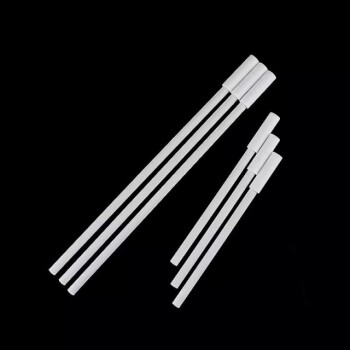
- Custom PTFE Teflon Parts Manufacturer for Magnetic Stirring Bar
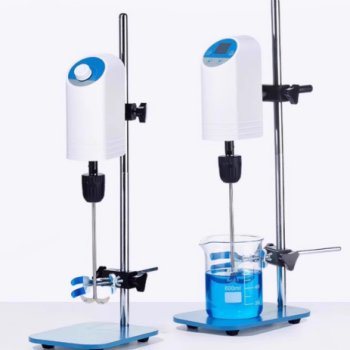
- High Performance Laboratory Stirrers for Diverse Applications
- Custom PTFE Teflon Parts Manufacturer for PTFE Stirring Bar Recovery Rod
People Also Ask
- What role does a magnetic stirrer with heating play in ZnO nanoparticle synthesis? Precision Control for Quality Results
- What role does a constant temperature heating magnetic stirrer play in MFC-HAp synthesis? Achieve Material Homogeneity
- What is the function of a laboratory magnetic stirrer in Ni–Cr–P electrodeposition? Optimize Ion Transport & Coating
- Why is a laboratory magnetic stirrer required for benzoic acid esters? Boost Reaction Speed & Yield with High RPM
- What role does a laboratory magnetic stirrer play in TiO2 and TiO2-Ag sol preparation? Master Chemical Kinetics