Knowledge Vacuum Furnace How does furnace cooling occur in the heat treatment process? A Guide to Controlled Slow Cooling
Author avatar

Tech Team · Kintek Solution

Updated 2 months ago

How does furnace cooling occur in the heat treatment process? A Guide to Controlled Slow Cooling


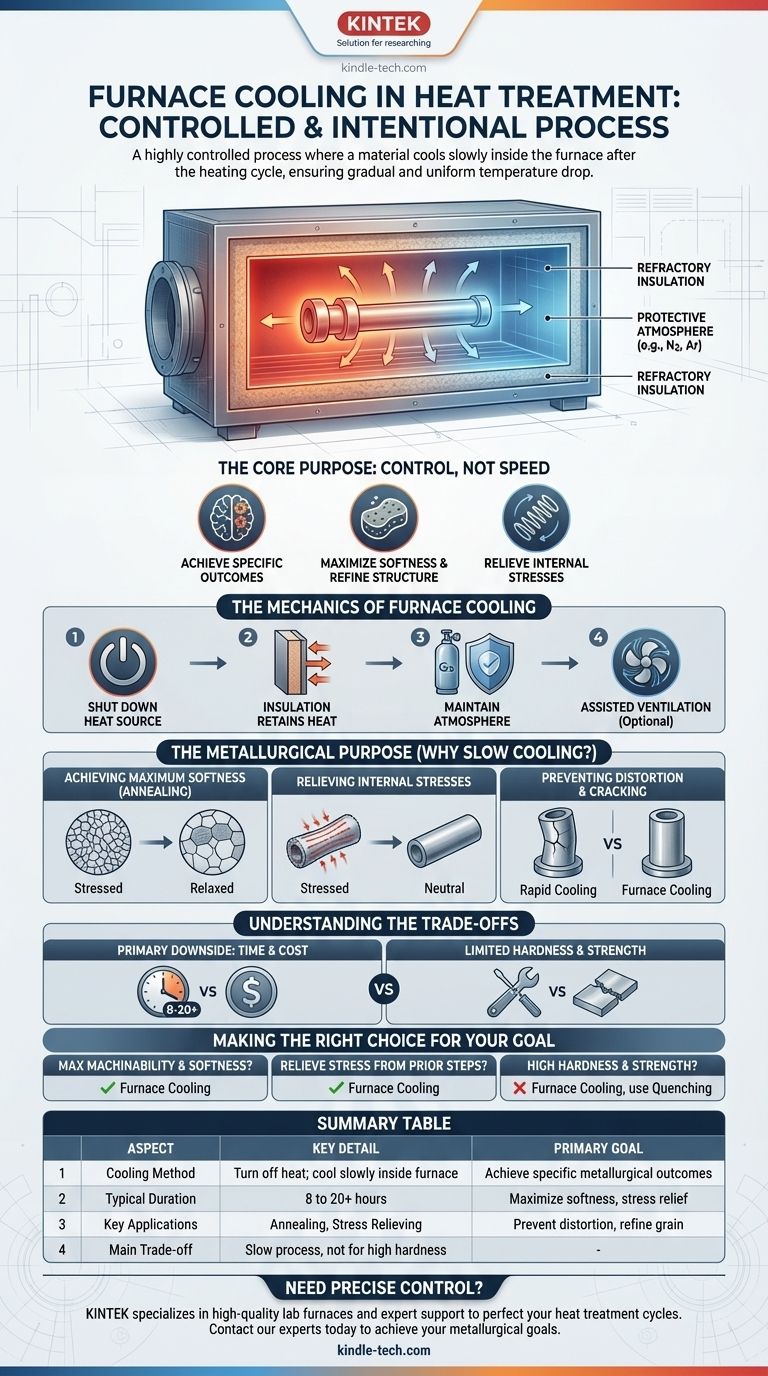
Furnace cooling is a highly controlled, intentional process used in heat treatment where a material is cooled slowly inside the furnace itself after the heating cycle is complete. The process relies on shutting off the heat source and allowing the insulated furnace chamber and the material within it to cool down together, often over many hours, ensuring a gradual and uniform temperature drop.

The core purpose of furnace cooling is not speed, but control. This deliberately slow process is chosen to achieve specific metallurgical outcomes, primarily to maximize softness, refine the grain structure, and relieve internal stresses that other, faster cooling methods would introduce.
How does furnace cooling occur in the heat treatment process? A Guide to Controlled Slow Cooling

The Mechanics of Furnace Cooling

The process may seem passive, but it is a carefully managed phase of heat treatment. Several key components and principles work together to control the cooling rate.

Shutting Down the Heat Source

The first and most obvious step is turning off the furnace's heating elements or gas burners. This action stops the introduction of new thermal energy into the system.

The Role of Furnace Insulation

Industrial furnaces are built with heavy-duty refractory insulation designed to retain heat efficiently. During the cooling phase, this same insulation prevents heat from escaping too quickly, becoming the primary factor dictating the slow cooling rate.

Maintaining the Protective Atmosphere

As the references note, furnaces often use a controlled atmosphere (e.g., nitrogen, argon) to prevent oxidation and other surface reactions at high temperatures. This atmosphere is maintained throughout the slow cooling cycle to protect the material's surface integrity until it is cool enough to be exposed to air.

Assisting Cooling with Ventilation

For certain processes requiring a slightly faster but still controlled cool-down, sealed fans are used. These fans circulate the inert atmosphere within the furnace, promoting more uniform temperature distribution and slightly accelerating heat transfer to the furnace's water-cooled walls or dedicated heat exchangers.

Why Choose Slow Cooling? The Metallurgical Purpose

The cooling rate is arguably the most critical variable in determining the final microstructure, and therefore the mechanical properties, of a metal part.

Achieving Maximum Softness (Annealing)

Furnace cooling is the defining characteristic of annealing. This slow rate allows the metal's internal crystal structure sufficient time to transform into its softest, most stable state. For steel, this means ensuring a full transformation into a coarse pearlite structure, which is ideal for subsequent machining.

Relieving Internal Stresses

Manufacturing processes like welding, casting, or heavy machining introduce significant internal stresses into a material. A slow furnace cool, often called stress relieving, allows the material's atoms to gently reposition themselves, relaxing these stresses and reducing the risk of distortion or cracking later in the component's life.

Preventing Distortion and Cracking

Rapid cooling (quenching) creates a severe temperature gradient between the surface and the core of a part, inducing massive internal stress. Furnace cooling minimizes this thermal shock, making it essential for complex shapes or brittle materials that would otherwise warp or crack.

Understanding the Trade-offs

While furnace cooling provides significant metallurgical benefits, it is not the right choice for every application. Its primary trade-offs are time and the resulting material properties.

The Primary Downside: Time and Cost

Furnace cooling is exceptionally slow, often taking 8 to 20 hours or more. This long cycle time occupies expensive furnace equipment, reduces production throughput, and increases the overall cost per part.

Limited Hardness and Strength

This process produces the softest and most ductile condition possible for a given metal. It is fundamentally unsuitable for applications where high hardness and strength are the primary objectives, such as creating tools or wear-resistant surfaces. Those require the exact opposite: rapid quenching.

Making the Right Choice for Your Goal

Selecting the correct cooling method is essential for achieving the desired outcome of any heat treatment process.

  • If your primary focus is maximum machinability and softness: Furnace cooling, as part of an annealing cycle, is the correct method to produce the required soft and uniform microstructure.
  • If your primary focus is relieving stress from prior manufacturing steps: A controlled furnace cool is the standard and safest procedure to reduce internal stresses and prevent future distortion.
  • If your primary focus is achieving high hardness and strength: You must use a rapid cooling method, such as quenching in oil, water, or polymer, as furnace cooling will produce the opposite result.

Ultimately, mastering the cooling rate is fundamental to controlling the final properties and performance of any heat-treated component.

Summary Table:

Aspect Key Detail
Primary Goal Achieve specific metallurgical outcomes (softness, stress relief)
Cooling Method Turn off heat; material cools slowly inside the insulated furnace
Typical Duration 8 to 20+ hours
Key Applications Annealing (for softness), Stress Relieving
Main Trade-off Slow process, not suitable for achieving high hardness

Need precise control over your material's properties? The furnace cooling process is key to achieving specific outcomes like maximum softness and stress relief. KINTEK specializes in providing the high-quality lab furnaces and expert support you need to perfect your heat treatment cycles. Whether you're annealing, stress relieving, or developing new processes, our equipment is designed for reliability and precision. Contact our thermal processing experts today to discuss how we can help you achieve your metallurgical goals.

Visual Guide
How does furnace cooling occur in the heat treatment process? A Guide to Controlled Slow Cooling Visual Guide

Related Products

People Also Ask

Related Products

Graphite Vacuum Furnace High Thermal Conductivity Film Graphitization Furnace

Graphite Vacuum Furnace High Thermal Conductivity Film Graphitization Furnace

The high thermal conductivity film graphitization furnace has uniform temperature, low energy consumption and can operate continuously.

High Temperature Muffle Oven Furnace for Laboratory Debinding and Pre Sintering

High Temperature Muffle Oven Furnace for Laboratory Debinding and Pre Sintering

KT-MD High temperature debinding and pre-sintering furnace for ceramic materials with various molding processes. Ideal for electronic components such as MLCC and NFC.

1700℃ Controlled Atmosphere Furnace Nitrogen Inert Atmosphere Furnace

1700℃ Controlled Atmosphere Furnace Nitrogen Inert Atmosphere Furnace

KT-17A Controlled atmosphere furnace: 1700℃ heating, vacuum sealing technology, PID temperature control, and versatile TFT smart touch screen controller for laboratory and industrial use.

Vertical High Temperature Graphite Vacuum Graphitization Furnace

Vertical High Temperature Graphite Vacuum Graphitization Furnace

Vertical high temperature graphitization furnace for carbonization and graphitization of carbon materials up to 3100℃.Suitable for shaped graphitization of carbon fiber filaments and other materials sintered in a carbon environment.Applications in metallurgy, electronics, and aerospace for producing high-quality graphite products like electrodes and crucibles.

1700℃ Muffle Oven Furnace for Laboratory

1700℃ Muffle Oven Furnace for Laboratory

Get superior heat control with our 1700℃ Muffle Furnace. Equipped with intelligent temperature microprocessor, TFT touch screen controller & advanced insulation materials for precise heating up to 1700C. Order now!

1200℃ Split Tube Furnace with Quartz Tube Laboratory Tubular Furnace

1200℃ Split Tube Furnace with Quartz Tube Laboratory Tubular Furnace

KT-TF12 split tube furnace: high-purity insulation, embedded heating wire coils, and max. 1200C. Widely used for new materials and chemical vapour deposition.

Ultra-High Temperature Graphite Vacuum Graphitization Furnace

Ultra-High Temperature Graphite Vacuum Graphitization Furnace

The ultra-high temperature graphitization furnace utilizes medium frequency induction heating in a vacuum or inert gas environment. The induction coil generates an alternating magnetic field, inducing eddy currents in the graphite crucible, which heats up and radiates heat to the workpiece, bringing it to the desired temperature. This furnace is primarily used for graphitization and sintering of carbon materials, carbon fiber materials, and other composite materials.

Graphite Vacuum Furnace Bottom Discharge Graphitization Furnace for Carbon Materials

Graphite Vacuum Furnace Bottom Discharge Graphitization Furnace for Carbon Materials

Bottom-out graphitization furnace for carbon materials, ultra-high temperature furnace up to 3100°C, suitable for graphitization and sintering of carbon rods and carbon blocks. Vertical design, bottom discharging, convenient feeding and discharging, high temperature uniformity, low energy consumption, good stability, hydraulic lifting system, convenient loading and unloading.

Controlled Nitrogen Inert Hydrogen Atmosphere Furnace

Controlled Nitrogen Inert Hydrogen Atmosphere Furnace

KT-AH Hydrogen atmosphere furnace - induction gas furnace for sintering/annealing with built-in safety features, dual housing design, and energy-saving efficiency. Ideal for lab and industrial use.

Large Vertical Graphite Vacuum Graphitization Furnace

Large Vertical Graphite Vacuum Graphitization Furnace

A large vertical high-temperature graphitization furnace is a type of industrial furnace used for the graphitization of carbon materials, such as carbon fiber and carbon black. It is a high-temperature furnace that can reach temperatures of up to 3100°C.

600T Vacuum Induction Hot Press Furnace for Heat Treat and Sintering

600T Vacuum Induction Hot Press Furnace for Heat Treat and Sintering

Discover the 600T Vacuum Induction Hot Press Furnace, designed for high-temperature sintering experiments in vacuum or protected atmospheres. Its precise temperature and pressure control, adjustable working pressure, and advanced safety features make it ideal for nonmetal materials, carbon composites, ceramics, and metal powders.

Laboratory Muffle Oven Furnace Bottom Lifting Muffle Furnace

Laboratory Muffle Oven Furnace Bottom Lifting Muffle Furnace

Efficiently produce batches with excellent temperature uniformity using our Bottom Lifting Furnace. Features two electric lifting stages and advanced temperature control up to 1600℃.

Vacuum Hot Press Furnace Machine Heated Vacuum Press

Vacuum Hot Press Furnace Machine Heated Vacuum Press

Discover the advantages of Vacuum Hot Press Furnace! Manufacture dense refractory metals & compounds, ceramics, and composites under high temp and pressure.

Vacuum Sealed Continuous Working Rotary Tube Furnace Rotating Tube Furnace

Vacuum Sealed Continuous Working Rotary Tube Furnace Rotating Tube Furnace

Experience efficient material processing with our vacuum-sealed rotary tube furnace. Perfect for experiments or industrial production, equipped with optional features for controlled feeding and optimized results. Order now.

2200 ℃ Graphite Vacuum Heat Treat Furnace

2200 ℃ Graphite Vacuum Heat Treat Furnace

Discover the power of the KT-VG Graphite Vacuum Furnace - with a maximum working temperature of 2200℃, it's perfect for vacuum sintering of various materials. Learn more now.

Electric Rotary Kiln Pyrolysis Furnace Plant Machine Calciner Small Rotary Kiln Rotating Furnace

Electric Rotary Kiln Pyrolysis Furnace Plant Machine Calciner Small Rotary Kiln Rotating Furnace

Electric rotary kiln - precisely controlled, it's ideal for calcination and drying of materials like lithium cobalate, rare earths, and non-ferrous metals.

Vacuum Heat Treat and Molybdenum Wire Sintering Furnace for Vacuum Sintering

Vacuum Heat Treat and Molybdenum Wire Sintering Furnace for Vacuum Sintering

A vacuum molybdenum wire sintering furnace is a vertical or bedroom structure, which is suitable for withdrawal, brazing, sintering and degassing of metal materials under high vacuum and high temperature conditions. It is also suitable for dehydroxylation treatment of quartz materials.

Dental Porcelain Zirconia Sintering Ceramic Furnace Chairside with Transformer

Dental Porcelain Zirconia Sintering Ceramic Furnace Chairside with Transformer

Experience top-notch sintering with Chairside Sintering Furnace with Transformer. Easy to operate, noise-free pallet, and automatic temperature calibration. Order now!

Horizontal High Temperature Graphite Vacuum Graphitization Furnace

Horizontal High Temperature Graphite Vacuum Graphitization Furnace

Horizontal Graphitization Furnace: This type of furnace is designed with the heating elements placed horizontally, allowing for uniform heating of the sample. It's well-suited for graphitizing large or bulky samples that require precise temperature control and uniformity.

Vacuum Heat Treat and Pressure Sintering Furnace for High Temperature Applications

Vacuum Heat Treat and Pressure Sintering Furnace for High Temperature Applications

Vacuum pressure sintering furnaces are designed for high temperature hot pressing applications in metal and ceramic sintering. Its advanced features ensure precise temperature control, reliable pressure maintenance, and a robust design for seamless operation.


Leave Your Message