Knowledge Vacuum Furnace How is temperature controlled in a furnace? Mastering Precise Thermal Management
Author avatar

Tech Team · Kintek Solution

Updated 3 months ago

How is temperature controlled in a furnace? Mastering Precise Thermal Management


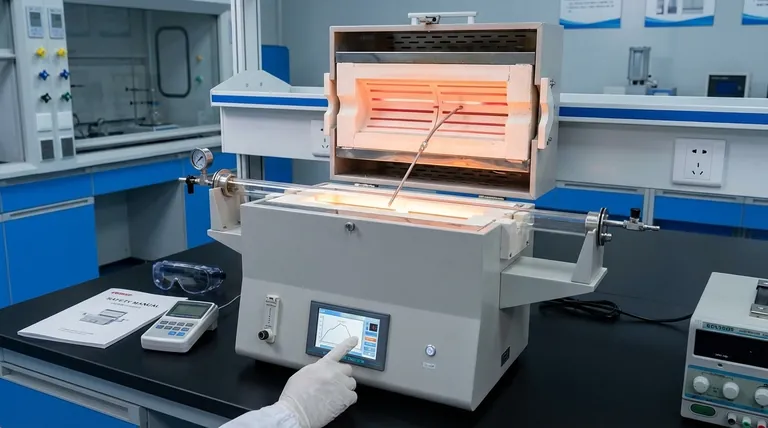
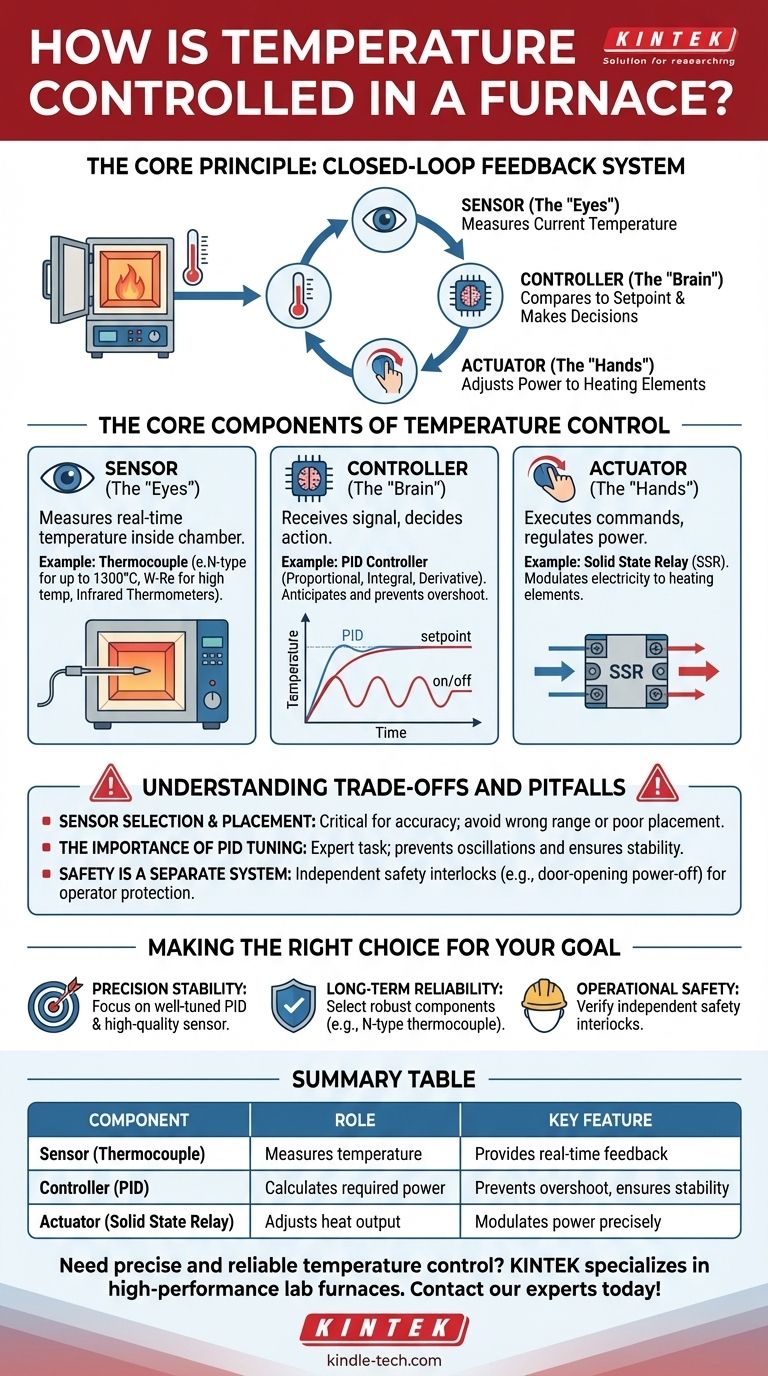
At its core, furnace temperature is controlled through a precise, closed-loop feedback system. This system constantly measures the current temperature, compares it to the desired setpoint, and intelligently adjusts the power sent to the heating elements to eliminate any difference.

The essential principle is not simply heating, but continuous correction. Modern furnaces achieve this using a combination of a sensor to measure temperature, a controller to make decisions, and an actuator to regulate power, ensuring the system remains stable and accurate.
How is temperature controlled in a furnace? Mastering Precise Thermal Management

The Core Components of Temperature Control

A furnace's temperature control system can be understood as having three primary parts working in unison: the sensor, the controller, and the actuator.

The Sensor (The "Eyes")

The system's "eyes" are a temperature sensor that provides a real-time measurement from inside the furnace chamber.

The most common sensor is a thermocouple. This device consists of two different metals joined at one end. A temperature change creates a tiny, measurable voltage, which the controller can interpret as a specific temperature.

Different applications require different thermocouples. For example, a W-Re (Tungsten-Rhenium) thermocouple is often used in high-temperature vacuum furnaces, while an N-type thermocouple is a durable choice for general use up to about 1300°C. Some systems also use non-contact infrared thermometers.

The Controller (The "Brain")

The controller is the brain of the operation. It receives the temperature signal from the sensor and decides what to do next.

The most prevalent and effective type is the PID controller. PID stands for Proportional, Integral, and Derivative—three mathematical functions that allow the controller to react not just to the current error, but also to past errors and the rate of temperature change.

This "smart" control allows the system to anticipate and prevent overshooting the target temperature, leading to a much more stable and precise result than a simple on/off thermostat.

The Actuator (The "Hands")

The actuator executes the controller's commands. It's the component that physically adjusts the heat output.

In modern electric furnaces, this is typically a Solid State Relay (SSR). An SSR is an electronic switch with no moving parts that can turn power on and off thousands of times per second.

The PID controller sends a precise signal to the SSR, which then modulates the flow of electricity to the furnace's heating elements, delivering just the right amount of energy to maintain the setpoint.

Understanding the Trade-offs and Pitfalls

Achieving perfect temperature control involves balancing performance, cost, and reliability. Understanding the potential failure points is critical.

Sensor Selection and Placement

The entire system is only as good as its sensor. Using a thermocouple outside of its intended temperature range will lead to inaccurate readings and rapid degradation.

Furthermore, sensor placement is crucial. A thermocouple that is too close to a heating element or the door may not reflect the true temperature of the work area, leading to processing errors. Some vacuum furnaces even use mechanisms to automatically insert and retract the thermocouple to protect it during extreme temperature ramps.

The Importance of PID Tuning

A PID controller is not "plug-and-play." It must be "tuned" for the specific thermal properties of the furnace.

Poor tuning can lead to wild temperature oscillations (swinging above and below the setpoint) or an extremely slow response time. Proper tuning is an expert task that ensures the system is both fast and stable.

Safety is a Separate System

Temperature control ensures process accuracy, but safety interlocks ensure operator protection. These are not the same thing.

A feature like a door-opening power-off switch is a critical safety mechanism. It operates independently of the PID controller to immediately cut power to the heating elements if the door is opened, preventing exposure to extreme heat and electrical hazards.

Making the Right Choice for Your Goal

Your specific objective dictates which aspect of the temperature control system you should prioritize.

  • If your primary focus is high-precision stability: Ensure the furnace uses a well-tuned PID controller and a high-quality sensor appropriate for your exact temperature range.
  • If your primary focus is long-term reliability: Select a system with robust components known for long service life, such as an N-type thermocouple for mid-range applications.
  • If your primary focus is operational safety: Verify the furnace includes independent safety interlocks, such as door power-off switches, that are separate from the primary control loop.

Ultimately, effective temperature control comes from a thoughtful integration of high-quality components designed to work together as a single, intelligent system.

Summary Table:

Component Role Key Feature
Sensor (Thermocouple) Measures temperature Provides real-time feedback
Controller (PID) Calculates required power Prevents overshoot, ensures stability
Actuator (Solid State Relay) Adjusts heat output Modulates power precisely

Need precise and reliable temperature control for your lab processes? KINTEK specializes in high-performance lab furnaces with advanced PID controllers, durable thermocouples, and robust safety features. Our equipment ensures the accuracy and repeatability your research demands. Contact our experts today to find the perfect furnace for your application!

Visual Guide
How is temperature controlled in a furnace? Mastering Precise Thermal Management Visual Guide

Related Products

People Also Ask

Related Products

Graphite Vacuum Furnace High Thermal Conductivity Film Graphitization Furnace

Graphite Vacuum Furnace High Thermal Conductivity Film Graphitization Furnace

The high thermal conductivity film graphitization furnace has uniform temperature, low energy consumption and can operate continuously.

High Temperature Muffle Oven Furnace for Laboratory Debinding and Pre Sintering

High Temperature Muffle Oven Furnace for Laboratory Debinding and Pre Sintering

KT-MD High temperature debinding and pre-sintering furnace for ceramic materials with various molding processes. Ideal for electronic components such as MLCC and NFC.

1700℃ Controlled Atmosphere Furnace Nitrogen Inert Atmosphere Furnace

1700℃ Controlled Atmosphere Furnace Nitrogen Inert Atmosphere Furnace

KT-17A Controlled atmosphere furnace: 1700℃ heating, vacuum sealing technology, PID temperature control, and versatile TFT smart touch screen controller for laboratory and industrial use.

Vertical High Temperature Graphite Vacuum Graphitization Furnace

Vertical High Temperature Graphite Vacuum Graphitization Furnace

Vertical high temperature graphitization furnace for carbonization and graphitization of carbon materials up to 3100℃.Suitable for shaped graphitization of carbon fiber filaments and other materials sintered in a carbon environment.Applications in metallurgy, electronics, and aerospace for producing high-quality graphite products like electrodes and crucibles.

1700℃ Muffle Oven Furnace for Laboratory

1700℃ Muffle Oven Furnace for Laboratory

Get superior heat control with our 1700℃ Muffle Furnace. Equipped with intelligent temperature microprocessor, TFT touch screen controller & advanced insulation materials for precise heating up to 1700C. Order now!

1200℃ Split Tube Furnace with Quartz Tube Laboratory Tubular Furnace

1200℃ Split Tube Furnace with Quartz Tube Laboratory Tubular Furnace

KT-TF12 split tube furnace: high-purity insulation, embedded heating wire coils, and max. 1200C. Widely used for new materials and chemical vapour deposition.

Ultra-High Temperature Graphite Vacuum Graphitization Furnace

Ultra-High Temperature Graphite Vacuum Graphitization Furnace

The ultra-high temperature graphitization furnace utilizes medium frequency induction heating in a vacuum or inert gas environment. The induction coil generates an alternating magnetic field, inducing eddy currents in the graphite crucible, which heats up and radiates heat to the workpiece, bringing it to the desired temperature. This furnace is primarily used for graphitization and sintering of carbon materials, carbon fiber materials, and other composite materials.

Graphite Vacuum Furnace Bottom Discharge Graphitization Furnace for Carbon Materials

Graphite Vacuum Furnace Bottom Discharge Graphitization Furnace for Carbon Materials

Bottom-out graphitization furnace for carbon materials, ultra-high temperature furnace up to 3100°C, suitable for graphitization and sintering of carbon rods and carbon blocks. Vertical design, bottom discharging, convenient feeding and discharging, high temperature uniformity, low energy consumption, good stability, hydraulic lifting system, convenient loading and unloading.

Controlled Nitrogen Inert Hydrogen Atmosphere Furnace

Controlled Nitrogen Inert Hydrogen Atmosphere Furnace

KT-AH Hydrogen atmosphere furnace - induction gas furnace for sintering/annealing with built-in safety features, dual housing design, and energy-saving efficiency. Ideal for lab and industrial use.

Large Vertical Graphite Vacuum Graphitization Furnace

Large Vertical Graphite Vacuum Graphitization Furnace

A large vertical high-temperature graphitization furnace is a type of industrial furnace used for the graphitization of carbon materials, such as carbon fiber and carbon black. It is a high-temperature furnace that can reach temperatures of up to 3100°C.

600T Vacuum Induction Hot Press Furnace for Heat Treat and Sintering

600T Vacuum Induction Hot Press Furnace for Heat Treat and Sintering

Discover the 600T Vacuum Induction Hot Press Furnace, designed for high-temperature sintering experiments in vacuum or protected atmospheres. Its precise temperature and pressure control, adjustable working pressure, and advanced safety features make it ideal for nonmetal materials, carbon composites, ceramics, and metal powders.

Laboratory Muffle Oven Furnace Bottom Lifting Muffle Furnace

Laboratory Muffle Oven Furnace Bottom Lifting Muffle Furnace

Efficiently produce batches with excellent temperature uniformity using our Bottom Lifting Furnace. Features two electric lifting stages and advanced temperature control up to 1600℃.

Vacuum Hot Press Furnace Machine Heated Vacuum Press

Vacuum Hot Press Furnace Machine Heated Vacuum Press

Discover the advantages of Vacuum Hot Press Furnace! Manufacture dense refractory metals & compounds, ceramics, and composites under high temp and pressure.

Vacuum Sealed Continuous Working Rotary Tube Furnace Rotating Tube Furnace

Vacuum Sealed Continuous Working Rotary Tube Furnace Rotating Tube Furnace

Experience efficient material processing with our vacuum-sealed rotary tube furnace. Perfect for experiments or industrial production, equipped with optional features for controlled feeding and optimized results. Order now.

Vacuum Heat Treat and Molybdenum Wire Sintering Furnace for Vacuum Sintering

Vacuum Heat Treat and Molybdenum Wire Sintering Furnace for Vacuum Sintering

A vacuum molybdenum wire sintering furnace is a vertical or bedroom structure, which is suitable for withdrawal, brazing, sintering and degassing of metal materials under high vacuum and high temperature conditions. It is also suitable for dehydroxylation treatment of quartz materials.

Electric Rotary Kiln Pyrolysis Furnace Plant Machine Calciner Small Rotary Kiln Rotating Furnace

Electric Rotary Kiln Pyrolysis Furnace Plant Machine Calciner Small Rotary Kiln Rotating Furnace

Electric rotary kiln - precisely controlled, it's ideal for calcination and drying of materials like lithium cobalate, rare earths, and non-ferrous metals.

2200 ℃ Graphite Vacuum Heat Treat Furnace

2200 ℃ Graphite Vacuum Heat Treat Furnace

Discover the power of the KT-VG Graphite Vacuum Furnace - with a maximum working temperature of 2200℃, it's perfect for vacuum sintering of various materials. Learn more now.

Dental Porcelain Zirconia Sintering Ceramic Furnace Chairside with Transformer

Dental Porcelain Zirconia Sintering Ceramic Furnace Chairside with Transformer

Experience top-notch sintering with Chairside Sintering Furnace with Transformer. Easy to operate, noise-free pallet, and automatic temperature calibration. Order now!

Horizontal High Temperature Graphite Vacuum Graphitization Furnace

Horizontal High Temperature Graphite Vacuum Graphitization Furnace

Horizontal Graphitization Furnace: This type of furnace is designed with the heating elements placed horizontally, allowing for uniform heating of the sample. It's well-suited for graphitizing large or bulky samples that require precise temperature control and uniformity.

Vacuum Heat Treat and Pressure Sintering Furnace for High Temperature Applications

Vacuum Heat Treat and Pressure Sintering Furnace for High Temperature Applications

Vacuum pressure sintering furnaces are designed for high temperature hot pressing applications in metal and ceramic sintering. Its advanced features ensure precise temperature control, reliable pressure maintenance, and a robust design for seamless operation.


Leave Your Message