Knowledge What are the advantages and disadvantages of pyrolysis in solid waste management? A Guide to Waste-to-Resource Conversion
Author avatar

Tech Team · Kintek Solution

Updated 6 days ago

What are the advantages and disadvantages of pyrolysis in solid waste management? A Guide to Waste-to-Resource Conversion


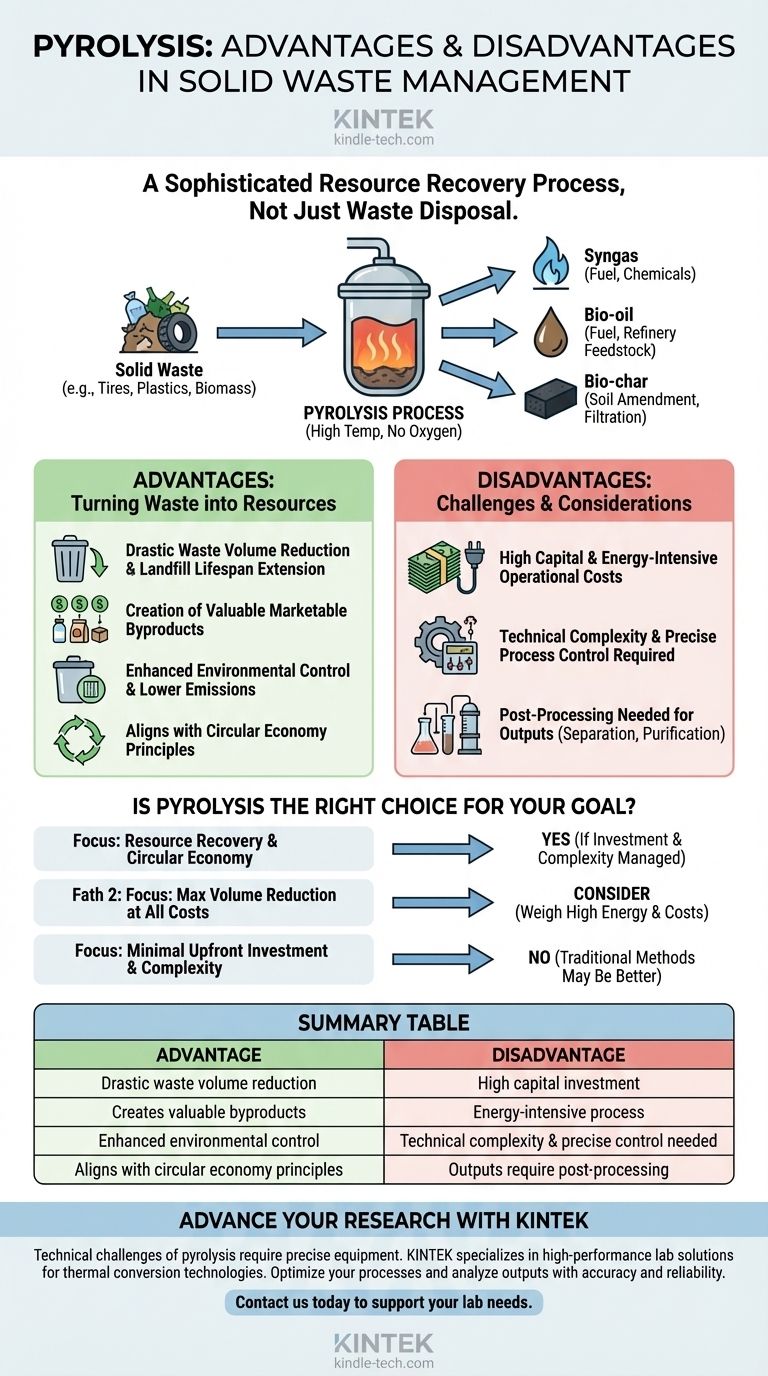
At its core, pyrolysis is a powerful waste conversion technology with the primary advantage of transforming solid waste into valuable resources like fuel and bio-char, significantly reducing landfill volume. However, its main disadvantages are the high capital investment required and its operational complexity, as it is an energy-intensive process that demands precise control.

Pyrolysis should be understood not as a simple waste disposal method, but as a sophisticated resource recovery process. This distinction is the key to appreciating both its significant potential and its demanding technical and financial requirements.
What are the advantages and disadvantages of pyrolysis in solid waste management? A Guide to Waste-to-Resource Conversion

What is Pyrolysis in Waste Management?

Pyrolysis is a form of thermal treatment that fundamentally changes the chemical structure of waste materials. It's a technology aimed at reclamation rather than simple destruction.

The Core Process: Thermal Decomposition Without Oxygen

Pyrolysis involves heating organic-based solid waste, such as biomass, plastics, or tires, to high temperatures in an environment with little to no oxygen.

The absence of oxygen is critical. It prevents combustion (burning) and instead causes the materials to break down into smaller, more valuable molecules.

Key Inputs: What Waste Can Be Treated?

The process is most effective for specific types of solid waste. This typically includes materials like used tires, various types of plastics, and biomass such as wood chips or agricultural residue.

Valuable Outputs: From Waste to Resource

The process breaks down complex waste into three primary products, each with potential uses:

  • Syngas: A mixture of combustible gases that can be used to generate electricity or as a feedstock for producing chemicals and fuels.
  • Bio-oil (Pyrolysis Oil): A liquid fuel that can be refined for use in engines and boilers or upgraded into higher-grade transportation fuels.
  • Bio-char: A stable, carbon-rich solid that can be used to amend and improve soil quality or be processed into activated carbon for filtration purposes.

The Primary Advantages of Pyrolysis

When implemented correctly, pyrolysis offers compelling benefits over traditional waste disposal methods like landfilling.

Drastic Waste Volume Reduction

The most immediate benefit is a significant decrease in the volume of waste requiring disposal. This directly extends the lifespan of existing landfills and reduces the need for new ones.

Creation of Valuable Byproducts

Instead of burying waste, pyrolysis converts it into marketable commodities. This creates a potential revenue stream that can offset operational costs and aligns with the principles of a circular economy.

Enhanced Environmental Control

Because pyrolysis occurs in a sealed, oxygen-free system, it offers a high degree of control over emissions compared to direct incineration. It captures the value within the waste rather than releasing it through uncontrolled burning.

Understanding the Disadvantages and Challenges

The potential of pyrolysis is balanced by significant practical and economic hurdles that must be carefully considered.

High Capital and Operational Costs

Pyrolysis plants require a substantial upfront investment in specialized equipment and infrastructure. The process is also energy-intensive, consuming a notable amount of power to maintain the high temperatures needed for decomposition.

Technical Complexity and Process Control

Achieving efficient and consistent results is not simple. The process requires specific and stable operating conditions, including precise temperature control and management of waste feedstock, demanding skilled operators and robust engineering.

The Need for Post-Processing

The outputs of pyrolysis—syngas, bio-oil, and bio-char—are not immediately ready for use. They often require separation, purification, and refinement to meet market specifications, adding another layer of complexity and cost to the overall operation.

Is Pyrolosis the Right Choice for Your Goal?

Evaluating pyrolysis requires aligning its capabilities with your primary waste management objectives.

  • If your primary focus is resource recovery and creating a circular economy: Pyrolysis is a powerful contender, provided you can justify the high capital investment and manage the technical demands of a sophisticated chemical process.
  • If your primary focus is reducing landfill volume at all costs: Pyrolysis is extremely effective at volume reduction, but you must weigh its high energy and operational costs against simpler thermal treatment options.
  • If your primary focus is minimizing upfront investment and operational complexity: Traditional waste management methods or less complex conversion technologies may be more suitable for your immediate needs and budget.

Ultimately, viewing pyrolysis not as simple waste disposal but as a specialized manufacturing process that uses waste as a raw material is the key to evaluating its true potential.

Summary Table:

Advantage Disadvantage
Drastic waste volume reduction High capital investment
Creates valuable byproducts (syngas, bio-oil, bio-char) Energy-intensive process
Enhanced environmental control vs. incineration Technical complexity & precise control needed
Aligns with circular economy principles Outputs require post-processing

Ready to explore advanced waste management solutions for your laboratory?

The technical challenges of pyrolysis, like precise temperature control and process efficiency, are areas where the right equipment makes all the difference. KINTEK specializes in high-performance lab equipment and consumables that can support your research and development in thermal conversion technologies like pyrolysis.

Whether you're optimizing processes or analyzing outputs, our solutions are designed for accuracy and reliability. Contact us today to discuss how we can support your specific laboratory needs and help you turn waste into valuable resources.

Get in touch with our experts

Visual Guide

What are the advantages and disadvantages of pyrolysis in solid waste management? A Guide to Waste-to-Resource Conversion Visual Guide

Related Products

People Also Ask

Related Products

Electric Rotary Kiln Small Rotary Furnace Biomass Pyrolysis Plant

Electric Rotary Kiln Small Rotary Furnace Biomass Pyrolysis Plant

Learn about Rotary Biomass Pyrolysis Furnaces & how they decompose organic material at high temps without oxygen. Use for biofuels, waste processing, chemicals & more.

Vacuum Dental Porcelain Sintering Furnace

Vacuum Dental Porcelain Sintering Furnace

Get precise and reliable results with KinTek's Vacuum Porcelain Furnace. Suitable for all porcelain powders, it features hyperbolic ceramic furnace function, voice prompt, and automatic temperature calibration.

Small Vacuum Heat Treat and Tungsten Wire Sintering Furnace

Small Vacuum Heat Treat and Tungsten Wire Sintering Furnace

The small vacuum tungsten wire sintering furnace is a compact experimental vacuum furnace specially designed for universities and scientific research institutes. The furnace features a CNC welded shell and vacuum piping to ensure leak-free operation. Quick-connect electrical connections facilitate relocation and debugging, and the standard electrical control cabinet is safe and convenient to operate.

Laboratory Sterilizer Lab Autoclave Vertical Pressure Steam Sterilizer for Liquid Crystal Display Automatic Type

Laboratory Sterilizer Lab Autoclave Vertical Pressure Steam Sterilizer for Liquid Crystal Display Automatic Type

Liquid crystal display automatic vertical sterilizer is a safe, reliable and automatic control sterilization equipment, which is composed of heating system, microcomputer control system and overheating and overvoltage protection system.

Vacuum Heat Treat and Molybdenum Wire Sintering Furnace for Vacuum Sintering

Vacuum Heat Treat and Molybdenum Wire Sintering Furnace for Vacuum Sintering

A vacuum molybdenum wire sintering furnace is a vertical or bedroom structure, which is suitable for withdrawal, brazing, sintering and degassing of metal materials under high vacuum and high temperature conditions. It is also suitable for dehydroxylation treatment of quartz materials.

Laboratory Sterilizer Lab Autoclave Pulse Vacuum Lifting Sterilizer

Laboratory Sterilizer Lab Autoclave Pulse Vacuum Lifting Sterilizer

The pulse vacuum lifting sterilizer is a state-of-the-art equipment for efficient and precise sterilization. It uses pulsating vacuum technology, customizable cycles, and a user-friendly design for easy operation and safety.

915MHz MPCVD Diamond Machine Microwave Plasma Chemical Vapor Deposition System Reactor

915MHz MPCVD Diamond Machine Microwave Plasma Chemical Vapor Deposition System Reactor

915MHz MPCVD Diamond Machine and its multi-crystal effective growth, the maximum area can reach 8 inches, the maximum effective growth area of single crystal can reach 5 inches. This equipment is mainly used for the production of large-size polycrystalline diamond films, the growth of long single crystal diamonds, the low-temperature growth of high-quality graphene, and other materials that require energy provided by microwave plasma for growth.

Laboratory Test Sieves and Sieving Machines

Laboratory Test Sieves and Sieving Machines

Precision lab test sieves & sieving machines for accurate particle analysis. Stainless steel, ISO-compliant, 20μm-125mm range. Request specs now!

Benchtop Laboratory Vacuum Freeze Dryer

Benchtop Laboratory Vacuum Freeze Dryer

Benchtop laboratory freeze dryer for efficient lyophilization of biological, pharmaceutical, and food samples. Features intuitive touchscreen, high-performance refrigeration, and durable design. Preserve sample integrity—consult now!

Vacuum Hot Press Furnace Machine for Lamination and Heating

Vacuum Hot Press Furnace Machine for Lamination and Heating

Experience clean and precise lamination with Vacuum Lamination Press. Perfect for wafer bonding, thin-film transformations, and LCP lamination. Order now!

Benchtop Laboratory Freeze Dryer for Lab Use

Benchtop Laboratory Freeze Dryer for Lab Use

Premium benchtop laboratory freeze dryer for lyophilization, preserving samples with ≤ -60°C cooling. Ideal for pharmaceuticals & research.

HFCVD Machine System Equipment for Drawing Die Nano-Diamond Coating

HFCVD Machine System Equipment for Drawing Die Nano-Diamond Coating

The nano-diamond composite coating drawing die uses cemented carbide (WC-Co) as the substrate, and uses the chemical vapor phase method ( CVD method for short ) to coat the conventional diamond and nano-diamond composite coating on the surface of the inner hole of the mold.

Anti-Cracking Press Mold for Lab Use

Anti-Cracking Press Mold for Lab Use

The anti-cracking press mold is a specialized equipment designed for molding various shapes and sizes of film using high pressure and electric heating.

High Energy Planetary Ball Mill Milling Machine for Laboratory

High Energy Planetary Ball Mill Milling Machine for Laboratory

Experience fast and effective sample processing with the F-P2000 high-energy planetary ball mill. This versatile equipment offers precise control and excellent grinding capabilities. Perfect for laboratories, it features multiple grinding bowls for simultaneous testing and high output. Achieve optimal results with its ergonomic design, compact structure, and advanced features. Ideal for a wide range of materials, it ensures consistent particle size reduction and low maintenance.

High Energy Vibratory Laboratory Ball Mill Grinding Mill Single Tank Type

High Energy Vibratory Laboratory Ball Mill Grinding Mill Single Tank Type

High-energy vibration ball mill is a small desktop laboratory grinding instrument.It can be ball-milled or mixed with different particle sizes and materials by dry and wet methods.

Variable Speed Peristaltic Pump

Variable Speed Peristaltic Pump

KT-VSP Series Smart Variable Speed Peristaltic Pumps offer precise flow control for labs, medical, and industrial applications. Reliable, contamination-free liquid transfer.

Laboratory Vibratory Sieve Shaker Machine Slap Vibrating Sieve

Laboratory Vibratory Sieve Shaker Machine Slap Vibrating Sieve

KT-T200TAP is a slapping and oscillating sieving instrument for laboratory desktop use, with 300 rpm horizontal circular motion and 300 vertical slapping motions to simulate manual sieving to help sample particles pass through better.

Silicon Carbide SiC Thermal Heating Elements for Electric Furnace

Silicon Carbide SiC Thermal Heating Elements for Electric Furnace

Experience the advantages of Silicon Carbide (SiC) Heating Element: Long service life, high corrosion and oxidation resistance, fast heating speed, and easy maintenance. Learn more now!

Laboratory Ten-Body Horizontal Jar Mill for Lab Use

Laboratory Ten-Body Horizontal Jar Mill for Lab Use

The Ten-body horizontal jar mill is for 10 ball mill pots (3000ml or less). It has frequency conversion control, rubber roller movement, and PE protective cover.

Engineering Advanced Fine Ceramics Aluminum Oxide Al2O3 Heat Sink for Insulation

Engineering Advanced Fine Ceramics Aluminum Oxide Al2O3 Heat Sink for Insulation

The hole structure of the ceramic heat sink increases the heat dissipation area in contact with the air, which greatly enhances the heat dissipation effect, and the heat dissipation effect is better than that of super copper and aluminum.


Leave Your Message