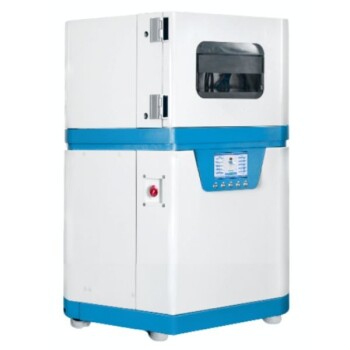
The use of an induction hot pressing (IHP) system for consolidating (Co,Fe,Ni)3Se4 particles provides a superior alternative to conventional sintering by combining mechanical pressure with rapid thermal energy. This synergy allows for the achievement of high relative densities (93%–95%) in significantly shorter timeframes while preserving the material’s critical chemical composition and metallic conductivity.
Core Takeaway: Induction hot pressing (IHP) outperforms conventional sintering by utilizing eddy current-assisted densification to achieve near-theoretical density while simultaneously inhibiting grain growth and preventing the loss of selenium anions.
Superior Microstructural Control
Inhibition of Abnormal Grain Growth
Unlike conventional sintering, which often requires prolonged exposure to high temperatures, IHP uses rapid induction heating to minimize thermal exposure. This process effectively inhibits abnormal grain growth, resulting in a fine-grained microstructure that enhances the mechanical strength of the final component. The reduction in sintering time ensures that the particles consolidate without the excessive grain enlargement that typically weakens the material.
Preservation of Chemical Composition
(Co,Fe,Ni)3Se4 is susceptible to the desorption of selenium anions when held at high temperatures for extended periods. The IHP system operates quickly enough to reduce selenium loss, maintaining the stoichiometric integrity of the material. By preventing this desorption, the system ensures the material retains its metallic conductivity and structural stability, which are often compromised during slow, conventional sintering cycles.
Enhanced Densification and Efficiency
Synergy of Thermal and Mechanical Activation
IHP applies a uniaxial pressure of 50 MPa simultaneously with induction heating, creating a dual-force densification process. This mechanical activation allows the material to reach 93% to 95% of its theoretical density far more efficiently than pressureless sintering. The process significantly enhances the charge transfer capability of the resulting electrode by ensuring a highly compact and interconnected particle network.
Energy and Operational Efficiency
The system utilizes induction coils to generate eddy currents that heat the mold and powder directly, rather than relying on radiant heat. This direct heating method significantly reduces energy consumption and results in a more uniform temperature field across the workpiece. Furthermore, the independent control of pressure and inductive power allows for precise tuning of the densification process to suit specific material requirements.
Understanding the Trade-offs
Equipment and Geometry Limitations
While IHP offers rapid processing, the uniaxial nature of the pressure can lead to density gradients in very tall or complex shapes compared to isostatic pressing. The dependence on conductive molds (typically graphite) means the system requires specialized tooling that must be maintained and replaced over time. Additionally, while IHP is more efficient than isostatic pressing, the initial equipment complexity and the need for induction-compatible setups may require a higher technical baseline for operators.
Pressure Constraints
The pressures used in IHP (often around 50 MPa) are an order of magnitude lower than those found in hot isostatic pressing (HIP). While this allows for thinner pressure-bearing materials and lower investment costs, it may not be sufficient for materials that require extreme mechanical force to reach 100% density. Users must balance the need for speed and thermal control against the absolute maximum pressure requirements of their specific alloy.
How to Apply IHP to Your Project
Implementation Recommendations
- If your primary focus is maximizing electrical conductivity: Utilize IHP specifically to prevent the desorption of selenium, as maintaining the anion concentration is vital for metallic behavior.
- If your primary focus is high-throughput production: Lean into the rapid heating cycles of induction technology to reduce total sintering time from hours to minutes.
- If your primary focus is mechanical durability: Focus on the system's ability to limit grain growth, as the resulting fine-grained structure will offer higher hardness and fracture resistance.
By leveraging the rapid thermal response and mechanical activation of IHP, engineers can produce high-density (Co,Fe,Ni)3Se4 materials with optimized electrochemical and structural properties.
Summary Table:
| Feature | Induction Hot Pressing (IHP) | Conventional Sintering |
|---|---|---|
| Heating Mechanism | Rapid Induction (Eddy Currents) | Radiant Heating (Slow) |
| Relative Density | High (93%–95%) | Lower/Variable |
| Microstructure | Fine-grained (Inhibits growth) | Potential for abnormal grain growth |
| Chemical Integrity | Preserves Selenium (Short cycles) | High risk of Selenium desorption |
| Processing Time | Minutes | Hours |
| Energy Efficiency | High (Direct heating) | Low (Environment heating) |
Elevate Your Material Consolidation with KINTEK Precision
Achieving near-theoretical density while maintaining the delicate chemical balance of materials like (Co,Fe,Ni)3Se4 requires more than just heat—it requires precision control. KINTEK specializes in high-performance laboratory equipment designed to meet these rigorous standards. Our extensive portfolio includes advanced hydraulic presses (pellet, hot, isostatic) and a comprehensive range of high-temperature furnaces (vacuum, atmosphere, tube, and induction melting) tailored for cutting-edge research and industrial production.
Whether you are focused on inhibiting grain growth, preventing anion loss, or maximizing metallic conductivity, KINTEK provides the reliable tools and high-quality consumables (ceramics, crucibles, and PTFE) your lab demands.
Ready to optimize your densification process? Contact our experts today to find the perfect sintering or pressing solution for your specific material requirements!
References
- Andrzej Mikuła, Ulf‐Peter Apfel. Synthesis, properties and catalytic performance of the novel, pseudo-spinel, multicomponent transition-metal selenides. DOI: 10.1039/d2ta09401k
This article is also based on technical information from Kintek Solution Knowledge Base .
Related Products
- 600T Vacuum Induction Hot Press Furnace for Heat Treat and Sintering
- Lab Infrared Press Mold
- Automatic Laboratory Heat Press Machine
- Heated Hydraulic Press Machine with Heated Plates Split Manual Laboratory Hot Press
- Automatic Heated Hydraulic Press Machine with Heated Plates for Laboratory Hot Press
People Also Ask
- What role does an induction vacuum hot pressing furnace play in sintering? Achieve 98% Density in Carbide Blocks
- What advantages does a vacuum hot press furnace provide for LSLBO ceramic electrolytes? Achieve 94% Relative Density
- What role does a Vacuum Hot Press (VHP) furnace play in the densification of austenitic stainless steel 316 composites?
- What are the advantages of a vacuum hot press furnace for W-50%Cu? Achieve 99.6% Density at Lower Temperatures
- What role does mechanical pressure play during the vacuum diffusion bonding of tungsten and copper? Keys to Solid Bonding