Knowledge What are the applications of silicon carbide? From Abrasives to High-Tech Semiconductors
Author avatar

Tech Team · Kintek Solution

Updated 6 days ago

What are the applications of silicon carbide? From Abrasives to High-Tech Semiconductors


At its core, silicon carbide (SiC) is a high-performance ceramic whose applications span from common abrasives to the frontiers of space technology. Its uses include heating elements in industrial furnaces, critical components in semiconductor manufacturing chambers, wear-resistant pump parts, and substrates for modern light-emitting diodes (LEDs).

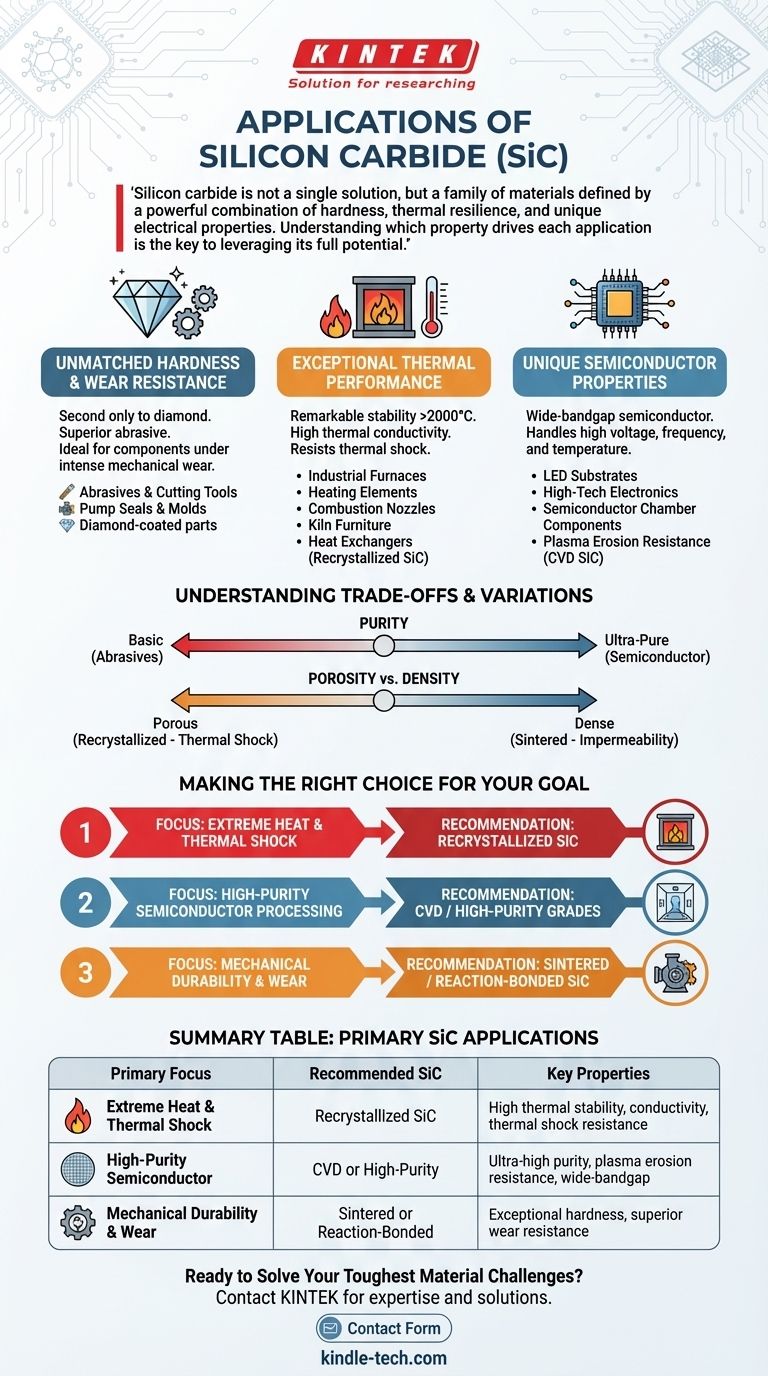
Silicon carbide is not a single solution, but a family of materials defined by a powerful combination of hardness, thermal resilience, and unique electrical properties. Understanding which property drives each application is the key to leveraging its full potential.
What are the applications of silicon carbide? From Abrasives to High-Tech Semiconductors

The Foundation: Why Silicon Carbide is a "Problem-Solver" Material

Silicon carbide's value comes from a rare blend of characteristics that allow it to perform where many other materials fail. Its applications are a direct result of these fundamental properties.

Unmatched Hardness and Wear Resistance

Silicon carbide is an exceptionally hard synthetic material, second only to diamond in common use. This makes it a superior abrasive and an ideal choice for components subjected to intense mechanical wear.

Historically, this property led to its use in sandpaper and cutting tools. Today, it is used for demanding mechanical parts like pump seals and molds, which are sometimes coated with diamond film to further extend their operational life.

Exceptional Thermal Performance

SiC demonstrates remarkable stability at extreme temperatures, with a refractoriness exceeding 2000°C. Critically, it combines this heat resistance with high thermal conductivity, allowing it to dissipate heat effectively and resist thermal shock.

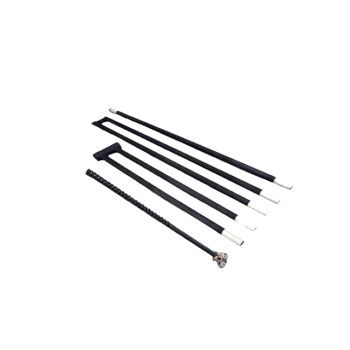
This makes it indispensable for high-temperature industrial furnaces, where it is used for heating elements, furnace floors, and combustion nozzles. Recrystallized silicon carbide, a pure and porous variant, is particularly valued for kilns and heat exchangers.

Unique Semiconductor Properties

In its highly pure, crystalline form, silicon carbide acts as a wide-bandgap semiconductor. This allows it to handle higher voltages, frequencies, and temperatures than traditional silicon.

This capability is crucial in high-tech fields. It serves as the structural base (substrate) for manufacturing bright and efficient LEDs. Furthermore, its ability to resist erosion from high-energy plasmas makes it a key material for components inside semiconductor processing chambers.

Understanding the Trade-offs and Variations

While incredibly capable, "silicon carbide" is not a monolithic term. The manufacturing process and resulting purity dictate its final application and cost, creating a spectrum of grades for different needs.

Purity Dictates Performance

The SiC used for abrasives or basic furnace linings is different from the ultra-pure, defect-free SiC required for semiconductor applications. The latter, often produced via Chemical Vapor Deposition (CVD), is significantly more expensive and complex to manufacture.

Porosity vs. Density

Some applications benefit from the porous structure of recrystallized silicon carbide, which offers excellent thermal shock resistance. In contrast, applications requiring impermeability or maximum plasma resistance will use a dense, fully sintered form. Choosing the wrong grade can lead to premature failure or unnecessary expense.

Making the Right Choice for Your Goal

Selecting the right type of silicon carbide depends entirely on the primary challenge you need to solve.

  • If your primary focus is extreme heat and thermal shock: Seek out recrystallized SiC for components like kiln furniture, heat exchangers, and furnace elements where thermal stability and conductivity are paramount.
  • If your primary focus is high-purity semiconductor processing: You will require CVD or equivalent high-purity grades for chamber components and substrates to ensure process integrity and resistance to plasma erosion.
  • If your primary focus is mechanical durability and wear: Use sintered or reaction-bonded SiC for applications like seals, nozzles, and pump components where hardness is the most critical attribute.

Ultimately, silicon carbide excels in environments where conventional materials reach their thermal, mechanical, or electrical limits.

Summary Table:

Primary Application Focus Recommended SiC Type Key Properties Utilized
Extreme Heat & Thermal Shock Recrystallized SiC High thermal stability & conductivity, thermal shock resistance
High-Purity Semiconductor Processing CVD or High-Purity Grades Ultra-high purity, plasma erosion resistance, wide-bandgap semiconductor properties
Mechanical Durability & Wear Resistance Sintered or Reaction-Bonded SiC Exceptional hardness, superior wear resistance

Ready to Solve Your Toughest Material Challenges?

Whether you need components that withstand extreme temperatures, resist intense wear, or meet the stringent demands of high-purity semiconductor processing, KINTEK has the silicon carbide expertise and lab equipment solutions for you. Our specialists can help you select the right SiC grade for your specific application, ensuring optimal performance and longevity.

Contact us today via our [#ContactForm] to discuss how KINTEK's high-performance materials and laboratory equipment can enhance your operations and drive innovation.

Visual Guide
What are the applications of silicon carbide? From Abrasives to High-Tech Semiconductors Visual Guide

Related Products

People Also Ask

Related Products

Customer Made Versatile CVD Tube Furnace Chemical Vapor Deposition Chamber System Equipment

Customer Made Versatile CVD Tube Furnace Chemical Vapor Deposition Chamber System Equipment

Get your exclusive CVD furnace with KT-CTF16 Customer Made Versatile Furnace. Customizable sliding, rotating, and tilting functions for precise reactions. Order now!

Evaporation Boat for Organic Matter

Evaporation Boat for Organic Matter

The evaporation boat for organic matter is an important tool for precise and uniform heating during the deposition of organic materials.

Split Chamber CVD Tube Furnace with Vacuum Station Chemical Vapor Deposition System Equipment Machine

Split Chamber CVD Tube Furnace with Vacuum Station Chemical Vapor Deposition System Equipment Machine

Efficient split chamber CVD furnace with vacuum station for intuitive sample checking and quick cooling. Up to 1200℃ max temperature with accurate MFC mass flowmeter control.

Inclined Rotary Plasma Enhanced Chemical Vapor Deposition PECVD Equipment Tube Furnace Machine

Inclined Rotary Plasma Enhanced Chemical Vapor Deposition PECVD Equipment Tube Furnace Machine

Upgrade your coating process with PECVD coating equipment. Ideal for LED, power semiconductors, MEMS and more. Deposits high-quality solid films at low temps.

Vacuum Hot Press Furnace Machine for Lamination and Heating

Vacuum Hot Press Furnace Machine for Lamination and Heating

Experience clean and precise lamination with Vacuum Lamination Press. Perfect for wafer bonding, thin-film transformations, and LCP lamination. Order now!

Silicon Carbide SiC Thermal Heating Elements for Electric Furnace

Silicon Carbide SiC Thermal Heating Elements for Electric Furnace

Experience the advantages of Silicon Carbide (SiC) Heating Element: Long service life, high corrosion and oxidation resistance, fast heating speed, and easy maintenance. Learn more now!

RF PECVD System Radio Frequency Plasma-Enhanced Chemical Vapor Deposition RF PECVD

RF PECVD System Radio Frequency Plasma-Enhanced Chemical Vapor Deposition RF PECVD

RF-PECVD is an acronym for "Radio Frequency Plasma-Enhanced Chemical Vapor Deposition." It deposits DLC (Diamond-like carbon film) on germanium and silicon substrates. It is utilized in the 3-12um infrared wavelength range.

CVD Diamond Domes for Industrial and Scientific Applications

CVD Diamond Domes for Industrial and Scientific Applications

Discover CVD diamond domes, the ultimate solution for high-performance loudspeakers. Made with DC Arc Plasma Jet technology, these domes deliver exceptional sound quality, durability, and power handling.

Microwave Plasma Chemical Vapor Deposition MPCVD Machine System Reactor for Lab and Diamond Growth

Microwave Plasma Chemical Vapor Deposition MPCVD Machine System Reactor for Lab and Diamond Growth

Get high-quality diamond films with our Bell-jar Resonator MPCVD machine designed for lab and diamond growth. Discover how Microwave Plasma Chemical Vapor Deposition works for growing diamonds using carbon gas and plasma.

1200℃ Split Tube Furnace with Quartz Tube Laboratory Tubular Furnace

1200℃ Split Tube Furnace with Quartz Tube Laboratory Tubular Furnace

KT-TF12 split tube furnace: high-purity insulation, embedded heating wire coils, and max. 1200C. Widely used for new materials and chemical vapour deposition.

Cylindrical Resonator MPCVD Machine System Reactor for Microwave Plasma Chemical Vapor Deposition and Lab Diamond Growth

Cylindrical Resonator MPCVD Machine System Reactor for Microwave Plasma Chemical Vapor Deposition and Lab Diamond Growth

Learn about Cylindrical Resonator MPCVD Machine, the microwave plasma chemical vapor deposition method used for growing diamond gemstones and films in the jewelry and semi-conductor industries. Discover its cost-effective advantages over traditional HPHT methods.

Graphite Vacuum Continuous Graphitization Furnace

Graphite Vacuum Continuous Graphitization Furnace

High-temperature graphitization furnace is a professional equipment for graphitization treatment of carbon materials. It is a key equipment for the production of high-quality graphite products. It has high temperature, high efficiency and uniform heating. It is suitable for various high-temperature treatments and graphitization treatments. It is widely used in metallurgy, electronics, aerospace, etc. industry.

1700℃ Laboratory Quartz Tube Furnace with Alumina Tube Tubular Furnace

1700℃ Laboratory Quartz Tube Furnace with Alumina Tube Tubular Furnace

Looking for a high-temperature tube furnace? Check out our 1700℃ Tube Furnace with Alumina Tube. Perfect for research and industrial applications up to 1700C.

Small Vacuum Heat Treat and Tungsten Wire Sintering Furnace

Small Vacuum Heat Treat and Tungsten Wire Sintering Furnace

The small vacuum tungsten wire sintering furnace is a compact experimental vacuum furnace specially designed for universities and scientific research institutes. The furnace features a CNC welded shell and vacuum piping to ensure leak-free operation. Quick-connect electrical connections facilitate relocation and debugging, and the standard electrical control cabinet is safe and convenient to operate.

High Pressure Laboratory Vacuum Tube Furnace Quartz Tubular Furnace

High Pressure Laboratory Vacuum Tube Furnace Quartz Tubular Furnace

KT-PTF High Pressure Tube Furnace: Compact split tube furnace with strong positive pressure resistance. Working temp up to 1100°C and pressure up to 15Mpa. Also works under controller atmosphere or high vacuum.

Aluminized Ceramic Evaporation Boat for Thin Film Deposition

Aluminized Ceramic Evaporation Boat for Thin Film Deposition

Vessel for depositing thin films; has an aluminum-coated ceramic body for improved thermal efficiency and chemical resistance. making it suitable for various applications.

Silicon Carbide (SIC) Ceramic Sheet Wear-Resistant Engineering Advanced Fine Ceramics

Silicon Carbide (SIC) Ceramic Sheet Wear-Resistant Engineering Advanced Fine Ceramics

Silicon carbide (sic) ceramic sheet is composed of high-purity silicon carbide and ultra-fine powder, which is formed by vibration molding and high-temperature sintering.

Customizable High Pressure Reactors for Advanced Scientific and Industrial Applications

Customizable High Pressure Reactors for Advanced Scientific and Industrial Applications

This laboratory-scale high-pressure reactor is a high-performance autoclave engineered for precision and safety in demanding research and development environments.

Vertical High Temperature Graphite Vacuum Graphitization Furnace

Vertical High Temperature Graphite Vacuum Graphitization Furnace

Vertical high temperature graphitization furnace for carbonization and graphitization of carbon materials up to 3100℃.Suitable for shaped graphitization of carbon fiber filaments and other materials sintered in a carbon environment.Applications in metallurgy, electronics, and aerospace for producing high-quality graphite products like electrodes and crucibles.

High Pressure Laboratory Autoclave Reactor for Hydrothermal Synthesis

High Pressure Laboratory Autoclave Reactor for Hydrothermal Synthesis

Discover the applications of Hydrothermal Synthesis Reactor - a small, corrosion-resistant reactor for chemical labs. Achieve rapid digestion of insoluble substances in a safe and reliable way. Learn more now.


Leave Your Message