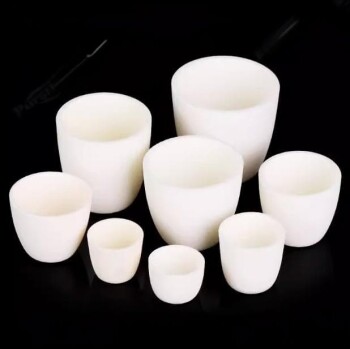
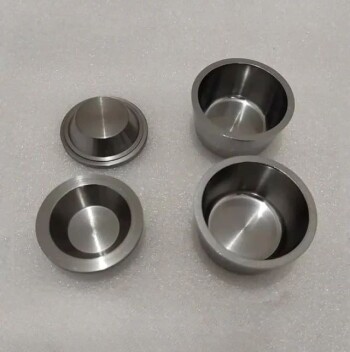
To ensure the integrity of strontium titanate samples, ceramic crucibles must meet three strict performance criteria: exceptional thermal shock resistance, high structural strength at elevated temperatures, and absolute chemical inertness. Specifically, for sintering processes conducted at 1100°C, the crucible must carry a temperature rating of at least 1500°C to provide an adequate safety margin against failure.
The success of high-temperature sintering depends on the crucible acting as a neutral vessel. It must withstand the thermal stress of the process while remaining chemically invisible to prevent altering the sample's precise stoichiometry.
Thermal Capability and Safety Margins
The Importance of the Safety Margin
Selecting a crucible based solely on the peak operating temperature is a common error. While the sintering process may occur at 1100°C, the crucible itself requires a rating of at least 1500°C.
This 400-degree buffer acts as a critical safety margin. It ensures the material retains its structural rigidity and does not approach its softening point during prolonged heat exposure.
Resisting Thermal Shock
Sintering involves heating and cooling cycles that induce significant stress on ceramic materials. The crucible must possess excellent thermal shock resistance.
Without this property, rapid temperature changes can cause micro-fractures or catastrophic failure. This jeopardizes not only the crucible but the valuable sample contained within.
Chemical Compatibility and Purity
Maintaining Chemical Inertness
At high temperatures, materials that are stable at room temperature often become reactive. The crucible must remain chemically inert when in contact with the sample materials.
Strontium titanate samples often contain active elements, including strontium, titanium, and potentially dopants like samarium. If the crucible is not inert, it may react with these elements.
Preserving Elemental Composition
Any chemical interaction between the vessel and the sample will alter the final product. Leaching or absorption can shift the precise chemical composition of the ceramic sample.
To ensure the experimental or production data remains valid, the crucible must prevent these cross-reactions completely.
Structural Durability
High-Temperature Structural Strength
Heat softens most materials, increasing the risk of deformation under load. The crucible must maintain high-temperature structural strength.
It must hold the weight of the dense strontium titanate sample without warping or sagging. Structural failure during the sintering hold time can lead to sample contamination or damage to the furnace elements.
Understanding the Trade-offs
The Risk of Minimum Ratings
A common pitfall is using a crucible rated too closely to the operating temperature to save on consumable costs. This eliminates the safety buffer.
Operating without the recommended 1500°C rating for a 1100°C process increases the likelihood of structural fatigue over time, leading to unexpected failure during a critical run.
Chemical vs. Thermal priorities
A crucible may have high thermal resistance but poor chemical resistance to specific elements like strontium. You must verify both properties independently.
High melting points do not guarantee chemical inertness. Always prioritize the compatibility with active elements (strontium, titanium, samarium) over raw thermal data once the 1500°C threshold is met.
Making the Right Choice for Your Goal
Selecting the correct crucible requires balancing thermal safety with chemical purity.
- If your primary focus is Sample Purity: Prioritize materials with verified inertness to active elements like strontium, titanium, and samarium to prevent composition shifts.
- If your primary focus is Process Safety: Adhere strictly to the 1500°C rating requirement for 1100°C processes to ensure a sufficient thermal safety margin.
By strictly enforcing the safety margin and verifying chemical compatibility, you ensure the crucible supports the process rather than compromising it.
Summary Table:
| Performance Criterion | Requirement Detail | Importance for Strontium Titanate |
|---|---|---|
| Temperature Rating | Minimum 1500°C (for 1100°C process) | Provides a 400°C safety margin to prevent structural softening. |
| Chemical Inertness | Zero reactivity with Sr, Ti, and dopants | Prevents leaching and preserves precise sample stoichiometry. |
| Thermal Shock Resistance | High resistance to rapid ΔT | Prevents micro-fractures during heating and cooling cycles. |
| Structural Strength | Rigid at elevated temperatures | Supports dense samples without warping or sagging under load. |
Elevate Your Material Research with KINTEK Precision Solutions
Don't let crucible failure or chemical contamination compromise your strontium titanate research. KINTEK specializes in premium laboratory equipment and high-performance consumables designed for the most demanding thermal processes.
Whether you need advanced high-temperature furnaces or ultra-pure ceramic crucibles that maintain absolute inertness, our expert team is ready to support your lab's success. Our extensive portfolio also includes crushing and milling systems, isostatic presses, and high-pressure reactors tailored for advanced ceramic production.
Ensure process safety and sample purity—Contact KINTEK today for a consultation!
References
- Maxim V. Zdorovets, Аrtem L. Kozlovskiy. Synthesis and Properties of SrTiO3 Ceramic Doped with Sm2O3. DOI: 10.3390/ma14247549
This article is also based on technical information from Kintek Solution Knowledge Base .
Related Products
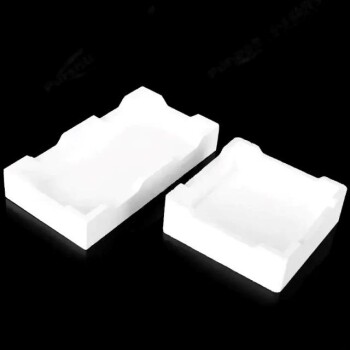
- Arc-Shaped Alumina Ceramic Crucible High Temperature Resistant for Engineering Advanced Fine Ceramics
- Electron Beam Evaporation Coating Tungsten Crucible and Molybdenum Crucible for High Temperature Applications
- Boron Nitride (BN) Crucible for Phosphorous Powder Sintered
- High Purity Pure Graphite Crucible for Evaporation
- Engineering Advanced Fine Ceramics Alumina Crucibles (Al2O3) for Thermal Analysis TGA DTA
People Also Ask
- Why Use Alumina Crucibles & Powder Burial for NaSICON? Ensure Phase Purity and Prevent Elemental Volatilization
- What is the primary purpose of using alumina crucibles for LLTO ceramics? Optimize Your High-Temperature Sintering
- Why are alumina crucibles and mother powder essential for LATP sintering? Optimize Your Solid Electrolyte Performance
- Why are high-purity alumina crucibles used for liquid lead corrosion experiments? Ensure Data Accuracy at 550°C
- Primary considerations for choosing alumina crucibles and quartz tubes in indium intercalation: Ensure Material Purity