Knowledge What is a rotary kiln used for? Mastering Uniform High-Temperature Processing
Author avatar

Tech Team · Kintek Solution

Updated 6 days ago

What is a rotary kiln used for? Mastering Uniform High-Temperature Processing


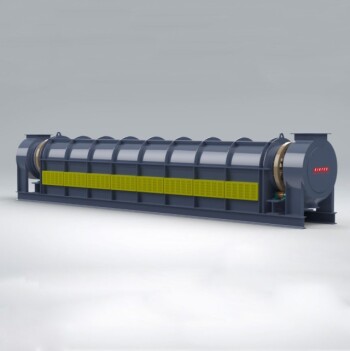
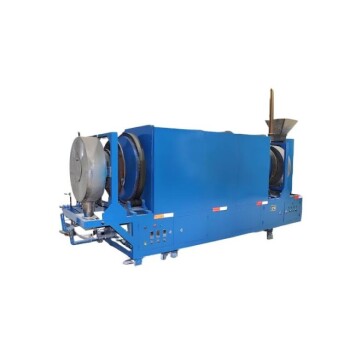
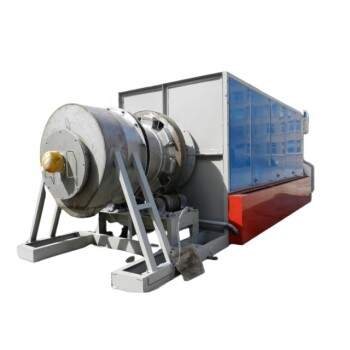
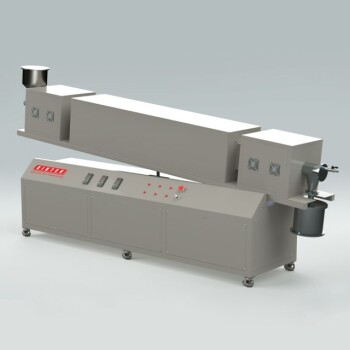
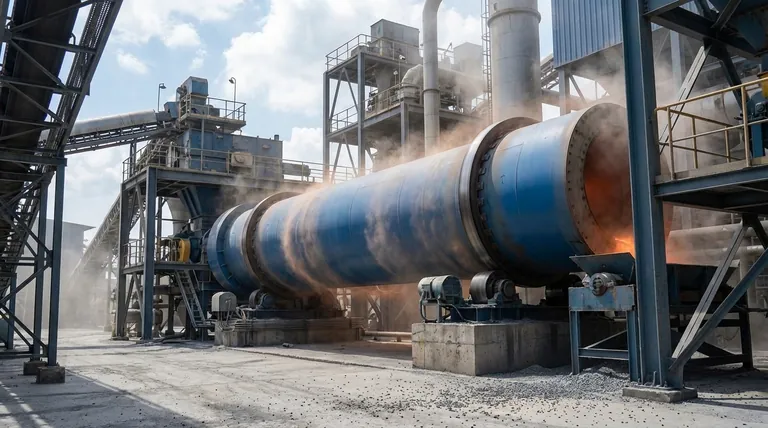
At its core, a rotary kiln is an industrial furnace used to process solid materials at extremely high temperatures. It functions as a versatile heat exchanger designed to induce a specific chemical reaction or physical change, making it essential for manufacturing products like cement, processing minerals, and treating waste.

The true value of a rotary kiln is not just its ability to reach high temperatures, but its unique rotating design. This continuous tumbling motion ensures every particle of material is heated uniformly, which is the critical factor for achieving consistent and controlled thermal transformation on an industrial scale.
What is a rotary kiln used for? Mastering Uniform High-Temperature Processing

How a Rotary Kiln Achieves Uniform Processing

The effectiveness of a rotary kiln comes from its fundamental design: a long, rotating cylinder mounted on a slight incline. This simple mechanical concept is the key to its widespread use.

The Core Principle: Tumbling and Heat Transfer

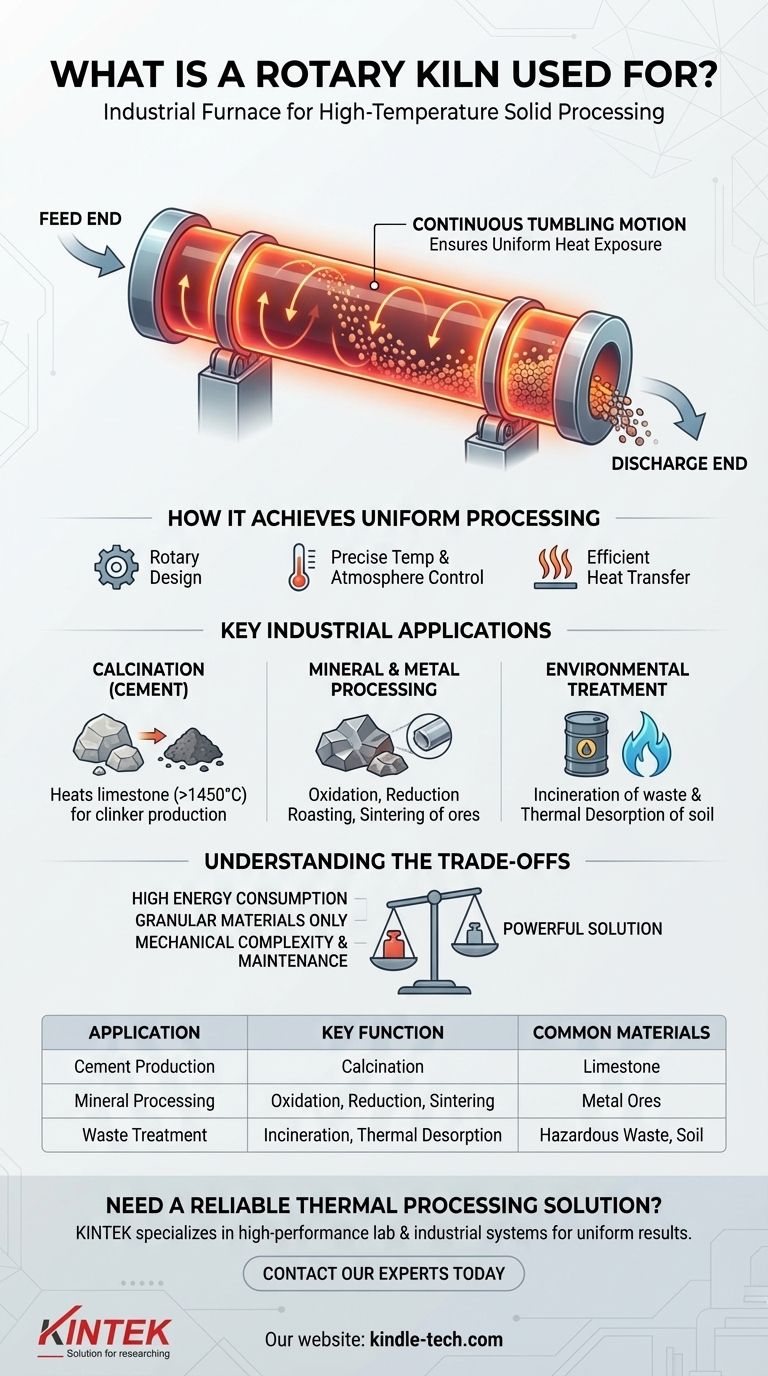
A rotary kiln is the heart of many thermal processing systems. As the cylinder rotates, the solid material inside is continuously lifted and cascaded down, a motion often described as "tumbling."

This action ensures the entire bed of material is constantly mixed. Unlike a static oven where the outer layers can scorch while the core remains under-processed, the kiln's tumbling guarantees uniform exposure to the heat source.

Precise Temperature and Atmosphere Control

The kiln's long body allows engineers to establish a precise temperature profile from the feed end to the discharge end. This means a material can be systematically dried, preheated, and then brought to its final reaction temperature all in a single pass.

Furthermore, specialized seals on either end allow for tight control over the internal atmosphere. This is crucial for carrying out specific chemical reactions, such as oxidation (using excess air) or reduction (in a low-oxygen environment).

Key Industrial Applications

The kiln's ability to deliver uniform heat to solids makes it indispensable across several major industries. Each application leverages the core principle of controlled, continuous processing.

Calcination: The Foundation of Cement

The most common use for rotary kilns is the calcination of limestone to produce clinker, the primary component of cement. This process requires heating limestone to over 1450°C (2640°F) to drive off carbon dioxide and trigger the necessary chemical changes. The kiln's efficiency at handling and uniformly heating huge volumes of material makes this possible.

Mineral and Metal Processing

Rotary kilns are used for a variety of high-temperature reactions involving ores and metal compounds.

  • Oxidation: Creating metal oxides like zinc oxide or manganese oxide.
  • Reduction Roasting: Removing oxygen from iron ores as a step in steelmaking.
  • Sintering/Induration: Fusing fine mineral particles (like iron ore pellets) into strong, coarse lumps by heating them just below their melting point.

Environmental and Waste Treatment

The kiln's high temperatures and tumbling action make it an effective tool for destroying hazardous materials and recovering resources.

  • Incineration: The constant mixing ensures the complete combustion of organic waste.
  • Thermal Desorption: Contaminated soils are heated to vaporize and remove volatile pollutants like oil or mercury, which are then collected and treated separately.

Understanding the Trade-offs

While powerful, a rotary kiln is not a universal solution. Understanding its limitations is key to proper application.

High Energy Consumption

Achieving and maintaining temperatures often exceeding 1000°C is an extremely energy-intensive process. Fuel costs represent a significant portion of the operational budget for any kiln system.

Material Suitability

Rotary kilns are designed for granular or powdered solid materials. They are not suitable for liquids or materials that become sticky and would adhere to the kiln walls, preventing the critical tumbling action.

Mechanical Complexity and Maintenance

A rotary kiln is a massive piece of rotating heavy machinery. The drive systems, support rollers, refractory lining, and air seals all require regular inspection and significant maintenance to ensure safe and efficient operation.

Making the Right Choice for Your Goal

Selecting the correct thermal processing technology depends entirely on your material and your desired outcome.

  • If your primary focus is uniformly processing large volumes of solid, granular material: The rotary kiln is the definitive industrial standard for this task.
  • If your primary focus is achieving a specific chemical change like calcination or reduction: The kiln's ability to control both the temperature profile and internal atmosphere is its key advantage.
  • If your primary focus is treating small batches or non-granular items: A static batch furnace or conveyor oven may be a more practical and cost-effective solution.

Ultimately, the rotary kiln's genius lies in its simple mechanical principle: using rotation to master the complex challenge of uniform high-temperature material transformation.

Summary Table:

Application Key Function Common Materials
Cement Production Calcination (heating to drive off CO₂) Limestone
Mineral Processing Oxidation, Reduction Roasting, Sintering Metal Ores (e.g., Iron, Zinc)
Waste Treatment Incineration, Thermal Desorption Hazardous Waste, Contaminated Soil

Need a reliable thermal processing solution for your materials?

KINTEK specializes in high-performance lab equipment and industrial-scale systems. Whether you are developing a new process or scaling up production, our expertise in thermal processing can help you achieve uniform and consistent results.

Contact our experts today to discuss how we can support your specific application in cement, minerals, or waste treatment.

Visual Guide
What is a rotary kiln used for? Mastering Uniform High-Temperature Processing Visual Guide

Related Products

People Also Ask

Related Products

Electric Rotary Kiln Pyrolysis Furnace Plant Machine Calciner Small Rotary Kiln Rotating Furnace

Electric Rotary Kiln Pyrolysis Furnace Plant Machine Calciner Small Rotary Kiln Rotating Furnace

Electric rotary kiln - precisely controlled, it's ideal for calcination and drying of materials like lithium cobalate, rare earths, and non-ferrous metals.

Electric Rotary Kiln Continuous Working Small Rotary Furnace Heating Pyrolysis Plant

Electric Rotary Kiln Continuous Working Small Rotary Furnace Heating Pyrolysis Plant

Efficiently calcine and dry bulk powder and lump fluid materials with an electric heating rotary furnace. Ideal for processing lithium ion battery materials and more.

Electric Rotary Kiln Small Rotary Furnace for Activated Carbon Regeneration

Electric Rotary Kiln Small Rotary Furnace for Activated Carbon Regeneration

Revitalize your activated carbon with KinTek's Electric Regeneration Furnace. Achieve efficient and cost-effective regeneration with our highly automated rotary kiln and intelligent thermal controller.

Vacuum Sealed Continuous Working Rotary Tube Furnace Rotating Tube Furnace

Vacuum Sealed Continuous Working Rotary Tube Furnace Rotating Tube Furnace

Experience efficient material processing with our vacuum-sealed rotary tube furnace. Perfect for experiments or industrial production, equipped with optional features for controlled feeding and optimized results. Order now.

Three-dimensional electromagnetic sieving instrument

Three-dimensional electromagnetic sieving instrument

KT-VT150 is a desktop sample processing instrument for both sieving and grinding. Grinding and sieving can be used both dry and wet. The vibration amplitude is 5mm and the vibration frequency is 3000-3600 times/min.

Mesh belt controlled atmosphere furnace

Mesh belt controlled atmosphere furnace

Discover our KT-MB mesh belt sintering furnace - perfect for high-temperature sintering of electronic components & glass insulators. Available for open air or controlled atmosphere environments.

Laboratory Muffle Oven Furnace Bottom Lifting Muffle Furnace

Laboratory Muffle Oven Furnace Bottom Lifting Muffle Furnace

Efficiently produce batches with excellent temperature uniformity using our Bottom Lifting Furnace. Features two electric lifting stages and advanced temperature control up to 1600℃.

1700℃ Laboratory Quartz Tube Furnace with Alumina Tube Tubular Furnace

1700℃ Laboratory Quartz Tube Furnace with Alumina Tube Tubular Furnace

Looking for a high-temperature tube furnace? Check out our 1700℃ Tube Furnace with Alumina Tube. Perfect for research and industrial applications up to 1700C.

Laboratory Disc Rotary Mixer for Efficient Sample Mixing and Homogenization

Laboratory Disc Rotary Mixer for Efficient Sample Mixing and Homogenization

Efficient Laboratory Disc Rotary Mixer for Precise Sample Mixing, Versatile for Various Applications, DC Motor and Microcomputer Control, Adjustable Speed and Angle.

Small Vacuum Heat Treat and Tungsten Wire Sintering Furnace

Small Vacuum Heat Treat and Tungsten Wire Sintering Furnace

The small vacuum tungsten wire sintering furnace is a compact experimental vacuum furnace specially designed for universities and scientific research institutes. The furnace features a CNC welded shell and vacuum piping to ensure leak-free operation. Quick-connect electrical connections facilitate relocation and debugging, and the standard electrical control cabinet is safe and convenient to operate.

Graphite Vacuum Continuous Graphitization Furnace

Graphite Vacuum Continuous Graphitization Furnace

High-temperature graphitization furnace is a professional equipment for graphitization treatment of carbon materials. It is a key equipment for the production of high-quality graphite products. It has high temperature, high efficiency and uniform heating. It is suitable for various high-temperature treatments and graphitization treatments. It is widely used in metallurgy, electronics, aerospace, etc. industry.

High Temperature Constant Temperature Heating Circulator Water Bath Chiller Circulator for Reaction Bath

High Temperature Constant Temperature Heating Circulator Water Bath Chiller Circulator for Reaction Bath

Efficient and reliable, KinTek KHB Heating Circulator is perfect for your lab needs. With a max. heating temperature of up to 300℃, it features accurate temperature control and fast heating.

Small Jaw Crusher for Laboratory and Small Mines Efficient Flexible Affordable Laboratory Ore Crusher Coal Crusher

Small Jaw Crusher for Laboratory and Small Mines Efficient Flexible Affordable Laboratory Ore Crusher Coal Crusher

Discover the small jaw crusher for efficient, flexible, and affordable crushing in labs and small mines. Ideal for coal, ores, and rocks. Learn more now!

Vacuum Hot Press Furnace Machine for Lamination and Heating

Vacuum Hot Press Furnace Machine for Lamination and Heating

Experience clean and precise lamination with Vacuum Lamination Press. Perfect for wafer bonding, thin-film transformations, and LCP lamination. Order now!

Precision Wire Saw Laboratory Cutting Machine with 800mm x 800mm Workbench for Diamond Single Wire Circular Small Cutting

Precision Wire Saw Laboratory Cutting Machine with 800mm x 800mm Workbench for Diamond Single Wire Circular Small Cutting

Diamond wire cutting machines are mainly used for precision cutting of ceramics, crystals, glass, metals, rocks, thermoelectric materials, infrared optical materials, composite materials, biomedical materials and other material analysis samples. Especially suitable for precision cutting of ultra-thin plates with thickness up to 0.2mm.

Platinum Sheet Electrode for Laboratory and Industrial Applications

Platinum Sheet Electrode for Laboratory and Industrial Applications

Elevate your experiments with our Platinum Sheet Electrode. Crafted with quality materials, our safe and durable models can be tailored to fit your needs.

Laboratory Vibratory Sieve Shaker Machine Slap Vibrating Sieve

Laboratory Vibratory Sieve Shaker Machine Slap Vibrating Sieve

KT-T200TAP is a slapping and oscillating sieving instrument for laboratory desktop use, with 300 rpm horizontal circular motion and 300 vertical slapping motions to simulate manual sieving to help sample particles pass through better.

Engineering Advanced Fine Ceramics Head Tweezers with Pointed Elbow Zirconia Ceramic Tip

Engineering Advanced Fine Ceramics Head Tweezers with Pointed Elbow Zirconia Ceramic Tip

Zirconia ceramic tweezers are a high-precision tool made of advanced ceramic materials, especially suitable for operating environments that require high precision and corrosion resistance. This type of tweezers not only has excellent physical properties, but is also popular in the medical and laboratory fields because of its biocompatibility.

Infrared Heating Quantitative Flat Plate Press Mold

Infrared Heating Quantitative Flat Plate Press Mold

Discover advanced infrared heating solutions with high-density insulation and precise PID control for uniform thermal performance in various applications.

Quartz Electrolytic Electrochemical Cell for Electrochemical Experiments

Quartz Electrolytic Electrochemical Cell for Electrochemical Experiments

Looking for a reliable quartz electrochemical cell? Our product boasts excellent corrosion resistance and complete specifications. With high-quality materials and good sealing, it's both safe and durable. Customize to meet your needs.


Leave Your Message