Knowledge What is conduction in vacuum? Understanding Heat Transfer in the Absence of Matter
Author avatar

Tech Team · Kintek Solution

Updated 6 days ago

What is conduction in vacuum? Understanding Heat Transfer in the Absence of Matter


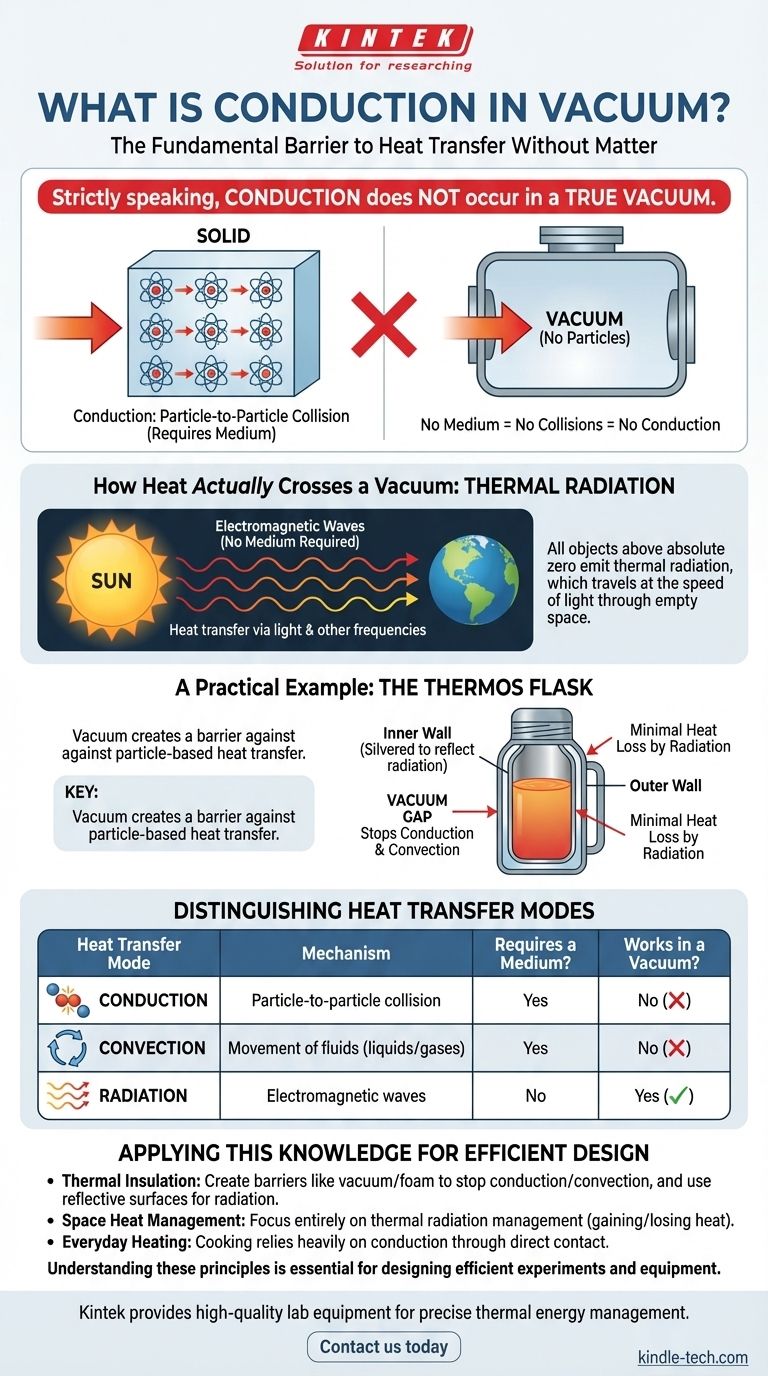
Strictly speaking, conduction in a true vacuum does not occur. Conduction is the transfer of heat through direct molecular collision, a process that requires a physical medium. Because a vacuum is an absence of matter, there are no particles to collide and transfer thermal energy, making conduction impossible.

The core misunderstanding arises from applying a concept (conduction) to an environment (a vacuum) that fundamentally lacks the necessary components for it to happen. Heat can cross a vacuum, but it does so exclusively through the mechanism of thermal radiation, not conduction or convection.
What is conduction in vacuum? Understanding Heat Transfer in the Absence of Matter

The Fundamental Barrier to Conduction

To understand why conduction fails in a vacuum, we must first define how it works. It is a process of direct, particle-to-particle energy transfer.

Conduction is a Chain Reaction

Think of heat as the vibration of atoms and molecules. In a solid, when one side of an object is heated, its atoms vibrate more intensely.

These energetic atoms then jostle and collide with their immediate neighbors, transferring that vibrational energy. This process continues down the line, like a series of falling dominoes, until the heat has propagated through the material.

A Vacuum Has No Particles

A vacuum, by its very definition, is a space devoid of matter. There are no atoms or molecules to form the "chain" needed for conduction.

Without a medium, there can be no particle-to-particle collisions. The pathway for conduction is completely broken.

How Heat Actually Crosses a Vacuum

If conduction is impossible, how does the Sun's heat reach Earth? The answer is an entirely different mechanism that requires no medium at all.

The Role of Thermal Radiation

Every object with a temperature above absolute zero (0 Kelvin) emits its thermal energy as electromagnetic waves. This is called thermal radiation.

These waves, which include infrared light, visible light, and other frequencies, travel at the speed of light and can move through the empty void of space.

No Medium Required

Unlike conduction or convection, thermal radiation does not need any particles to propagate. When these electromagnetic waves strike an object, their energy is absorbed, causing the object's atoms to vibrate more intensely—which we perceive as an increase in heat.

A Practical Example: The Thermos Flask

A thermos (or vacuum flask) is a perfect real-world application of this principle. It is designed with a gap between its inner and outer walls from which the air has been removed, creating a vacuum.

This vacuum acts as a powerful insulator precisely because it stops heat transfer by both conduction and convection. Heat cannot conduct across the empty space. The silvered surfaces of the inner walls also serve to minimize heat transfer by radiation.

Distinguishing the Three Modes of Heat Transfer

Confusion often arises from mixing up the three distinct ways heat can move. Understanding each one's requirement clarifies why only one works in a vacuum.

Conduction: Direct Contact

This is heat transfer through a substance via direct molecular contact. It is most effective in solids, like a metal spoon heating up in a hot cup of tea. It requires a medium.

Convection: Fluid Movement

This is heat transfer through the movement of fluids (liquids or gases). Warmer, less dense fluid rises, and cooler, denser fluid sinks, creating a current that circulates heat. Think of boiling water or a room heater. It requires a fluid medium.

Radiation: Electromagnetic Waves

This is heat transfer via electromagnetic waves. It is the only mode of heat transfer that does not require a medium and can therefore operate across the vacuum of space.

Applying This Knowledge

Understanding these distinctions is critical for solving practical engineering and design problems.

  • If your primary focus is thermal insulation (like a thermos or home insulation): Your goal is to create barriers that stop conduction and convection (like a vacuum or foam) and use surfaces that minimize radiation (like reflective foil).
  • If your primary focus is heat management in space (like a satellite): You must focus entirely on managing thermal radiation, as it's the only way your object can gain heat from the sun or lose its own heat into deep space.
  • If your primary focus is cooking on a stovetop: You are primarily using conduction from the burner to the pan, and subsequently into the food through direct contact.

Recognizing which heat transfer mechanism dominates a given environment is the first step toward effectively controlling it.

Summary Table:

Heat Transfer Mode Mechanism Requires a Medium? Works in a Vacuum?
Conduction Particle-to-particle collision Yes No
Convection Movement of fluids (liquids/gases) Yes No
Radiation Electromagnetic waves No Yes

Need to control heat transfer in your lab processes? Understanding the principles of conduction, convection, and radiation is essential for designing efficient experiments and equipment. KINTEK specializes in providing high-quality lab equipment and consumables that help you manage thermal energy effectively. Whether you're working with vacuum furnaces, insulation, or thermal analysis, our solutions are designed to meet the precise needs of your laboratory. Contact us today to learn how we can support your research and innovation!

Visual Guide
What is conduction in vacuum? Understanding Heat Transfer in the Absence of Matter Visual Guide

Related Products

People Also Ask

Related Products

Vacuum Heat Treat Furnace with Ceramic Fiber Liner

Vacuum Heat Treat Furnace with Ceramic Fiber Liner

Vacuum furnace with polycrystalline ceramic fiber insulation liner for excellent heat insulation and uniform temperature field. Choose from 1200℃ or 1700℃ max. working temperature with high vacuum performance and precise temperature control.

Molybdenum Vacuum Heat Treat Furnace

Molybdenum Vacuum Heat Treat Furnace

Discover the benefits of a high-configuration molybdenum vacuum furnace with heat shield insulation. Ideal for high-purity, vacuum environments like sapphire crystal growth and heat treatment.

Vacuum Heat Treat Furnace and Levitation Induction Melting Furnace

Vacuum Heat Treat Furnace and Levitation Induction Melting Furnace

Experience precise melting with our Vacuum Levitation Melting Furnace. Ideal for high melting point metals or alloys, with advanced technology for effective smelting. Order now for high-quality results.

2200 ℃ Tungsten Vacuum Heat Treat and Sintering Furnace

2200 ℃ Tungsten Vacuum Heat Treat and Sintering Furnace

Experience the ultimate refractory metal furnace with our Tungsten vacuum furnace. Capable of reaching 2200℃, perfect for sintering advanced ceramics and refractory metals. Order now for high-quality results.

2200 ℃ Graphite Vacuum Heat Treat Furnace

2200 ℃ Graphite Vacuum Heat Treat Furnace

Discover the power of the KT-VG Graphite Vacuum Furnace - with a maximum working temperature of 2200℃, it's perfect for vacuum sintering of various materials. Learn more now.

Vacuum Heat Treat Sintering Brazing Furnace

Vacuum Heat Treat Sintering Brazing Furnace

A vacuum brazing furnace is a type of industrial furnace used for brazing, a metalworking process that joins two pieces of metal using a filler metal that melts at a lower temperature than the base metals. Vacuum brazing furnaces are typically used for high-quality applications where a strong, clean joint is required.

High Pressure Laboratory Vacuum Tube Furnace Quartz Tubular Furnace

High Pressure Laboratory Vacuum Tube Furnace Quartz Tubular Furnace

KT-PTF High Pressure Tube Furnace: Compact split tube furnace with strong positive pressure resistance. Working temp up to 1100°C and pressure up to 15Mpa. Also works under controller atmosphere or high vacuum.

Vacuum Heat Treat and Molybdenum Wire Sintering Furnace for Vacuum Sintering

Vacuum Heat Treat and Molybdenum Wire Sintering Furnace for Vacuum Sintering

A vacuum molybdenum wire sintering furnace is a vertical or bedroom structure, which is suitable for withdrawal, brazing, sintering and degassing of metal materials under high vacuum and high temperature conditions. It is also suitable for dehydroxylation treatment of quartz materials.

Graphite Vacuum Furnace High Thermal Conductivity Film Graphitization Furnace

Graphite Vacuum Furnace High Thermal Conductivity Film Graphitization Furnace

The high thermal conductivity film graphitization furnace has uniform temperature, low energy consumption and can operate continuously.

Vacuum Hot Press Furnace Heated Vacuum Press Machine Tube Furnace

Vacuum Hot Press Furnace Heated Vacuum Press Machine Tube Furnace

Reduce forming pressure & shorten sintering time with Vacuum Tube Hot Press Furnace for high-density, fine-grain materials. Ideal for refractory metals.

Vertical Laboratory Quartz Tube Furnace Tubular Furnace

Vertical Laboratory Quartz Tube Furnace Tubular Furnace

Elevate your experiments with our Vertical Tube Furnace. Versatile design allows for operation under various environments and heat treatment applications. Order now for precise results!

Laboratory Muffle Oven Furnace Bottom Lifting Muffle Furnace

Laboratory Muffle Oven Furnace Bottom Lifting Muffle Furnace

Efficiently produce batches with excellent temperature uniformity using our Bottom Lifting Furnace. Features two electric lifting stages and advanced temperature control up to 1600℃.

1800℃ Muffle Oven Furnace for Laboratory

1800℃ Muffle Oven Furnace for Laboratory

KT-18 muffle furnace with Japan Al2O3 polycrystalline fibe and Silicon Molybdenum heating element, up to 1900℃, PID temperature control and 7" smart touch screen. Compact design, low heat loss, and high energy efficiency. Safety interlock system and versatile functions.

1700℃ Controlled Atmosphere Furnace Nitrogen Inert Atmosphere Furnace

1700℃ Controlled Atmosphere Furnace Nitrogen Inert Atmosphere Furnace

KT-17A Controlled atmosphere furnace: 1700℃ heating, vacuum sealing technology, PID temperature control, and versatile TFT smart touch screen controller for laboratory and industrial use.

1700℃ Muffle Oven Furnace for Laboratory

1700℃ Muffle Oven Furnace for Laboratory

Get superior heat control with our 1700℃ Muffle Furnace. Equipped with intelligent temperature microprocessor, TFT touch screen controller & advanced insulation materials for precise heating up to 1700C. Order now!

High Temperature Muffle Oven Furnace for Laboratory Debinding and Pre Sintering

High Temperature Muffle Oven Furnace for Laboratory Debinding and Pre Sintering

KT-MD High temperature debinding and pre-sintering furnace for ceramic materials with various molding processes. Ideal for electronic components such as MLCC and NFC.

Ultra-High Temperature Graphite Vacuum Graphitization Furnace

Ultra-High Temperature Graphite Vacuum Graphitization Furnace

The ultra-high temperature graphitization furnace utilizes medium frequency induction heating in a vacuum or inert gas environment. The induction coil generates an alternating magnetic field, inducing eddy currents in the graphite crucible, which heats up and radiates heat to the workpiece, bringing it to the desired temperature. This furnace is primarily used for graphitization and sintering of carbon materials, carbon fiber materials, and other composite materials.

600T Vacuum Induction Hot Press Furnace for Heat Treat and Sintering

600T Vacuum Induction Hot Press Furnace for Heat Treat and Sintering

Discover the 600T Vacuum Induction Hot Press Furnace, designed for high-temperature sintering experiments in vacuum or protected atmospheres. Its precise temperature and pressure control, adjustable working pressure, and advanced safety features make it ideal for nonmetal materials, carbon composites, ceramics, and metal powders.

Vacuum Heat Treat and Sintering Furnace with 9MPa Air Pressure

Vacuum Heat Treat and Sintering Furnace with 9MPa Air Pressure

The air pressure sintering furnace is a high-tech equipment commonly used for the sintering of advanced ceramic materials. It combines vacuum sintering and pressure sintering techniques to achieve high-density and high-strength ceramics.

Laboratory Quartz Tube Furnace Tubular RTP Heating Furnace

Laboratory Quartz Tube Furnace Tubular RTP Heating Furnace

Get lightning-fast heating with our RTP Rapid Heating Tube Furnace. Designed for precise, high-speed heating and cooling with convenient sliding rail and TFT touch screen controller. Order now for ideal thermal processing!


Leave Your Message