Knowledge What is laminating technique? Unlock the Power of Layered Materials for Superior Results
Author avatar

Tech Team · Kintek Solution

Updated 1 week ago

What is laminating technique? Unlock the Power of Layered Materials for Superior Results


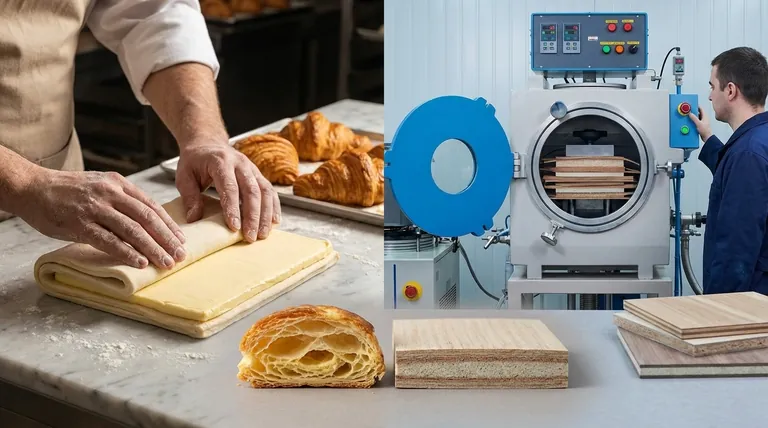
In simple terms, lamination is the technique of manufacturing a material in multiple layers. This process creates a composite material where the final product achieves improved strength, stability, appearance, or texture that the individual layers could not achieve on their own. The technique is applied in fields as different as baking, where it creates flaky pastries, and manufacturing, where it produces durable furniture surfaces.

The core principle of lamination is always the same: bonding distinct layers together to create a superior final product. Whether folding butter into dough or pressing wood veneer onto a core, the goal is to leverage the properties of a layered structure.
What is laminating technique? Unlock the Power of Layered Materials for Superior Results

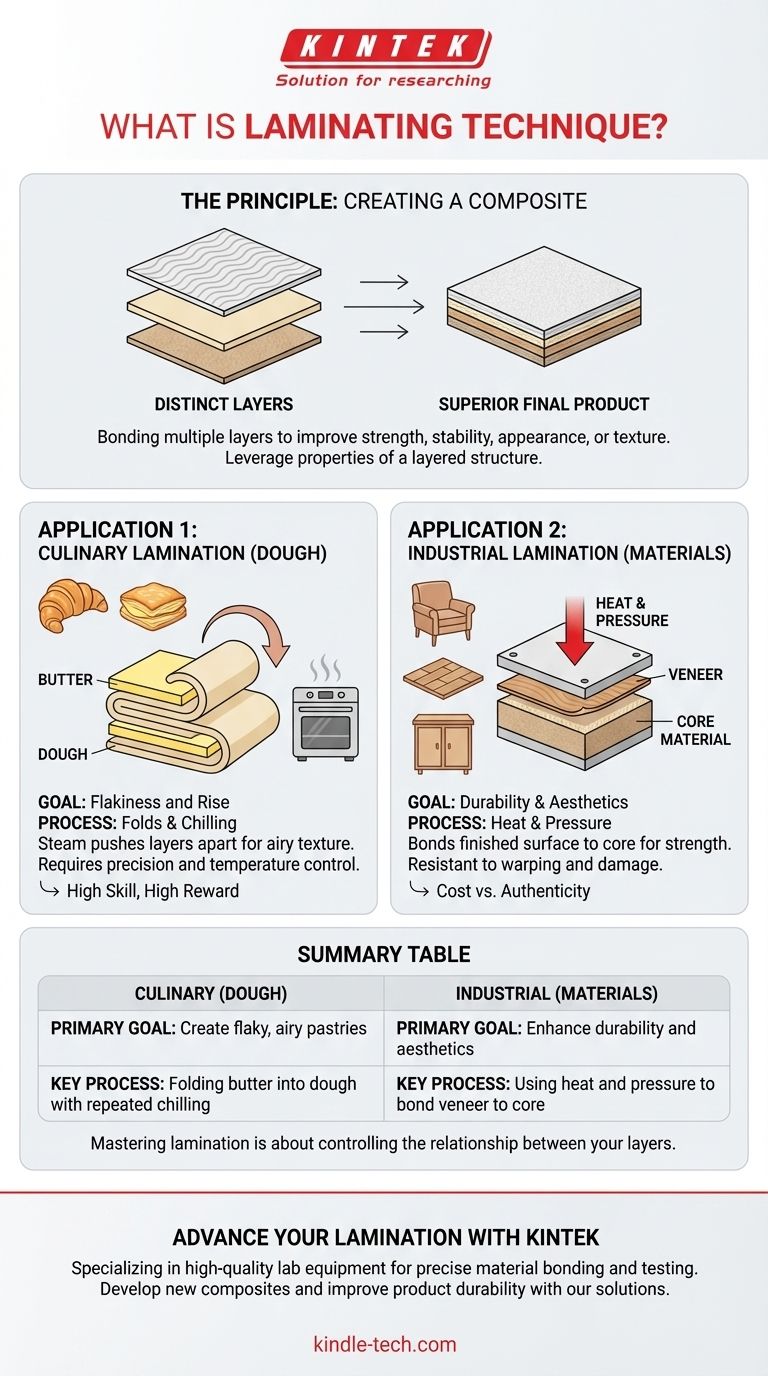
The Principle of Lamination: Creating a Composite

The Goal is a New Material

Lamination is not just about stacking things. It is about creating a new, composite material through the fusion of different layers.

The resulting material gains benefits from each component layer. For example, a decorative but fragile top layer can be bonded to a strong but plain core, creating a final product that is both beautiful and durable.

The Power of Layers

The magic of lamination lies in the interfaces between the layers. In pastry, these layers create separation and flakiness. In manufacturing, they provide a surface for powerful adhesives to bond materials permanently.

The process almost always involves pressure, and often heat or a binding agent (like butter in dough or glue in wood), to ensure the layers act as a single, cohesive unit.

Application 1: Culinary Lamination (Dough)

The Goal: Flakiness and Rise

In baking, lamination is the process responsible for the airy, flaky layers in croissants, puff pastry, and danishes. The goal is to create dozens of ultra-thin alternating layers of dough and butter.

When baked, the water in the butter turns to steam. This steam pushes the dough layers apart, creating the signature puffy and delicate texture.

The Process: Folds and Chilling

The technique involves enclosing a slab of cold, pliable butter within a lean dough. This package is then carefully rolled out and folded over on itself multiple times.

Between each "turn" or fold, the dough is chilled rigorously. This is critical to ensure the butter remains a distinct, solid layer and doesn't simply melt into the dough, which would ruin the effect.

Application 2: Industrial Lamination (Materials)

The Goal: Durability and Aesthetics

In manufacturing, lamination is used to apply a finished surface layer to a core material. This is common in furniture, flooring, and cabinetry.

The primary goals are to improve appearance by adding a wood grain or color veneer, and to enhance durability by adding a protective, scratch-resistant outer layer to a core like particleboard or MDF.

The Process: Heat and Pressure

Industrial lamination typically uses large hot-press machines. These machines apply immense pressure and heat to bond layers together with a powerful adhesive.

This process creates a permanent, stable bond that makes the final panel or door resistant to warping and surface damage.

Understanding the Trade-offs

Culinary: High Skill, High Reward

Laminating dough is a time-consuming and technically demanding process. Success requires precision, patience, and strict temperature control.

If the butter gets too warm and melts, or gets too cold and shatters, the layers will be compromised, resulting in a greasy or dense pastry instead of a light, flaky one.

Industrial: Cost vs. Authenticity

Laminating materials allows manufacturers to produce strong, attractive products at a lower cost than using solid hardwood. It is an efficient and versatile method.

The primary trade-off is the potential for delamination (peeling) over time if the bonding is poor. Furthermore, laminated products lack the authentic feel and repairability of solid materials.

How to Apply This Knowledge

Understanding the context is key to understanding the technique.

  • If your primary focus is creating flaky pastries: Your lamination technique involves precisely folding cold butter into dough with repeated chills to create separation.
  • If your primary focus is producing durable, decorative surfaces: Your lamination technique uses industrial heat and pressure to permanently bond a veneer to a core material.

Ultimately, mastering lamination in any field comes from controlling the relationship between your layers.

Summary Table:

Application Primary Goal Key Process
Culinary (Dough) Create flaky, airy pastries Folding butter into dough with repeated chilling
Industrial (Materials) Enhance durability and aesthetics Using heat and pressure to bond veneer to core

Ready to enhance your lab or production process with advanced lamination techniques? KINTEK specializes in high-quality lab equipment and consumables, providing the tools you need for precise material bonding and testing. Whether you're developing new composite materials or improving product durability, our solutions are designed to meet your laboratory's unique needs. Contact us today to discover how we can support your projects with reliable, cutting-edge equipment!

Visual Guide
What is laminating technique? Unlock the Power of Layered Materials for Superior Results Visual Guide

Related Products

People Also Ask

Related Products

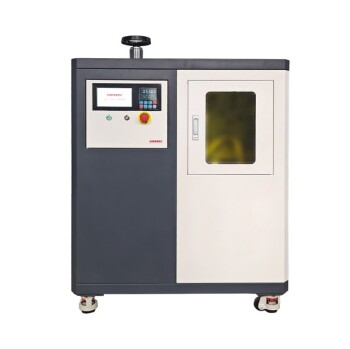
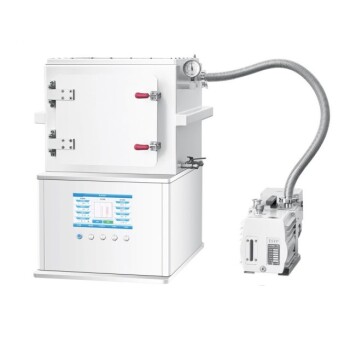
Vacuum Hot Press Furnace Machine for Lamination and Heating

Vacuum Hot Press Furnace Machine for Lamination and Heating

Experience clean and precise lamination with Vacuum Lamination Press. Perfect for wafer bonding, thin-film transformations, and LCP lamination. Order now!

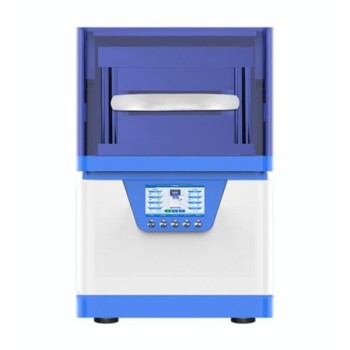
Warm Isostatic Press for Solid State Battery Research

Warm Isostatic Press for Solid State Battery Research

Discover the advanced Warm Isostatic Press (WIP) for semiconductor lamination. Ideal for MLCC, hybrid chips, and medical electronics. Enhance strength and stability with precision.

Laboratory Hydraulic Press Split Electric Lab Pellet Press

Laboratory Hydraulic Press Split Electric Lab Pellet Press

Efficiently prepare samples with a split electric lab press - available in various sizes and ideal for material research, pharmacy, and ceramics. Enjoy greater versatility and higher pressure with this portable and programmable option.

Automatic Laboratory Heat Press Machine

Automatic Laboratory Heat Press Machine

Precision automatic heat press machines for labs—ideal for material testing, composites, and R&D. Customizable, safe, and efficient. Contact KINTEK today!

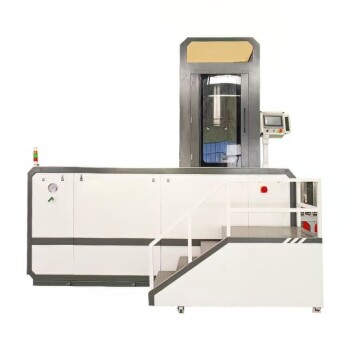
Warm Isostatic Press WIP Workstation 300Mpa for High Pressure Applications

Warm Isostatic Press WIP Workstation 300Mpa for High Pressure Applications

Discover Warm Isostatic Pressing (WIP) - A cutting-edge technology that enables uniform pressure to shape and press powdered products at a precise temperature. Ideal for complex parts and components in manufacturing.

Heated Hydraulic Press Machine with Heated Plates for Vacuum Box Laboratory Hot Press

Heated Hydraulic Press Machine with Heated Plates for Vacuum Box Laboratory Hot Press

Enhance your lab's precision with our lab press for vacuum box. Press pills and powders with ease and precision in a vacuum environment, reducing oxidation and improving consistency. Compact and easy to use with a digital pressure gauge.

Laboratory Hydraulic Press Lab Pellet Press Machine for Glove Box

Laboratory Hydraulic Press Lab Pellet Press Machine for Glove Box

Controlled environment lab press machine for glove box. Specialized equipment for material pressing and shaping with high precision digital pressure gauge.

Double Plate Heating Press Mold for Lab

Double Plate Heating Press Mold for Lab

Discover precision in heating with our Double Plate Heating Mold, featuring high-quality steel and uniform temperature control for efficient lab processes. Ideal for various thermal applications.

Heated Hydraulic Press Machine with Heated Plates Split Manual Laboratory Hot Press

Heated Hydraulic Press Machine with Heated Plates Split Manual Laboratory Hot Press

Efficiently prepare your samples with our Split Manual Heated Lab Press. With a pressure range up to 40T and heating plates up to 300°C, it's perfect for various industries.

Heated Hydraulic Press Machine with Heated Plates for Vacuum Box Laboratory Hot Press

Heated Hydraulic Press Machine with Heated Plates for Vacuum Box Laboratory Hot Press

The lab press for vacuum box is a specialized piece of equipment designed for laboratory use. Its main purpose is to press pills and powders according to specific requirements.

Electric Lab Cold Isostatic Press CIP Machine for Cold Isostatic Pressing

Electric Lab Cold Isostatic Press CIP Machine for Cold Isostatic Pressing

Produce dense, uniform parts with improved mechanical properties with our Electric Lab Cold Isostatic Press. Widely used in material research, pharmacy, and electronic industries. Efficient, compact, and vacuum-compatible.

Automatic Heated Hydraulic Press Machine with Heated Plates for Laboratory Hot Press

Automatic Heated Hydraulic Press Machine with Heated Plates for Laboratory Hot Press

The Automatic High Temperature Heat Press is a sophisticated hydraulic hot press designed for efficient temperature control and product quality processing.

Manual Heated Hydraulic Press Machine with Heated Plates for Laboratory Hot Press

Manual Heated Hydraulic Press Machine with Heated Plates for Laboratory Hot Press

The Manual Heat Press is a versatile piece of equipment suitable for a variety of applications, operated by a manual hydraulic system that applies controlled pressure and heat to the material placed on the piston.

Laboratory Manual Hydraulic Pellet Press for Lab Use

Laboratory Manual Hydraulic Pellet Press for Lab Use

Efficient Manure Lab Hydraulic Press with Safety Cover for sample preparation in material research, pharmacy, and electronic industries. Available in 15T to 60T.

Automatic High Temperature Heated Hydraulic Press Machine with Heated Plates for Lab

Automatic High Temperature Heated Hydraulic Press Machine with Heated Plates for Lab

The High Temperature Hot Press is a machine specifically designed for pressing, sintering and processing materials in a high temperature environment. It is capable of operating in the range of hundreds of degrees Celsius to thousands of degrees Celsius for a variety of high temperature process requirements.

Manual Cold Isostatic Pressing Machine CIP Pellet Press

Manual Cold Isostatic Pressing Machine CIP Pellet Press

Lab Manual Isostatic Press is a high-efficient equipment for sample preparation widely used in material research, pharmacy, ceramics, and electronic industries. It allows for precision control of the pressing process and can work in a vacuum environment.

Automatic Lab Cold Isostatic Press CIP Machine Cold Isostatic Pressing

Automatic Lab Cold Isostatic Press CIP Machine Cold Isostatic Pressing

Efficiently prepare samples with our Automatic Lab Cold Isostatic Press. Widely used in material research, pharmacy, and electronic industries. Provides greater flexibility and control compared to electric CIPs.

Laboratory Hydraulic Press Lab Pellet Press for Button Battery

Laboratory Hydraulic Press Lab Pellet Press for Button Battery

Efficiently prepare samples with our 2T Button Battery Press. Ideal for material research labs and small-scale production. Small footprint, lightweight, and vacuum-compatible.

Heated Hydraulic Press Machine with Integrated Manual Heated Plates for Lab Use

Heated Hydraulic Press Machine with Integrated Manual Heated Plates for Lab Use

Efficiently process heat-pressing samples with our Integrated Manual Heated Lab Press. With a heating range up to 500°C, it's perfect for various industries.

Manual High Temperature Heated Hydraulic Press Machine with Heated Plates for Lab

Manual High Temperature Heated Hydraulic Press Machine with Heated Plates for Lab

The High Temperature Hot Press is a machine specifically designed for pressing, sintering and processing materials in a high temperature environment. It is capable of operating in the range of hundreds of degrees Celsius to thousands of degrees Celsius for a variety of high temperature process requirements.


Leave Your Message