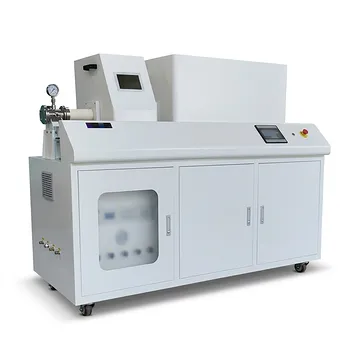
Organometallic Chemical Vapour Deposition (MOCVD) is the primary manufacturing process used to create specific high-performance semiconductor layers. Its most critical application is the epitaxial growth of GaN-based (Gallium Nitride) materials, which serves as the foundation for manufacturing blue, green, or UV-emitting diode chips. Furthermore, it is valued for its ability to provide excellent coverage over uneven surfaces, effectively coating complex features like holes and trenches.
MOCVD is the industry standard for depositing high-purity, crystalline films required for modern optoelectronics. By combining the precision of epitaxial growth with the ability to coat complex geometries, it enables the mass production of advanced LED and semiconductor technologies.
The Core Applications
Semiconductor Manufacturing
The primary use case for MOCVD is in the semiconductor industry. It is specifically designed for the epitaxial growth of materials.
Epitaxy refers to the deposition of a crystalline overlayer on a crystalline substrate. This alignment of crystal structures is essential for the functionality of advanced electronic devices.
Optoelectronics and LEDs
MOCVD is the specific technology behind the production of light-emitting diodes (LEDs).
It is used to manufacture chips that emit blue, green, or UV light. These specific wavelengths utilize GaN-based materials, which MOCVD is uniquely suited to deposit.
Complex Surface Geometries
Unlike line-of-sight processes (such as physical vapour deposition), MOCVD excels at coating irregular surfaces.
Because the reactants are in the gas phase, the process provides good coverage of holes and trenches. This ensures uniform film thickness even on substrates with restricted access surfaces or complex topographies.
How the Process Works
Gas-Phase Reaction
MOCVD is a specific subset of Chemical Vapour Deposition (CVD).
The process relies on a chemical reaction occurring in the gas phase. Metal-organic precursors are selected and mixed with reaction gases (such as hydrogen or nitrogen) before being transported into a process chamber.
Thermal Deposition
The deposition occurs on a heated substrate.
When the mixed gases flow onto the substrate—which is heated to temperatures ranging from hundreds to thousands of degrees Celsius—the precursors decompose. This chemical reaction deposits the desired solid material directly onto the surface.
By-Product Management
The process is continuous and clean.
As the solid material forms on the substrate, unreacted precursors and by-products are carried away from the reaction chamber by the gas flow, helping maintain the purity of the deposited film.
Operational Trade-offs
High Thermal Requirements
MOCVD is an energy-intensive process.
The substrate must be heated to extremely high temperatures to facilitate the necessary chemical reactions. This requires specialized equipment capable of maintaining strict thermal controls ranging from hundreds to thousands of degrees Celsius.
Chemical Complexity
The process involves handling volatile and reactive chemical precursors.
Successful deposition requires the precise selection and mixing of metal-organic precursors. Additionally, the system must effectively manage the emission of by-products to prevent contamination and ensure safety.
Making the Right Choice for Your Project
MOCVD is a specialized tool for high-precision applications. Use the criteria below to determine if it fits your manufacturing goals.
- If your primary focus is LED or Optoelectronic production: MOCVD is the required standard for growing the GaN-based materials needed for blue, green, and UV emitters.
- If your primary focus is coating complex 3D structures: MOCVD is an excellent choice due to its non-line-of-sight nature, allowing it to coat trenches and holes uniformly.
- If your primary focus is hard alloy coatings: You should investigate Medium Temperature Chemical Vapour Deposition (MTCVD), which is better suited for producing dense, hard alloy films.
MOCVD remains the definitive technology for applications requiring the high-purity epitaxial growth of compound semiconductors.
Summary Table:
| Application | Key Benefit | Target Industry |
|---|---|---|
| Epitaxial Growth | High-purity crystalline alignment | Semiconductor Manufacturing |
| Optoelectronics | Enables Blue/Green/UV LED production | LED & Display Tech |
| Complex Geometries | Superior coverage of holes and trenches | Precision Engineering |
| GaN Materials | Essential for Gallium Nitride layers | Power & RF Electronics |
Elevate Your Semiconductor Research with KINTEK
Unlock the full potential of MOCVD and epitaxial growth with precision-engineered solutions from KINTEK. Whether you are developing next-generation LEDs or advanced power electronics, our high-performance CVD systems (including CVD, PECVD, and MPCVD) and specialized high-temperature furnaces are designed to meet the rigorous thermal and purity demands of GaN-based materials.
From high-purity ceramic crucibles to integrated cooling solutions and laboratory equipment, KINTEK provides the comprehensive toolkit needed for cutting-edge material science.
Ready to optimize your thin-film deposition process? Contact KINTEK today to discuss your project requirements!
Related Products
- 915MHz MPCVD Diamond Machine Microwave Plasma Chemical Vapor Deposition System Reactor
- Multi Heating Zones CVD Tube Furnace Machine Chemical Vapor Deposition Chamber System Equipment
- Microwave Plasma Chemical Vapor Deposition MPCVD Machine System Reactor for Lab and Diamond Growth
- Cylindrical Resonator MPCVD Machine System Reactor for Microwave Plasma Chemical Vapor Deposition and Lab Diamond Growth
- Customer Made Versatile CVD Tube Furnace Chemical Vapor Deposition Chamber System Equipment
People Also Ask
- How does a microwave plasma reactor facilitate the synthesis of diamond? Master MPCVD with Precision Technology
- What are the advantages of a Microwave Plasma CVD reactor for MCD/NCD coatings? Precision Multilayer Diamond Engineering
- How do vacuum pumps and valves collaborate in MPCVD? Achieve Precise Pressure Control for Superior CNT Synthesis
- What are the primary advantages of the CVD method for growing diamonds? Engineering High-Purity Gems and Components
- How is a diamond formed from CVD? The Science of Growing Diamonds Atom by Atom