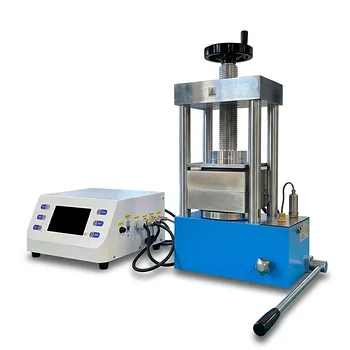
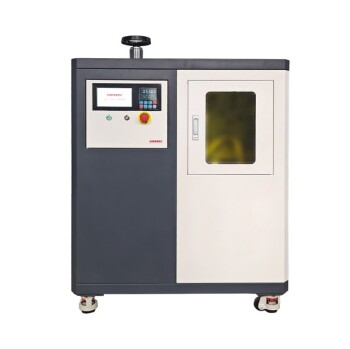
The core function of a laboratory heated hydraulic press in the Cold Sintering Process (CSP) is to act as a catalyst for a chemical phase change rather than just a thermal one. By simultaneously applying constant uniaxial pressure and a controlled thermal field typically below 300°C, the press triggers a dissolution-precipitation reaction in transient solvents. This allows for the high densification of solid-state battery composites—specifically those combining ceramics and polymers—without the destructive high heat required by traditional sintering.
The heated hydraulic press effectively solves the "thermal mismatch" in composite manufacturing. By replacing extreme heat with precise pressure and chemical activation, it enables the co-sintering of thermally sensitive polymers and hard ceramics into a dense, unified material.
The Mechanism of Cold Sintering
Triggering the Dissolution-Precipitation Reaction
The primary role of the press is to create the specific environment needed for transient solvents to function.
Unlike traditional sintering, which relies on atomic diffusion via extreme heat, CSP relies on a liquid phase. The press applies constant pressure to aid the redistribution of particles while the low heat activates the solvent, allowing ceramic particles to partially dissolve and re-precipitate into a dense structure.
Uniaxial Pressure for Mass Transport
The press provides the physical force necessary to drive mass transport.
While the chemical reaction occurs, the constant uniaxial pressure forces the solid and liquid phases together, closing pore spaces. This ensures that as the solvent evaporates or reacts, the remaining material is tightly packed, achieving high densification.
Controlled Low-Temperature Environment
The press maintains a precise thermal field, strictly capping temperatures below 300°C.
This thermal ceiling is non-negotiable for CSP. It provides just enough energy to facilitate the solvent reaction and evaporation but remains low enough to prevent thermal degradation of sensitive components.
Solving the Composite Challenge
Enabling Co-Sintering of Incompatible Materials
The most distinct advantage of using this equipment for battery composites is the ability to combine ceramics and polymers (such as PTFE).
Traditional furnaces operate at temperatures that would incinerate polymers long before the ceramic electrolyte densified. The heated hydraulic press circumvents this by densifying the ceramic matrix at temperatures the polymer can withstand, preserving the functional properties of both materials.
Eliminating Structural Defects
Beyond chemistry, the press serves a mechanical quality assurance role.
By maintaining high pressure during the heating phase, the press forces the melt or solution to fully penetrate pores, effectively excluding interfacial air. This eliminates microscopic voids and density gradients that would otherwise ruin the conductivity or structural integrity of a solid-state battery.
Preventing Deformation
The equipment controls the physical shape of the composite throughout the thermal cycle.
Maintaining pressure during the cooling phase is critical. It prevents warping and deformation that often occur due to thermal expansion mismatches between the ceramic and polymer, ensuring the final part has high interlaminar shear strength.
Critical Considerations for Process Control
The Necessity of Precision
While the press enables CSP, it requires exacting control over the pressure-temperature ramp.
If the pressure is applied too late, voids will remain; if the temperature overshoots even slightly, the polymer component may degrade. The "window" for success in CSP is significantly narrower than in conventional sintering, requiring equipment with high stability and responsiveness.
Limitation of Geometry
The uniaxial nature of the pressure limits the geometric complexity of the parts.
Because the force is applied in a single direction (vertical), density gradients can still form in very thick parts or complex shapes. This equipment is best suited for the flat, laminar structures typical of battery electrodes and electrolyte separators.
Making the Right Choice for Your Goal
To maximize the efficacy of a heated hydraulic press for solid-state battery composites, align your process parameters with your specific material constraints.
- If your primary focus is Material Integrity: Prioritize temperature stability to ensure the thermal ceiling never exceeds the degradation point of your polymer binder (e.g., <300°C).
- If your primary focus is Ionic Conductivity: Prioritize pressure magnitude to maximize densification and eliminate interfacial voids that impede ion transport.
Success in Cold Sintering lies in the precise synchronization of mechanical force and chemical activation to achieve what thermal energy alone cannot.
Summary Table:
| Feature | Role in Cold Sintering Process (CSP) | Key Benefit |
|---|---|---|
| Uniaxial Pressure | Drives mass transport and closes pore spaces. | Eliminates voids and ensures high densification. |
| Controlled Low Heat | Activates transient solvents (typically <300°C). | Prevents thermal degradation of sensitive polymers. |
| Phase Triggering | Catalyzes dissolution-precipitation reactions. | Enables co-sintering of incompatible materials. |
| Structural Control | Maintains pressure during the thermal cycle. | Prevents warping and maintains material integrity. |
Revolutionize Your Battery Research with KINTEK Precision
Unlock the full potential of Cold Sintering (CSP) for your solid-state battery composites. KINTEK specializes in advanced laboratory equipment, offering high-performance heated hydraulic presses (pellet, hot, isostatic) designed to provide the precise uniaxial pressure and thermal stability required for sensitive ceramic-polymer materials.
Whether you are developing electrolytes or electrodes, our comprehensive portfolio—from crushing and milling systems to high-temperature reactors and PTFE consumables—ensures your lab is equipped for success.
Ready to eliminate structural defects and enhance ionic conductivity?
Contact KINTEK Today for a Tailored Solution
Related Products
- Automatic High Temperature Heated Hydraulic Press Machine with Heated Plates for Lab
- 600T Vacuum Induction Hot Press Furnace for Heat Treat and Sintering
- 30T 40T Split Automatic Heated Hydraulic Press Machine with Heated Plates for Laboratory Hot Press
- 24T 30T 60T Heated Hydraulic Press Machine with Heated Plates for Laboratory Hot Press
- Automatic Heated Hydraulic Press Machine with Heated Plates for Laboratory Hot Press 25T 30T 50T
People Also Ask
- What is a heated hydraulic press used for? Essential Tool for Curing, Molding, and Laminating
- Why is a heated hydraulic press used for warm pressing NASICON green tapes? Optimize Your Solid Electrolyte Density
- Why is a heated laboratory hydraulic press necessary for composite laminates? Achieve Void-Free Structural Integrity
- What is a hot hydraulic press? Harness Heat and Pressure for Advanced Manufacturing
- What role does a heated hydraulic press play in Cold Sintering (CSP)? Enhancing LATP-Halide Densification