Knowledge Vacuum Furnace What is the difference between batch type and continuous type furnace? Choose the Right Heat Treatment Process
Author avatar

Tech Team · Kintek Solution

Updated 2 months ago

What is the difference between batch type and continuous type furnace? Choose the Right Heat Treatment Process


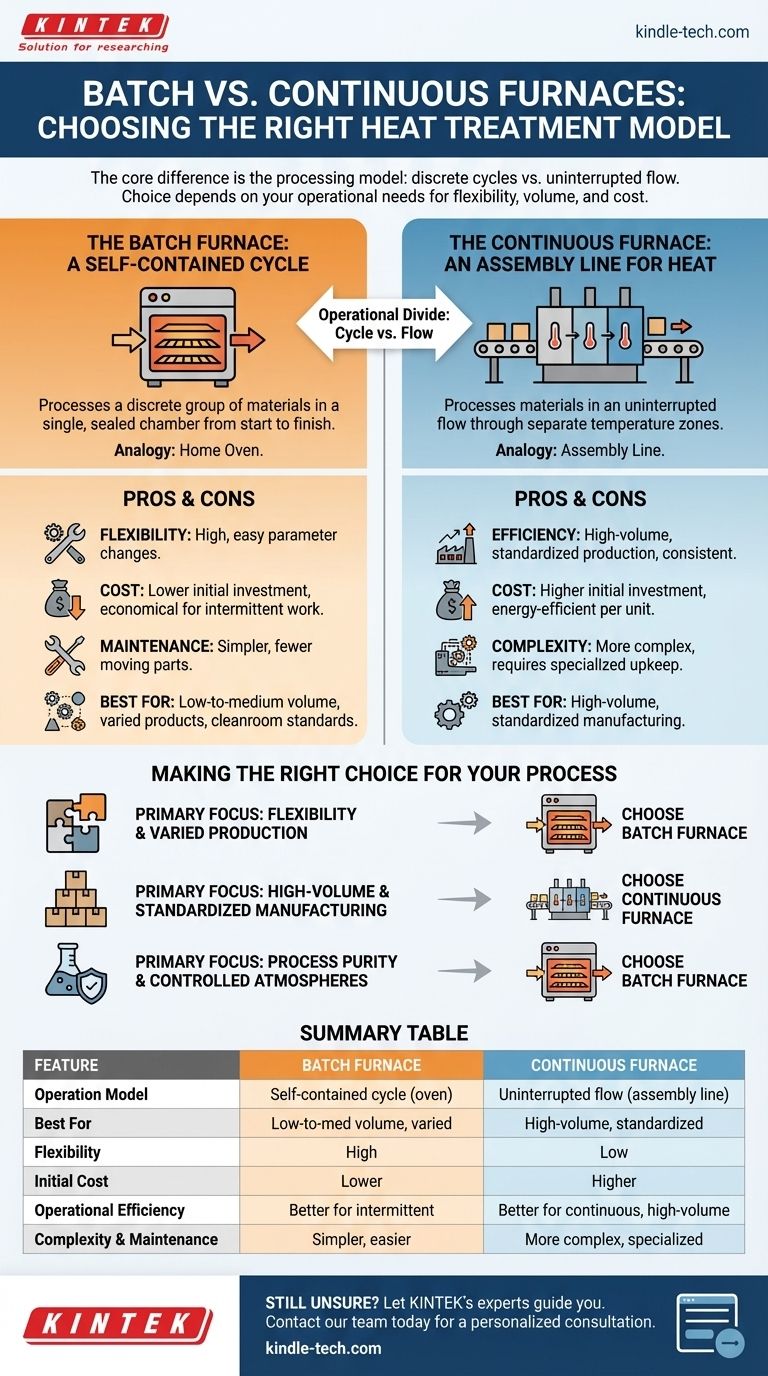
At its core, the difference between a batch and a continuous furnace is their processing model. A batch furnace processes a discrete group, or "batch," of materials in a single, self-contained cycle from start to finish within a closed chamber. In contrast, a continuous furnace processes materials in an uninterrupted flow, with products constantly entering one end, moving through various temperature zones, and exiting the other.

The choice is not about which furnace type is "better," but which aligns with your operational needs. Batch furnaces offer flexibility and lower cost for varied or smaller-scale work, while continuous furnaces deliver high-volume efficiency and consistency at the cost of higher initial investment and complexity.
What is the difference between batch type and continuous type furnace? Choose the Right Heat Treatment Process

The Operational Divide: Cycle vs. Flow

The most fundamental difference lies in how each furnace handles the product. This distinction dictates nearly every other factor, from cost to flexibility.

The Batch Furnace: A Self-Contained Cycle

A batch furnace operates much like a home oven. A specific quantity of product, often held in baskets or racks, is loaded into a single chamber.

The chamber is then sealed, and the entire batch is subjected to a programmed thermal cycle—heating, soaking, and cooling. Once the cycle is complete, the chamber is opened, and the finished batch is removed.

This single-chamber, all-in-one process makes it ideal for applications requiring cleanroom standards or controlled inert atmospheres, as the environment is easily sealed and managed.

The Continuous Furnace: An Assembly Line for Heat

A continuous furnace operates like an assembly line. Products are constantly fed into one end of the furnace, typically on a conveyor belt or pushed by a mechanism.

The material travels through different, physically separate zones within the furnace, each maintained at a constant temperature for a specific part of the process.

This design eliminates the need to heat and cool the entire furnace for each run, creating a highly efficient and consistent process for large quantities of identical products.

Understanding the Trade-offs

Choosing between these two models requires a clear understanding of their inherent compromises in cost, flexibility, and efficiency.

Production Volume and Flexibility

Batch furnaces are the clear winner for flexibility. You can easily change the temperature, time, and atmosphere for each new load, making them ideal for low-to-medium volume production or facilities that handle a wide variety of parts and processes.

Continuous furnaces are built for high-volume, standardized production. They are locked into a single thermal profile, offering exceptional consistency but virtually no flexibility without significant downtime and reconfiguration.

Capital and Operational Costs

From an initial investment standpoint, batch furnaces are significantly less expensive. They are less complex, smaller, and easier to install.

Operational cost is more nuanced. A continuous furnace, once running at temperature, is highly energy-efficient on a per-unit basis because it avoids repeated heat-up/cool-down cycles. However, a batch furnace is more economical for intermittent or varied work where a large continuous system would be idle.

Maintenance and Complexity

The simplicity of a batch furnace translates to easier maintenance and lower long-term upkeep costs. They have fewer moving parts and simpler control systems.

Continuous furnaces are mechanically complex systems with conveyors, sensors, and multiple control zones. This complexity demands more frequent and specialized maintenance to ensure reliable operation.

Making the Right Choice for Your Process

Your specific production goals will point directly to the correct furnace technology for your application.

  • If your primary focus is flexibility and varied production: Choose a batch furnace for its ability to handle different product types and thermal profiles with a lower initial investment.
  • If your primary focus is high-volume, standardized manufacturing: Choose a continuous furnace to maximize throughput and achieve the lowest possible per-unit processing cost.
  • If your primary focus is process purity and controlled atmospheres: A batch furnace often provides a more easily sealed and managed environment for applications requiring strict atmospheric control.

Ultimately, aligning the furnace's fundamental operating model with your production goals is the key to a sound investment.

Summary Table:

Feature Batch Furnace Continuous Furnace
Operation Model Self-contained cycle (like an oven) Uninterrupted flow (like an assembly line)
Best For Low-to-medium volume, varied products High-volume, standardized production
Flexibility High (easy to change parameters per batch) Low (locked into a single profile)
Initial Cost Lower Higher
Operational Efficiency Better for intermittent work Better for continuous, high-volume runs
Complexity & Maintenance Simpler, easier maintenance More complex, requires specialized upkeep

Still unsure which furnace is right for your application?

Let KINTEK's experts guide you to the perfect solution. We specialize in providing high-quality lab equipment, including both batch and continuous furnaces, tailored to your specific production volume, flexibility, and budget requirements.

Contact our team today for a personalized consultation and discover how the right furnace can optimize your heat treatment process, improve efficiency, and drive your success.

Visual Guide
What is the difference between batch type and continuous type furnace? Choose the Right Heat Treatment Process Visual Guide

Related Products

People Also Ask

Related Products

Graphite Vacuum Furnace High Thermal Conductivity Film Graphitization Furnace

Graphite Vacuum Furnace High Thermal Conductivity Film Graphitization Furnace

The high thermal conductivity film graphitization furnace has uniform temperature, low energy consumption and can operate continuously.

High Temperature Muffle Oven Furnace for Laboratory Debinding and Pre Sintering

High Temperature Muffle Oven Furnace for Laboratory Debinding and Pre Sintering

KT-MD High temperature debinding and pre-sintering furnace for ceramic materials with various molding processes. Ideal for electronic components such as MLCC and NFC.

1700℃ Controlled Atmosphere Furnace Nitrogen Inert Atmosphere Furnace

1700℃ Controlled Atmosphere Furnace Nitrogen Inert Atmosphere Furnace

KT-17A Controlled atmosphere furnace: 1700℃ heating, vacuum sealing technology, PID temperature control, and versatile TFT smart touch screen controller for laboratory and industrial use.

Vertical High Temperature Graphite Vacuum Graphitization Furnace

Vertical High Temperature Graphite Vacuum Graphitization Furnace

Vertical high temperature graphitization furnace for carbonization and graphitization of carbon materials up to 3100℃.Suitable for shaped graphitization of carbon fiber filaments and other materials sintered in a carbon environment.Applications in metallurgy, electronics, and aerospace for producing high-quality graphite products like electrodes and crucibles.

1700℃ Muffle Oven Furnace for Laboratory

1700℃ Muffle Oven Furnace for Laboratory

Get superior heat control with our 1700℃ Muffle Furnace. Equipped with intelligent temperature microprocessor, TFT touch screen controller & advanced insulation materials for precise heating up to 1700C. Order now!

1200℃ Split Tube Furnace with Quartz Tube Laboratory Tubular Furnace

1200℃ Split Tube Furnace with Quartz Tube Laboratory Tubular Furnace

KT-TF12 split tube furnace: high-purity insulation, embedded heating wire coils, and max. 1200C. Widely used for new materials and chemical vapour deposition.

Ultra-High Temperature Graphite Vacuum Graphitization Furnace

Ultra-High Temperature Graphite Vacuum Graphitization Furnace

The ultra-high temperature graphitization furnace utilizes medium frequency induction heating in a vacuum or inert gas environment. The induction coil generates an alternating magnetic field, inducing eddy currents in the graphite crucible, which heats up and radiates heat to the workpiece, bringing it to the desired temperature. This furnace is primarily used for graphitization and sintering of carbon materials, carbon fiber materials, and other composite materials.

Graphite Vacuum Furnace Bottom Discharge Graphitization Furnace for Carbon Materials

Graphite Vacuum Furnace Bottom Discharge Graphitization Furnace for Carbon Materials

Bottom-out graphitization furnace for carbon materials, ultra-high temperature furnace up to 3100°C, suitable for graphitization and sintering of carbon rods and carbon blocks. Vertical design, bottom discharging, convenient feeding and discharging, high temperature uniformity, low energy consumption, good stability, hydraulic lifting system, convenient loading and unloading.

Controlled Nitrogen Inert Hydrogen Atmosphere Furnace

Controlled Nitrogen Inert Hydrogen Atmosphere Furnace

KT-AH Hydrogen atmosphere furnace - induction gas furnace for sintering/annealing with built-in safety features, dual housing design, and energy-saving efficiency. Ideal for lab and industrial use.

Large Vertical Graphite Vacuum Graphitization Furnace

Large Vertical Graphite Vacuum Graphitization Furnace

A large vertical high-temperature graphitization furnace is a type of industrial furnace used for the graphitization of carbon materials, such as carbon fiber and carbon black. It is a high-temperature furnace that can reach temperatures of up to 3100°C.

600T Vacuum Induction Hot Press Furnace for Heat Treat and Sintering

600T Vacuum Induction Hot Press Furnace for Heat Treat and Sintering

Discover the 600T Vacuum Induction Hot Press Furnace, designed for high-temperature sintering experiments in vacuum or protected atmospheres. Its precise temperature and pressure control, adjustable working pressure, and advanced safety features make it ideal for nonmetal materials, carbon composites, ceramics, and metal powders.

Laboratory Muffle Oven Furnace Bottom Lifting Muffle Furnace

Laboratory Muffle Oven Furnace Bottom Lifting Muffle Furnace

Efficiently produce batches with excellent temperature uniformity using our Bottom Lifting Furnace. Features two electric lifting stages and advanced temperature control up to 1600℃.

Vacuum Hot Press Furnace Machine Heated Vacuum Press

Vacuum Hot Press Furnace Machine Heated Vacuum Press

Discover the advantages of Vacuum Hot Press Furnace! Manufacture dense refractory metals & compounds, ceramics, and composites under high temp and pressure.

Vacuum Sealed Continuous Working Rotary Tube Furnace Rotating Tube Furnace

Vacuum Sealed Continuous Working Rotary Tube Furnace Rotating Tube Furnace

Experience efficient material processing with our vacuum-sealed rotary tube furnace. Perfect for experiments or industrial production, equipped with optional features for controlled feeding and optimized results. Order now.

Electric Rotary Kiln Pyrolysis Furnace Plant Machine Calciner Small Rotary Kiln Rotating Furnace

Electric Rotary Kiln Pyrolysis Furnace Plant Machine Calciner Small Rotary Kiln Rotating Furnace

Electric rotary kiln - precisely controlled, it's ideal for calcination and drying of materials like lithium cobalate, rare earths, and non-ferrous metals.

2200 ℃ Graphite Vacuum Heat Treat Furnace

2200 ℃ Graphite Vacuum Heat Treat Furnace

Discover the power of the KT-VG Graphite Vacuum Furnace - with a maximum working temperature of 2200℃, it's perfect for vacuum sintering of various materials. Learn more now.

Vacuum Heat Treat and Molybdenum Wire Sintering Furnace for Vacuum Sintering

Vacuum Heat Treat and Molybdenum Wire Sintering Furnace for Vacuum Sintering

A vacuum molybdenum wire sintering furnace is a vertical or bedroom structure, which is suitable for withdrawal, brazing, sintering and degassing of metal materials under high vacuum and high temperature conditions. It is also suitable for dehydroxylation treatment of quartz materials.

Dental Porcelain Zirconia Sintering Ceramic Furnace Chairside with Transformer

Dental Porcelain Zirconia Sintering Ceramic Furnace Chairside with Transformer

Experience top-notch sintering with Chairside Sintering Furnace with Transformer. Easy to operate, noise-free pallet, and automatic temperature calibration. Order now!

Horizontal High Temperature Graphite Vacuum Graphitization Furnace

Horizontal High Temperature Graphite Vacuum Graphitization Furnace

Horizontal Graphitization Furnace: This type of furnace is designed with the heating elements placed horizontally, allowing for uniform heating of the sample. It's well-suited for graphitizing large or bulky samples that require precise temperature control and uniformity.

Vacuum Heat Treat and Pressure Sintering Furnace for High Temperature Applications

Vacuum Heat Treat and Pressure Sintering Furnace for High Temperature Applications

Vacuum pressure sintering furnaces are designed for high temperature hot pressing applications in metal and ceramic sintering. Its advanced features ensure precise temperature control, reliable pressure maintenance, and a robust design for seamless operation.


Leave Your Message