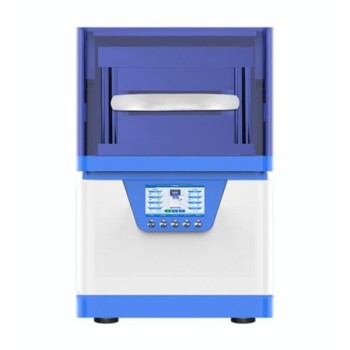
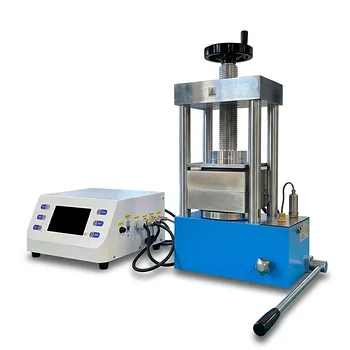
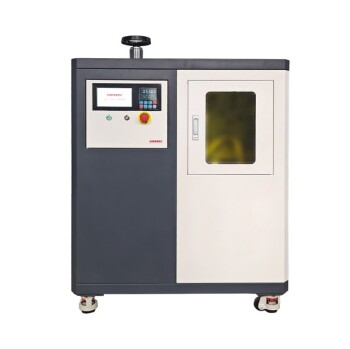
The primary function of a uniaxial hot press in this context is to synthesize a cohesive, transparent solid-state electrolyte film from raw precursors. By subjecting a mixture of Polyethylene Oxide (PEO) powder and lithium salts to simultaneous heat (e.g., 100°C) and moderate axial pressure (e.g., 8 MPa), the device melts the polymer and densifies the composite into a unified layer.
Core Takeaway: The uniaxial hot press acts as a fabrication tool that utilizes phase change rather than brute force. By melting the PEO under controlled pressure, it eliminates porosity and integrates the lithium salts into the polymer matrix, creating the structural integrity necessary for ionic conduction.
The Mechanics of Film Formation
Simultaneous Thermal and Mechanical Application
The defining characteristic of this process is the concurrent application of energy. The hot press does not simply squeeze the material; it creates a specific thermodynamic environment.
Heating the mixture to approximately 100°C forces the PEO polymer to melt. This phase change is essential for the polymer to flow and surround the lithium salt particles.
Densification of the Mixture
While the polymer is in a melted or softened state, the press applies an axial pressure of roughly 8 MPa. This pressure is critical for removing voids and air pockets within the molten mix.
The result is a significant increase in material density. This transforms the loose, opaque powder mixture into a solid, continuous form.
Achieving Optical and Structural Clarity
The successful completion of this phase is often marked by the visual transformation of the material. The process converts the raw ingredients into a preliminary, transparent film.
Transparency in this context is a quality indicator. It suggests that the mixture has been fully homogenized and that the salts have been properly integrated into the polymer melt.
Distinguishing Process Parameters
Hot Pressing vs. Cold Compaction
It is vital to distinguish the requirements of PEO film formation from other electrolyte preparation methods.
A standard uniaxial hydraulic press (often used for ceramics or cold powder compaction) typically relies on extreme pressures, such as 300 MPa. This high force is used to mechanically crush particles together to reduce grain boundary resistance in the absence of heat.
The Role of Lower Pressure in Melting
In the PEO hot press process, such extreme pressure is unnecessary and potentially detrimental. Because the PEO is melted, the material flows easily.
Therefore, a moderate pressure of 8 MPa is sufficient to densify the film. Relying on the thermal phase change allows for lower mechanical stress while still achieving excellent material contact.
Making the Right Choice for Your Goal
To ensure you are applying the correct processing parameters to your solid electrolytes, align your equipment settings with the material state.
- If your primary focus is PEO-based film formation: Prioritize simultaneous heating (100°C) with moderate pressure (8 MPa) to leverage the polymer's melting point for cohesion.
- If your primary focus is compacting solid powder pellets: Prioritize high mechanical pressure (300 MPa) using a hydraulic press to force particle contact and reduce grain boundary resistance without melting.
Success in solid electrolyte fabrication depends on balancing thermal energy with the appropriate level of mechanical force.
Summary Table:
| Parameter | PEO Hot Pressing (Film Formation) | Cold Compaction (Powder Pellets) |
|---|---|---|
| Primary Mechanism | Polymer Melting & Phase Change | Mechanical Particle Crushing |
| Applied Temperature | ~100°C (Simultaneous Heat) | Ambient / No Heat |
| Applied Pressure | Moderate (~8 MPa) | High (~300 MPa) |
| Physical Outcome | Cohesive, Transparent Thin Film | Solid Powder Pellet |
| Key Benefit | Eliminates Porosity & Integrates Salts | Reduces Grain Boundary Resistance |
Elevate Your Battery Research with KINTEK Precision
Are you looking to achieve superior homogeneity and ionic conductivity in your PEO-based solid electrolytes? KINTEK specializes in advanced laboratory equipment designed for the most demanding research applications. From our precision uniaxial hot presses and hydraulic pellet presses to specialized battery research tools and high-temperature furnaces, we provide the tools you need to master material densification.
Our Value to You:
- Precision Control: Expertly manage temperature and pressure for consistent film formation.
- Comprehensive Range: One-stop shop for crushing, milling, and high-pressure reactor systems.
- Durability & Reliability: Industrial-grade consumables including ceramics, crucibles, and PTFE products.
Contact KINTEK today to discuss how our solutions can optimize your electrolyte fabrication process!
Related Products
- Automatic High Temperature Heated Hydraulic Press Machine with Heated Plates for Lab
- 24T 30T 60T Heated Hydraulic Press Machine with Heated Plates for Laboratory Hot Press
- Automatic Heated Hydraulic Press Machine with Heated Plates for Laboratory Hot Press 25T 30T 50T
- Automatic Laboratory Heat Press Machine
- Heated Hydraulic Press Machine with Heated Plates Split Manual Laboratory Hot Press
People Also Ask
- Why is a heated hydraulic press used for warm pressing NASICON green tapes? Optimize Your Solid Electrolyte Density
- What is a heated hydraulic press used for? Essential Tool for Curing, Molding, and Laminating
- Why is a heated laboratory hydraulic press necessary for composite laminates? Achieve Void-Free Structural Integrity
- What is a hot hydraulic press? Harness Heat and Pressure for Advanced Manufacturing
- How is a heated hydraulic press used for Li-LLZO batteries? Optimize Interfacial Bonding with Thermal-Pressure