Knowledge What is the process of resistance heating? A Guide to Efficient and Precise Thermal Control
Author avatar

Tech Team · Kintek Solution

Updated 6 days ago

What is the process of resistance heating? A Guide to Efficient and Precise Thermal Control


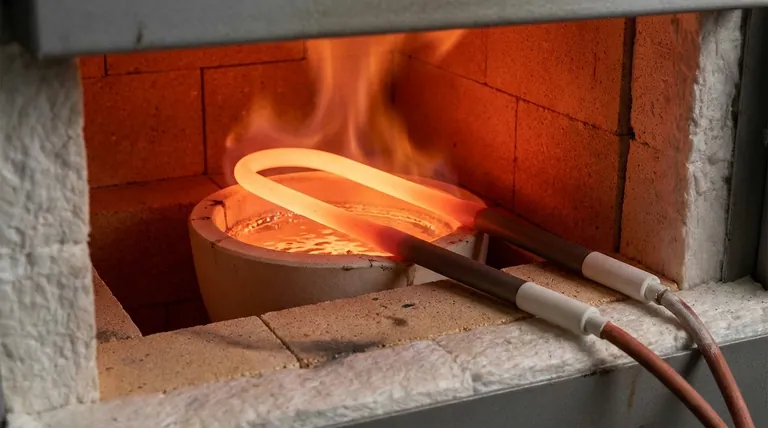
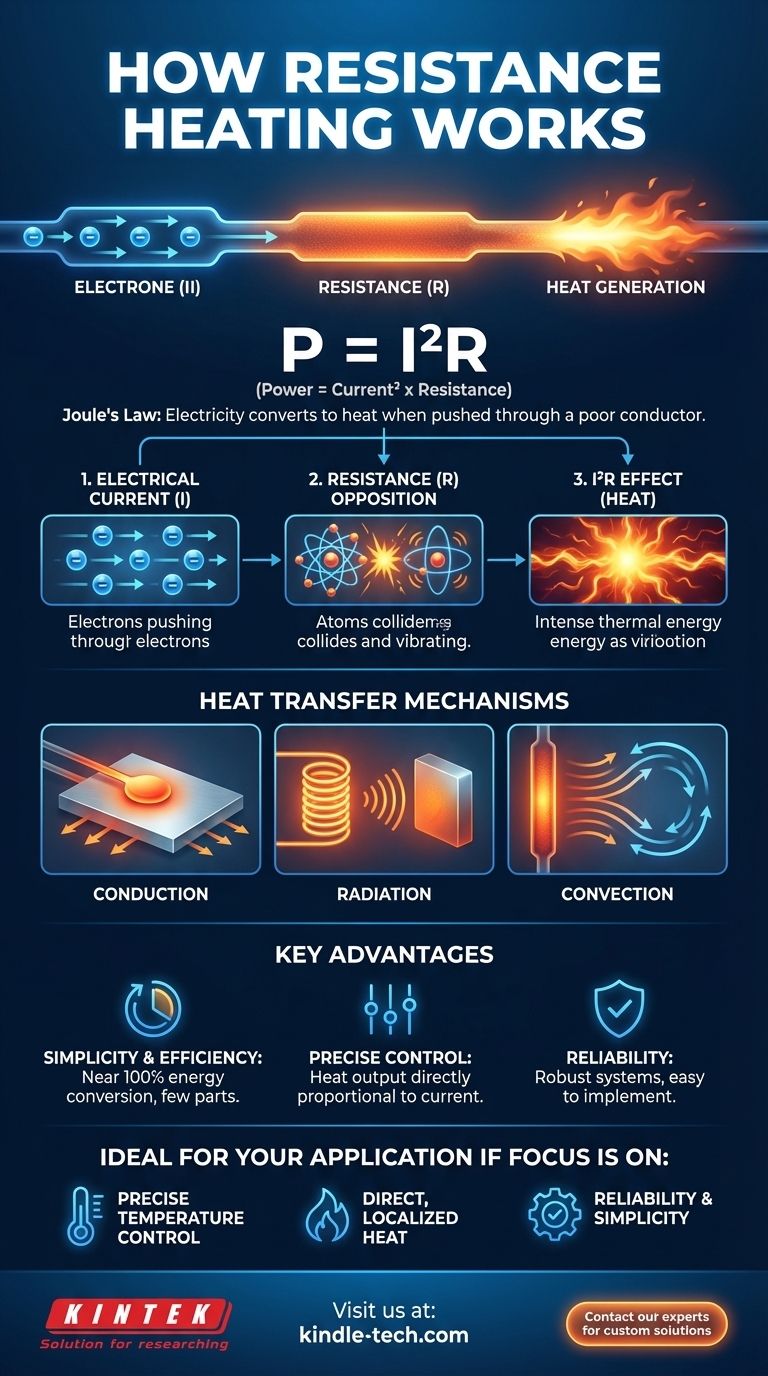
At its core, resistance heating is the process of generating heat by passing an electric current through a material that resists its flow. This principle, known as Joule's law or the I²R effect, is a fundamental method for converting electrical energy directly into thermal energy. The material's opposition to the electrical current causes friction at a microscopic level, releasing energy in the form of heat.

The central concept is simple: electricity is converted into heat when it is forced to travel through a poor conductor. The more the material resists the flow of electrons, the more heat it will generate.
What is the process of resistance heating? A Guide to Efficient and Precise Thermal Control

The Fundamental Principle: Joule Heating

To understand how resistance heating works, we must look at the relationship between electrical current, material resistance, and the energy they produce.

The Role of Electrical Current (I)

An electric current is simply the flow of electrons through a material. A power source provides the voltage necessary to push these electrons through a circuit.

The Importance of Resistance (R)

Resistance is a material's inherent opposition to the flow of electric current. At the atomic level, as electrons are pushed through the material, they collide with its atoms.

These collisions transfer kinetic energy from the electrons to the atoms, causing the atoms to vibrate more intensely. This increased atomic vibration is what we perceive as heat.

The I²R Effect

The amount of heat generated is defined by the formula P = I²R, where P is power (heat), I is current, and R is resistance. This means the heat produced increases exponentially with the current and linearly with the resistance.

Materials chosen for heating elements, such as specific metal alloys or ceramics, are selected precisely because they have a high electrical resistance.

How It Works in Practice

A practical resistance heating system consists of a few key components and relies on basic principles of heat transfer to be effective.

The Heating Element

This is the core component. It is a specially designed material, often a high-temperature-resistant alloy, that has both high electrical resistance and the ability to withstand extreme temperatures without degrading.

When current passes through this element, it glows hot, becoming the source of thermal energy for the system.

Heat Transfer Mechanisms

Once the element is hot, the heat must be transferred to the object or space you intend to warm. This happens in three primary ways:

  • Conduction: Heat transfers through direct physical contact, like a heating element touching a metal plate.
  • Radiation: Heat is emitted as electromagnetic waves, warming objects without direct contact, similar to how the sun warms the Earth.
  • Convection: Heat is transferred through the movement of a fluid (like air or water). A heating element warms the air around it, and that warm air then circulates to heat a room.

Understanding the Trade-offs

While highly effective, resistance heating has distinct advantages and limitations that make it suitable for specific applications.

Key Advantage: Simplicity and Efficiency

Resistance heating systems are mechanically simple, often with no moving parts. The conversion of electrical energy to heat at the point of use is nearly 100% efficient, as virtually all the resisted electrical energy becomes thermal energy.

Key Advantage: Precise Control

The heat output is directly and immediately proportional to the amount of electrical current applied. This allows for extremely precise and responsive temperature control.

Common Limitation: Heating Time

In systems using indirect heating—where the element heats a chamber, which then heats the target object via convection—the process can be slow. It takes time for the entire chamber and the air within it to reach the target temperature.

Making the Right Choice for Your Application

Understanding these principles allows you to determine where resistance heating is the most effective solution.

  • If your primary focus is precise temperature control: Resistance heating is ideal due to its direct and instantaneous response to electrical input.
  • If your primary focus is direct, localized heat: This method excels at applying heat exactly where it's needed through elements designed for conduction or radiation.
  • If your primary focus is reliability and simplicity: The lack of complex or moving parts makes resistance heating systems exceptionally robust and easy to implement.

Ultimately, resistance heating is a foundational technology that provides a reliable and controllable source of heat for countless applications.

Summary Table:

Aspect Key Detail
Core Principle Joule Heating (I²R Effect)
Heat Generation Current flow through a high-resistance material
Primary Advantage Near 100% efficiency & precise temperature control
Heat Transfer Methods Conduction, Radiation, Convection
Ideal For Applications requiring reliability and localized heat

Need a reliable and precise heating solution for your lab or process? KINTEK specializes in high-performance lab equipment, including custom resistance heating systems. Our expertise ensures you get the exact thermal control your application demands, enhancing efficiency and reproducibility. Contact our experts today to discuss how we can support your laboratory needs!

Visual Guide
What is the process of resistance heating? A Guide to Efficient and Precise Thermal Control Visual Guide

Related Products

People Also Ask

Related Products

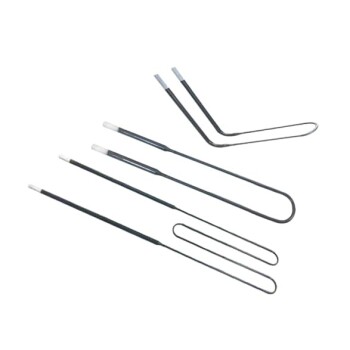
Molybdenum Disilicide (MoSi2) Thermal Elements Electric Furnace Heating Element

Molybdenum Disilicide (MoSi2) Thermal Elements Electric Furnace Heating Element

Discover the power of Molybdenum Disilicide (MoSi2) Heating Element for high-temperature resistance. Unique oxidation resistance with stable resistance value. Learn more about its benefits now!

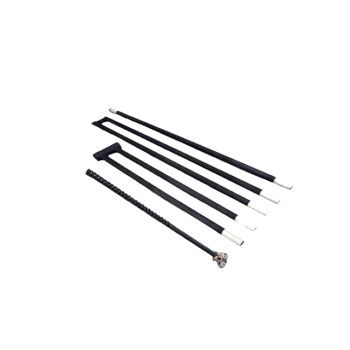
Silicon Carbide SiC Thermal Heating Elements for Electric Furnace

Silicon Carbide SiC Thermal Heating Elements for Electric Furnace

Experience the advantages of Silicon Carbide (SiC) Heating Element: Long service life, high corrosion and oxidation resistance, fast heating speed, and easy maintenance. Learn more now!

1700℃ Laboratory Quartz Tube Furnace with Alumina Tube Tubular Furnace

1700℃ Laboratory Quartz Tube Furnace with Alumina Tube Tubular Furnace

Looking for a high-temperature tube furnace? Check out our 1700℃ Tube Furnace with Alumina Tube. Perfect for research and industrial applications up to 1700C.

Multi Zone Laboratory Quartz Tube Furnace Tubular Furnace

Multi Zone Laboratory Quartz Tube Furnace Tubular Furnace

Experience precise, efficient thermal testing with our Multi Zone Tube Furnace. Independent heating zones and temperature sensors allow for controlled high-temperature gradient heating fields. Order now for advanced thermal analysis!

High Temperature Muffle Oven Furnace for Laboratory Debinding and Pre Sintering

High Temperature Muffle Oven Furnace for Laboratory Debinding and Pre Sintering

KT-MD High temperature debinding and pre-sintering furnace for ceramic materials with various molding processes. Ideal for electronic components such as MLCC and NFC.

Vacuum Sealed Continuous Working Rotary Tube Furnace Rotating Tube Furnace

Vacuum Sealed Continuous Working Rotary Tube Furnace Rotating Tube Furnace

Experience efficient material processing with our vacuum-sealed rotary tube furnace. Perfect for experiments or industrial production, equipped with optional features for controlled feeding and optimized results. Order now.

Vacuum Heat Treat Sintering Brazing Furnace

Vacuum Heat Treat Sintering Brazing Furnace

A vacuum brazing furnace is a type of industrial furnace used for brazing, a metalworking process that joins two pieces of metal using a filler metal that melts at a lower temperature than the base metals. Vacuum brazing furnaces are typically used for high-quality applications where a strong, clean joint is required.

Graphite Vacuum Continuous Graphitization Furnace

Graphite Vacuum Continuous Graphitization Furnace

High-temperature graphitization furnace is a professional equipment for graphitization treatment of carbon materials. It is a key equipment for the production of high-quality graphite products. It has high temperature, high efficiency and uniform heating. It is suitable for various high-temperature treatments and graphitization treatments. It is widely used in metallurgy, electronics, aerospace, etc. industry.

Vacuum Heat Treat and Molybdenum Wire Sintering Furnace for Vacuum Sintering

Vacuum Heat Treat and Molybdenum Wire Sintering Furnace for Vacuum Sintering

A vacuum molybdenum wire sintering furnace is a vertical or bedroom structure, which is suitable for withdrawal, brazing, sintering and degassing of metal materials under high vacuum and high temperature conditions. It is also suitable for dehydroxylation treatment of quartz materials.

600T Vacuum Induction Hot Press Furnace for Heat Treat and Sintering

600T Vacuum Induction Hot Press Furnace for Heat Treat and Sintering

Discover the 600T Vacuum Induction Hot Press Furnace, designed for high-temperature sintering experiments in vacuum or protected atmospheres. Its precise temperature and pressure control, adjustable working pressure, and advanced safety features make it ideal for nonmetal materials, carbon composites, ceramics, and metal powders.

Spark Plasma Sintering Furnace SPS Furnace

Spark Plasma Sintering Furnace SPS Furnace

Discover the benefits of Spark Plasma Sintering Furnaces for rapid, low-temperature material preparation. Uniform heating, low cost & eco-friendly.

Vertical High Temperature Graphite Vacuum Graphitization Furnace

Vertical High Temperature Graphite Vacuum Graphitization Furnace

Vertical high temperature graphitization furnace for carbonization and graphitization of carbon materials up to 3100℃.Suitable for shaped graphitization of carbon fiber filaments and other materials sintered in a carbon environment.Applications in metallurgy, electronics, and aerospace for producing high-quality graphite products like electrodes and crucibles.

Graphite Vacuum Furnace IGBT Experimental Graphitization Furnace

Graphite Vacuum Furnace IGBT Experimental Graphitization Furnace

IGBT experimental graphitization furnace, a tailored solution for universities and research institutions, with high heating efficiency, user-friendliness, and precise temperature control.

Ultra-High Temperature Graphite Vacuum Graphitization Furnace

Ultra-High Temperature Graphite Vacuum Graphitization Furnace

The ultra-high temperature graphitization furnace utilizes medium frequency induction heating in a vacuum or inert gas environment. The induction coil generates an alternating magnetic field, inducing eddy currents in the graphite crucible, which heats up and radiates heat to the workpiece, bringing it to the desired temperature. This furnace is primarily used for graphitization and sintering of carbon materials, carbon fiber materials, and other composite materials.

Vacuum Dental Porcelain Sintering Furnace

Vacuum Dental Porcelain Sintering Furnace

Get precise and reliable results with KinTek's Vacuum Porcelain Furnace. Suitable for all porcelain powders, it features hyperbolic ceramic furnace function, voice prompt, and automatic temperature calibration.

Vacuum Hot Press Furnace Machine for Lamination and Heating

Vacuum Hot Press Furnace Machine for Lamination and Heating

Experience clean and precise lamination with Vacuum Lamination Press. Perfect for wafer bonding, thin-film transformations, and LCP lamination. Order now!

Platinum Sheet Electrode for Laboratory and Industrial Applications

Platinum Sheet Electrode for Laboratory and Industrial Applications

Elevate your experiments with our Platinum Sheet Electrode. Crafted with quality materials, our safe and durable models can be tailored to fit your needs.

Vacuum Cold Trap Chiller Indirect Cold Trap Chiller

Vacuum Cold Trap Chiller Indirect Cold Trap Chiller

Boost vacuum system efficiency and prolong pump life with our Indirect Cold Trap. Built-in chilling system with no need for fluid or dry ice. Compact design and easy to use.

High-Purity Titanium Foil and Sheet for Industrial Applications

High-Purity Titanium Foil and Sheet for Industrial Applications

Titanium is chemically stable, with a density of 4.51g/cm3, which is higher than aluminum and lower than steel, copper, and nickel, but its specific strength ranks first among metals.

Automatic Laboratory Heat Press Machine

Automatic Laboratory Heat Press Machine

Precision automatic heat press machines for labs—ideal for material testing, composites, and R&D. Customizable, safe, and efficient. Contact KINTEK today!


Leave Your Message