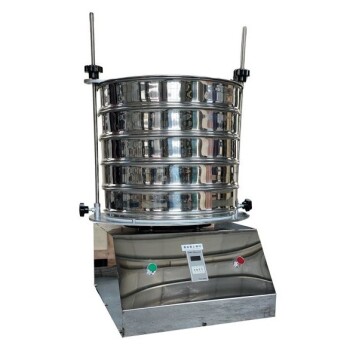
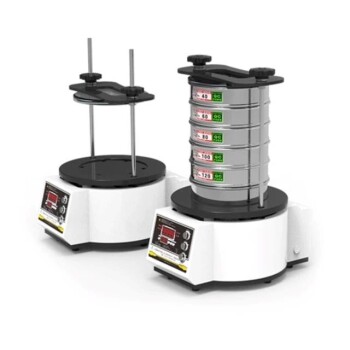
The primary purpose of using a 200-mesh nylon test sieve is to refine freeze-dried fluoride ceramic powders by breaking up pseudo-agglomerates and filtering out large impurities. This mechanical conditioning ensures the powder achieves excellent flowability and a uniform particle size distribution, which are critical requirements for effective mold loading.
By eliminating agglomerates and contaminants, sieving transforms unevenly dried material into a homogeneous powder capable of high packing density, directly reducing the risk of structural defects in the final product.
Optimizing Powder Characteristics
Breaking Down Pseudo-Agglomerates
During the freeze-drying stage, ceramic particles often clump together to form "pseudo-agglomerates." Passing the material through a 200-mesh sieve mechanically breaks these clusters back down into discrete, usable particles.
Removal of Impurities
The sieving process acts as a quality control gate. It physically removes large foreign particles or hard, unbreakable aggregates that would otherwise act as contaminants within the ceramic matrix.
Ensuring Uniform Particle Size
A 200-mesh screen standardizes the maximum particle size allowed into the mold. This uniformity is essential for predictable behavior during subsequent processing steps.
Impact on Molding and Density
Enhancing Flowability
Refined powders flow more like a fluid than a solid. High flowability ensures that when the powder is poured into the mold, it fills complex geometries evenly without bridging or clogging.
Maximizing Green Body Density
A uniform particle distribution allows the powder to pack together more tightly. This high packing density in the "green body" (the pressed but un-sintered part) is the foundation for a strong, dense final ceramic.
Preventing Sintering Defects
Inconsistent powder layers lead to internal voids and cracks during the heating (sintering) phase. Sieving ensures the powder layers are uniform in thickness, significantly reducing the occurrence of these large-scale defects.
Understanding Process Risks
The Importance of Material Choice
The specification of a nylon sieve is intentional. Unlike stainless steel or brass, nylon prevents the introduction of metallic impurities into the fluoride ceramic, which is critical for maintaining high purity.
Consequences of Inadequate Sieving
Skipping this step often results in "hard agglomerates" entering the mold. These dense clumps do not compact at the same rate as loose powder, creating internal stress points that weaken the final component.
Ensuring Quality in Ceramic Processing
To achieve the best results in your ceramic manufacturing process, align your sieving strategy with your end goals:
- If your primary focus is mechanical strength: Ensure the sieve effectively breaks all pseudo-agglomerates to maximize green body density and reduce internal voids.
- If your primary focus is chemical purity: Strictly adhere to using nylon mesh to avoid introducing metallic contaminants that could degrade the fluoride ceramic's properties.
Consistently processing your powder through the correct mesh ensures the physical uniformity required for high-performance ceramics.
Summary Table:
| Feature | Purpose in Fluoride Ceramic Processing |
|---|---|
| 200-Mesh Size | Standardizes maximum particle size and breaks pseudo-agglomerates. |
| Nylon Material | Prevents metallic contamination, maintaining high chemical purity. |
| Flowability | Ensures even mold filling and prevents bridging or clogging. |
| Packing Density | Maximizes green body density to reduce voids and sintering cracks. |
| Impurities | Filters out large foreign particles and hard aggregates. |
Elevate Your Material Research with KINTEK Precision Solutions
Achieving the perfect ceramic microstructure starts with superior powder conditioning and processing. KINTEK specializes in high-performance laboratory equipment designed for the most demanding applications.
Whether you require high-purity nylon and stainless steel sieving equipment, advanced crushing and milling systems, or precision hydraulic presses (pellet, hot, and isostatic) for creating high-density green bodies, our portfolio has you covered. We also offer industry-leading high-temperature furnaces (muffle, vacuum, CVD) and PTFE or ceramic consumables to ensure your fluoride ceramics are processed without contamination.
Ready to optimize your lab's workflow and ensure defect-free results? Contact our technical experts today to find the ideal equipment for your specific research needs!
Related Products
- Laboratory Test Sieves and Sieving Machines
- Custom PTFE Teflon Parts Manufacturer for PTFE Mesh F4 Sieve
- Laboratory Test Sieves and Vibratory Sieve Shaker Machine
- Laboratory Vibratory Sieve Shaker Machine Slap Vibrating Sieve
- Vibratory Sieve Shaker Machine Dry Three-Dimensional Vibrating Sieve
People Also Ask
- What are laboratory test sieves used for? A Guide to Particle Size Analysis
- How do you calculate the sieve test? Master Particle Size Distribution for Quality Control
- How does a lab test sieve contribute to biomass charcoal powder preparation? Achieve Uniform Particle Size
- What are the specifications for test sieves? A Guide to ASTM & ISO Standards for Accurate Particle Analysis
- What materials are required for sieving? Achieve Accurate Particle Size Analysis