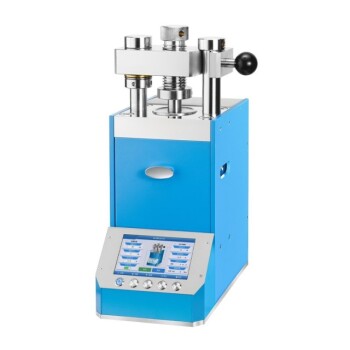
The primary purpose of using a hot isostatic press (HIP) as a secondary treatment is to achieve near-total density in copper-based composites by eliminating residual porosity. While the initial vacuum hot pressing is effective for starting densification, HIP applies high heat and uniform pressure to close remaining internal voids and correct structural inconsistencies.
While vacuum hot pressing creates a solid foundation, it often leaves behind microscopic voids and directional weaknesses. Hot isostatic pressing resolves these issues by applying uniform pressure to eliminate density gradients and maximize the material's structural integrity.
Achieving Maximum Material Density
Addressing the Limitations of Uniaxial Pressing
The initial stage of vacuum hot pressing is a uniaxial process, meaning pressure is applied in a single direction.
While this initiates the densification of the powder, it frequently fails to completely eliminate small internal voids. This leaves the material with residual porosity that can compromise its final performance.
The Mechanism of Pore Closure
The hot isostatic press acts as a corrective step after sintering necks have formed between particles.
By applying high isotropic pressure—often up to 100 MPa—along with high temperatures, the HIP process forces the material together from every angle. This intense, uniform compression effectively closes the residual pores that the initial pressing could not reach.
Eliminating Density Gradients
In uniaxial pressing, friction and directional force often lead to uneven density throughout the composite.
HIP treatment resolves this by pressurizing the material equally from all sides. This eliminates density gradients, bringing the entire component to a near-fully dense state that is consistent throughout its volume.
Correcting Microstructural Flaws
Resolving Anisotropy
A major side effect of the initial vacuum hot pressing is microstructural anisotropy.
Because the initial pressure is applied in only one direction, the material's microstructure—and therefore its properties—may become directional, or anisotropic. This means the material behaves differently depending on the direction of the load applied to it.
Restoring Uniform Properties
The "isostatic" nature of the secondary treatment is the key solution here.
By applying pressure evenly in all directions (isotropically), the HIP process helps redistribute the internal structure. This significantly improves the material's isotropy, ensuring consistent mechanical properties regardless of orientation.
Understanding the Process Synergy
Why the Vacuum Step Comes First
It is critical to understand that HIP is not a replacement for the initial vacuum hot pressing, but a complement to it.
The supplementary references highlight that the vacuum environment is essential for removing adsorbed gases and volatiles. If these were not removed prior to the high-pressure HIP stage, they could become trapped inside the material, preventing true densification.
The Role of Oxidation Prevention
Furthermore, the vacuum step preserves the chemical integrity of the copper matrix and particles.
By preventing oxidation during the initial sintering phase, the process maintains the strength of the interfacial bonds. HIP then builds upon this chemically clean, partially dense structure to perfect the physical density.
Making the Right Choice for Your Goal
To determine if this secondary treatment is necessary for your specific application, consider the following technical priorities:
- If your primary focus is eliminating failure points: Use HIP to close microscopic pores that could act as crack initiation sites under stress.
- If your primary focus is consistent multi-directional strength: Rely on HIP to correct the anisotropy caused by the initial uniaxial pressing.
- If your primary focus is chemical purity: Ensure your initial vacuum hot pressing parameters are optimized to remove volatiles before the material ever reaches the HIP stage.
By combining the chemical protection of vacuum processing with the physical densification of isostatic pressing, you achieve a composite with superior structural reliability.
Summary Table:
| Feature | Vacuum Hot Pressing (Initial) | Hot Isostatic Pressing (Secondary) |
|---|---|---|
| Pressure Direction | Uniaxial (Single direction) | Isostatic (All directions) |
| Primary Function | Sintering & gas removal | Pore closure & densification |
| Microstructure | Prone to anisotropy | Promotes isotropy/uniformity |
| Key Benefit | Removes volatiles/prevents oxidation | Achieves near-total theoretical density |
Elevate Your Material Integrity with KINTEK
Don't let residual porosity compromise your advanced materials. KINTEK specializes in precision laboratory equipment, offering industry-leading vacuum hot presses and isostatic pressing systems designed for the most demanding research and production environments. Whether you are developing copper-based composites or high-performance ceramics, our equipment ensures maximum density, uniform mechanical properties, and superior structural reliability.
Ready to optimize your densification process? Contact our technical experts today to explore our comprehensive range of high-temperature furnaces, hydraulic presses, and specialized sintering solutions tailored for your success.
Related Products
- Warm Isostatic Press for Solid State Battery Research
- Electric Split Lab Cold Isostatic Press CIP Machine for Cold Isostatic Pressing
- Manual Cold Isostatic Pressing Machine CIP Pellet Press
- Automatic High Temperature Heated Hydraulic Press Machine with Heated Plates for Lab
- Isostatic Molding Pressing Molds for Lab
People Also Ask
- What is the temperature of a warm isostatic press? Achieve Optimal Densification for Your Materials
- What is the function of a Warm Isostatic Press (WIP) in all-solid-state pouch cells? Optimize Battery Density
- Why are Warm Isostatic Presses (WIP) necessary for solid-state batteries? Achieve Atomic-Level Contact
- What advantages does a warm isostatic press offer over a traditional uniaxial press for Li6PS5Cl electrolyte sheets?
- How do warm isostatic presses improve dry electrode performance? Enhance ASSB Conductivity with Heat & Pressure