Knowledge What is the pyrolysis method for biochar production? A Guide to Maximizing Carbon-Rich Char Yield
Author avatar

Tech Team · Kintek Solution

Updated 1 week ago

What is the pyrolysis method for biochar production? A Guide to Maximizing Carbon-Rich Char Yield


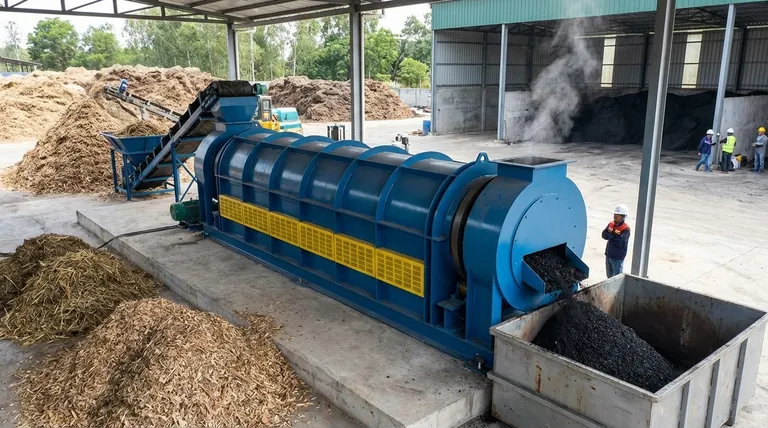
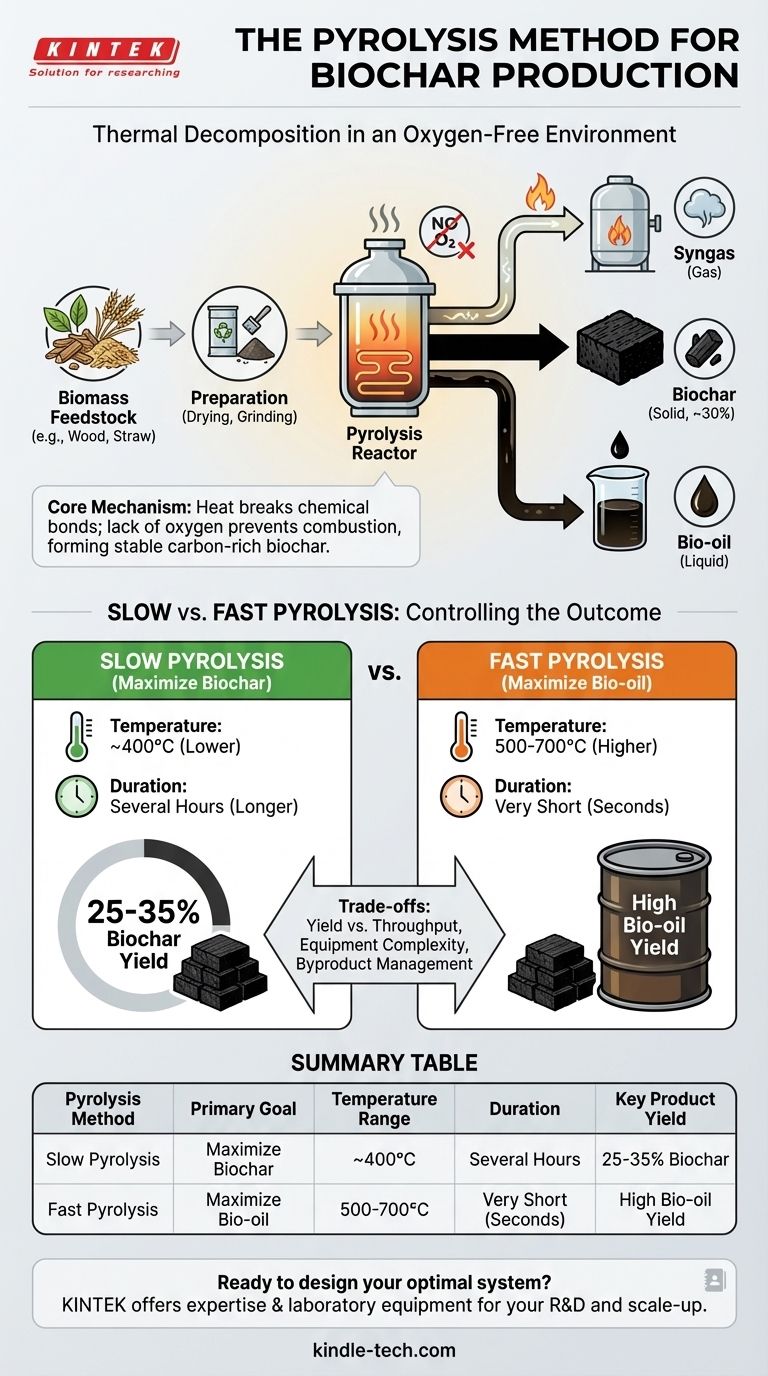
In essence, the pyrolysis method for biochar production is a process of thermal decomposition. It involves heating organic materials, known as biomass feedstock, to high temperatures in an environment with little to no oxygen. This lack of oxygen is critical, as it prevents the material from combusting and instead causes it to break down into a stable, carbon-rich solid (biochar), along with a liquid (bio-oil) and a gas (syngas).

The core principle is this: pyrolysis is not a single method, but a spectrum of processes. To maximize the yield of high-quality biochar, a specific technique called slow pyrolysis is used, which relies on lower temperatures and longer processing times to favor the creation of a solid char.
What is the pyrolysis method for biochar production? A Guide to Maximizing Carbon-Rich Char Yield

The Core Mechanism of Pyrolysis

Pyrolysis is fundamentally a chemical transformation driven by heat in an anaerobic (oxygen-free) setting. Understanding this mechanism is key to controlling the outcome of the process.

The Role of Heat and Oxygen

Heat provides the energy to break the complex chemical bonds within the biomass. Without oxygen, the material cannot burn. Instead, it thermally decomposes into simpler, more stable components.

The Input: Biomass Feedstock

The process begins with organic material, or feedstock. Common examples include pine wood, wheat straw, green waste, and even dried algae.

Before entering the pyrolysis reactor, this feedstock is typically prepared by drying to remove moisture and undergoing comminution (grinding or shredding) to create a uniform particle size.

The Outputs: Solids, Liquids, and Gases

Pyrolysis always produces three distinct products. The goal of the process determines which of these is optimized.

  1. Biochar (Solid): A stable, carbon-rich solid that is the primary target for biochar production.
  2. Bio-oil (Liquid): A dark, viscous liquid also known as pyrolysis oil or bio-crude.
  3. Syngas (Gas): A mixture of non-condensable gases, including hydrogen, carbon monoxide, and methane.

Slow vs. Fast Pyrolysis: Controlling the Outcome

The specific conditions of pyrolysis—primarily temperature and duration—dictate the proportion of the three outputs. This distinction is the most important factor in designing a production system.

Slow Pyrolysis for Biochar Production

This is the primary method for maximizing biochar yield. It is defined by lower temperatures and longer residence times.

  • Temperature: Typically around 400°C.
  • Duration: The biomass is heated for several hours.

Under these conditions, the process favors the formation of the solid char, resulting in biochar yields of 25-35% by weight.

Fast Pyrolysis for Bio-Oil Production

In contrast, fast pyrolysis is used when the main goal is to produce liquid fuel. It is defined by much more aggressive conditions.

  • Temperature: Much higher, ranging from 500°C to 700°C.
  • Duration: Extremely short, with biomass heated very rapidly.

These conditions "crack" the biomass into vapors that, when cooled and condensed, form bio-oil. Biochar is still produced, but it is a secondary byproduct in a much smaller quantity.

Understanding the Trade-offs

Choosing a pyrolysis method involves balancing competing priorities. There is no single "best" approach; the optimal method depends entirely on your primary goal.

Yield vs. Throughput

Slow pyrolysis maximizes the percentage of feedstock converted into biochar. However, because it takes several hours per batch, the overall throughput (tons per day) of a given reactor is lower. Fast pyrolysis has a much higher throughput but yields far less biochar.

Equipment Complexity

Fast pyrolysis requires sophisticated engineering to achieve rapid heating rates and to quickly quench and collect the volatile vapors. Slow pyrolysis systems can often be simpler in design and operation.

Byproduct Management

You never produce just one output. A system designed for biochar must have a plan for utilizing or safely disposing of the bio-oil and syngas byproducts. Often, the syngas is looped back to provide the heat needed to sustain the pyrolysis reaction, improving energy efficiency.

Making the Right Choice for Your Goal

Your intended primary product dictates the correct pyrolysis parameters. To select the right path, first define your objective.

  • If your primary focus is maximizing biochar yield for agricultural or carbon sequestration purposes: You must use slow pyrolysis, operating at lower temperatures (~400°C) for extended periods (hours).
  • If your primary focus is producing liquid bio-oil as a renewable fuel source: You must use fast pyrolysis, operating at high temperatures (500-700°C) with very short residence times.
  • If your primary focus is a balanced output or energy self-sufficiency: You can use intermediate conditions and design a system where the syngas and bio-oil byproducts are used to power the entire process.

By controlling temperature and time in an oxygen-free environment, you can precisely steer the decomposition of biomass to create the products you need.

Summary Table:

Pyrolysis Method Primary Goal Temperature Range Duration Key Product Yield
Slow Pyrolysis Maximize Biochar ~400°C Several Hours 25-35% Biochar
Fast Pyrolysis Maximize Bio-Oil 500-700°C Very Short (Seconds) High Bio-Oil Yield

Ready to design your optimal pyrolysis system? Whether your goal is maximizing biochar yield for carbon sequestration or producing bio-oil for renewable fuel, KINTEK has the expertise and laboratory equipment to support your R&D and scale-up. Our reactors and consumables are designed for precise thermal processing control. Contact our experts today to discuss how we can help you achieve your biomass conversion objectives.

Visual Guide
What is the pyrolysis method for biochar production? A Guide to Maximizing Carbon-Rich Char Yield Visual Guide

Related Products

People Also Ask

Related Products

Electric Rotary Kiln Pyrolysis Furnace Plant Machine Calciner Small Rotary Kiln Rotating Furnace

Electric Rotary Kiln Pyrolysis Furnace Plant Machine Calciner Small Rotary Kiln Rotating Furnace

Electric rotary kiln - precisely controlled, it's ideal for calcination and drying of materials like lithium cobalate, rare earths, and non-ferrous metals.

Vacuum Sealed Continuous Working Rotary Tube Furnace Rotating Tube Furnace

Vacuum Sealed Continuous Working Rotary Tube Furnace Rotating Tube Furnace

Experience efficient material processing with our vacuum-sealed rotary tube furnace. Perfect for experiments or industrial production, equipped with optional features for controlled feeding and optimized results. Order now.

Electric Rotary Kiln Small Rotary Furnace for Activated Carbon Regeneration

Electric Rotary Kiln Small Rotary Furnace for Activated Carbon Regeneration

Revitalize your activated carbon with KinTek's Electric Regeneration Furnace. Achieve efficient and cost-effective regeneration with our highly automated rotary kiln and intelligent thermal controller.

Electric Rotary Kiln Small Rotary Furnace Biomass Pyrolysis Plant

Electric Rotary Kiln Small Rotary Furnace Biomass Pyrolysis Plant

Learn about Rotary Biomass Pyrolysis Furnaces & how they decompose organic material at high temps without oxygen. Use for biofuels, waste processing, chemicals & more.

Electric Rotary Kiln Continuous Working Small Rotary Furnace Heating Pyrolysis Plant

Electric Rotary Kiln Continuous Working Small Rotary Furnace Heating Pyrolysis Plant

Efficiently calcine and dry bulk powder and lump fluid materials with an electric heating rotary furnace. Ideal for processing lithium ion battery materials and more.

Mesh belt controlled atmosphere furnace

Mesh belt controlled atmosphere furnace

Discover our KT-MB mesh belt sintering furnace - perfect for high-temperature sintering of electronic components & glass insulators. Available for open air or controlled atmosphere environments.

Quartz Electrolytic Electrochemical Cell for Electrochemical Experiments

Quartz Electrolytic Electrochemical Cell for Electrochemical Experiments

Looking for a reliable quartz electrochemical cell? Our product boasts excellent corrosion resistance and complete specifications. With high-quality materials and good sealing, it's both safe and durable. Customize to meet your needs.

Small Vacuum Heat Treat and Tungsten Wire Sintering Furnace

Small Vacuum Heat Treat and Tungsten Wire Sintering Furnace

The small vacuum tungsten wire sintering furnace is a compact experimental vacuum furnace specially designed for universities and scientific research institutes. The furnace features a CNC welded shell and vacuum piping to ensure leak-free operation. Quick-connect electrical connections facilitate relocation and debugging, and the standard electrical control cabinet is safe and convenient to operate.

Graphite Vacuum Continuous Graphitization Furnace

Graphite Vacuum Continuous Graphitization Furnace

High-temperature graphitization furnace is a professional equipment for graphitization treatment of carbon materials. It is a key equipment for the production of high-quality graphite products. It has high temperature, high efficiency and uniform heating. It is suitable for various high-temperature treatments and graphitization treatments. It is widely used in metallurgy, electronics, aerospace, etc. industry.

Vacuum Hot Press Furnace Machine for Lamination and Heating

Vacuum Hot Press Furnace Machine for Lamination and Heating

Experience clean and precise lamination with Vacuum Lamination Press. Perfect for wafer bonding, thin-film transformations, and LCP lamination. Order now!

Customizable CO2 Reduction Flow Cell for NRR ORR and CO2RR Research

Customizable CO2 Reduction Flow Cell for NRR ORR and CO2RR Research

The cell is meticulously crafted from high-quality materials to ensure chemical stability and experimental accuracy.

RRDE rotating disk (ring disk) electrode / compatible with PINE, Japanese ALS, Swiss Metrohm glassy carbon platinum

RRDE rotating disk (ring disk) electrode / compatible with PINE, Japanese ALS, Swiss Metrohm glassy carbon platinum

Elevate your electrochemical research with our Rotating Disk and Ring Electrodes. Corrosion resistant and customizable to your specific needs, with complete specifications.

Rotating Platinum Disk Electrode for Electrochemical Applications

Rotating Platinum Disk Electrode for Electrochemical Applications

Upgrade your electrochemical experiments with our Platinum Disc Electrode. High-quality and reliable for accurate results.

Cylindrical Resonator MPCVD Machine System Reactor for Microwave Plasma Chemical Vapor Deposition and Lab Diamond Growth

Cylindrical Resonator MPCVD Machine System Reactor for Microwave Plasma Chemical Vapor Deposition and Lab Diamond Growth

Learn about Cylindrical Resonator MPCVD Machine, the microwave plasma chemical vapor deposition method used for growing diamond gemstones and films in the jewelry and semi-conductor industries. Discover its cost-effective advantages over traditional HPHT methods.

Custom PTFE Teflon Parts Manufacturer for PTFE Mesh F4 Sieve

Custom PTFE Teflon Parts Manufacturer for PTFE Mesh F4 Sieve

PTFE mesh sieve is a specialized test sieve designed for particle analysis in various industries, featuring a non-metallic mesh woven from PTFE filament. This synthetic mesh is ideal for applications where metal contamination is a concern . PTFE sieves are crucial for maintaining the integrity of samples in sensitive environments, ensuring accurate and reliable results in particle size distribution analysis.

Gold Disc Electrode

Gold Disc Electrode

Looking for a high-quality gold disc electrode for your electrochemical experiments? Look no further than our top-of-the-line product.

Customizable PEM Electrolysis Cells for Diverse Research Applications

Customizable PEM Electrolysis Cells for Diverse Research Applications

Custom PEM test cell for electrochemical research. Durable, versatile, for fuel cells & CO2 reduction. Fully customizable. Get a quote!

Electrolytic Electrochemical Cell for Coating Evaluation

Electrolytic Electrochemical Cell for Coating Evaluation

Looking for corrosion-resistant coating evaluation electrolytic cells for electrochemical experiments? Our cells boast complete specifications, good sealing, high-quality materials, safety, and durability. Plus, they're easily customizable to meet your needs.

Platinum Sheet Electrode for Laboratory and Industrial Applications

Platinum Sheet Electrode for Laboratory and Industrial Applications

Elevate your experiments with our Platinum Sheet Electrode. Crafted with quality materials, our safe and durable models can be tailored to fit your needs.

High Temperature Constant Temperature Heating Circulator Water Bath Chiller Circulator for Reaction Bath

High Temperature Constant Temperature Heating Circulator Water Bath Chiller Circulator for Reaction Bath

Efficient and reliable, KinTek KHB Heating Circulator is perfect for your lab needs. With a max. heating temperature of up to 300℃, it features accurate temperature control and fast heating.


Leave Your Message